
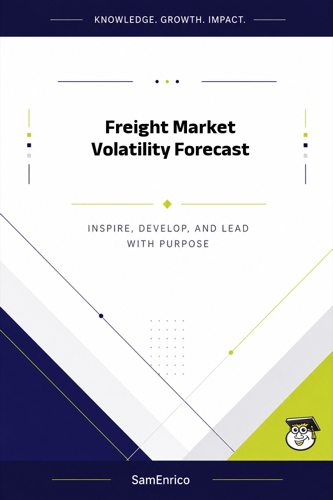
Non-FictionForecast & OutlookMarket Volatility
Freight Market Volatility Forecast
Five year projection for rate cycles, capacity swi
by Fuchs Willow
Five year projection for rate cycles, capacity swings, and risk management strategies.
Formats
About this book
Free sample
Chapter 1: The Weaponized Supply Chain--–- On a Tuesday morning in October 2026, a logistics manager in Chicago watches her screen as three ocean carriers simultaneously cancel their contracted sailings from Shanghai. Thirty miles away, a trucking dispatcher in Joliet rejects forty-seven consecutive tender requests because he has no drivers. In Mexico City, a trade official signs an enforcement memo that will add 12 percent to the cost of every Asian-made appliance crossing the USMCA border. And in Brussels, a carbon regulator publishes a new emissions factor that makes a container of Chinese steel twenty percent more expensive than it was yesterday. None of these people are speaking to one another.
None of them need to. The supply chain has become a weapon, and the ammunition is information asymmetry, trade policy, and the silent coordination of thousands of independent actors who have no idea they are working together.This is not hyperbole. This is the new operating system of global freight.For most of the past thirty years, supply chains were boring. That was their virtue. Predictable, efficient, and dull, they moved containers from Shanghai to Los Angeles, pallets from warehouses to stores, and components from factories to assembly lines with the mechanical regularity of a Swiss watch.
Geopolitics was a background condition. Tariffs were accounting line items. Trade wars were something that happened in history books, not something that disrupted sailing schedules.Those days ended sometime between the COVID pandemic and the Russian invasion of Ukraine. They were buried for good when the Houthis started firing missiles at container ships in the Red Sea, when Mexico decided that 50 percent tariffs were an acceptable tool for industrial policy, and when the European Union made carbon emissions a trade barrier. What emerged from the wreckage is not a broken version of the old system.
It is a new system entirely, with different rules, different players, and a different definition of what constitutes a risk.This chapter argues a single, uncomfortable proposition that will be tested repeatedly throughout this book: supply chains are no longer commercial infrastructure. They are geopolitical weapons. Moving freight now requires…
This is the end of the free sample. Get the eBook to keep going. Buy now
Contents
- Chapter 1
- Chapter 2
- Chapter 3
- Chapter 4
- Chapter 5
- Chapter 6
- Chapter 7
- Chapter 8
- Chapter 9
- Chapter 10
- Chapter 11
- Chapter 12
Details
- Author
- Fuchs Willow
- Publisher
- SamEnrico
- Language
- English
- Genre
- Non-Fiction, Forecast & Outlook, Market Volatility
- Released
- 2026-06-09
- Pages (approx.)
- 133
- Available as
- eBook, Audiobook

Read better in the ZLOADR app
Your eBooks on your phone or tablet. Sign in with your SamEnrico account and start reading.
More by Fuchs Willow
 Mediterranean Submarine WarFuchs Willow$11.99
 The Crypto Gambling Addiction GuideFuchs Willow$11.99
 Metta For Cancer SupportFuchs Willow$11.99
 The Breast Cancer Nutrition GuideFuchs Willow$11.99
 The Visionary and the Vanguard: How Doña Amalia Lacroze de Fortabat Built Argentina’s Art LegacyFuchs Willow$11.99
 How to Start a Caps Made of Cloth Business (Beginners Guide)Fuchs Willow$11.99
 Pricing Governance InflationFuchs Willow$12.99
 HARO for Introverts GuideFuchs Willow$12.99
 U Box Warehouse WorkerFuchs Willow$11.99
 Understanding Spastic Paraplegia Type 4, DominantFuchs Willow$17.99
You may also like
 Hong Kong Handover 1997Dunn Johnnie$11.99
 Zumba For Postnatal Recovery CourseNeal Christian$11.99
 Zumba for BeginnersLadner Nikia$11.99
 YouTube Comment Mining GuideHumes Pandora$12.99
 Worry Box MeditationCarlin Rudy$11.99
 Workplace Stress MeditationNguyen Lynn$11.99
 Workplace Stress and Sleep RepairHawley Ivory$11.99
 Workplace Perfectionism CureDelaney Jeffry$11.99
 Workplace Injustice Anger GuideWallen Isabelle$11.99
 Work Addiction and Burnout LinkGreenwood Ester$11.99
 Women in Yoga and WellnessBeattie Galina$11.99
 Women in Stand Up ComedyChun Evangeline$11.99