
Non-FictionBusiness BriefUser Education
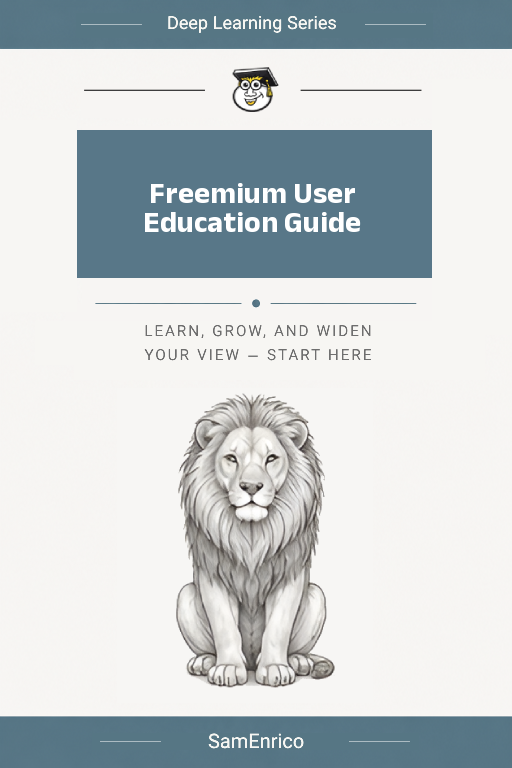
Freemium User Education Guide eBook
Teach freemium users how to manage data usage, syn
by Soria Scott
Teach freemium users how to manage data usage, sync manually, and use offline features effectively.
Formats
Free sample
Chapter 1: The $47 Billion Feeling--–- Every time you tap "Maybe later" on that upgrade prompt, you feel a small, quiet victory. You saved $9.99 this month. You outsmarted the system. But here is the truth the app companies don't want you to know: they are not disappointed when you stay free. They are relieved.
Because you just volunteered to become their product, their training data, and their most valuable marketing asset—all while believing you were winning.The average freemium user hits their first limit not on day 30 of the billing cycle, but on day 11. Eleven days into a fresh month, thirty days of data allowance burned in less than two weeks. And what happens in that moment? Not rational calculation. Not a measured response.
Something far more primal: the scarcity loop triggers, the amygdala activates, and suddenly you are not a smart consumer making a cost-benefit analysis. You are a caveman who just realized the berry bush is almost empty.This chapter is about that feeling. Not the mechanics of data limits—those come in Chapter 2. Not the technical fixes—those fill the rest of this book. This chapter is about the psychology that keeps you stuck.
The invisible architecture of frustration, urgency, and self-blame that has been deliberately engineered into every freemium app you use. And more importantly, it is about how to break that architecture by doing something most users never think to try: absolutely nothing. Not quitting. Not paying. Just pausing long enough to see the limit for what it really is—not a wall, but a dashboard.The Scarcity Loop: How Your Brain Gets Hacked Nir Eyal, in his book Hooked, mapped the anatomy of what he called the "addiction loop": trigger, action, variable reward, investment.
Freemium apps have perfected a darker variant: the scarcity loop. Instead of rewarding you for doing something, it punishes you for not doing something else. The loop goes like this.First, a trigger appears. Not a notification bell or a red badge—something more insidious. You are working normally, editing a document or scrolling a feed, when suddenly a file fails to upload.
Or a video stops playing. Or you see the words: "You have used 90% of your free storage." That is the trigger. It is unexpected, it is interruptive, and it carries an implicit threat.Second, the action the app wants you to take is presented as the only rational choice: "Upgrade now to continue." But notice the framing. It does not say "You have three options." It says "Upgrade now," with a button colored in high-contrast green or blue. The alternative actions—delete files, stop syncing, go offline—are hidden in submenus, written in gray text, or absent entirely.
The app has engineered the choice architecture so that paying feels like the path of least resistance.Third, the variable reward is the removal of the threat. You pay $9.99, and instantly the red bar turns green. The file uploads. The video plays. Your brain releases a small amount of relief dopamine—not the dopamine of pleasure, but the dopamine of danger averted.
This is the same neurological pathway activated when you slam the brakes to avoid a car accident. It is powerful. It is addictive. And it is completely manufactured.Fourth, the investment is the subscription. Once you pay, you have skin in the game.
You will check the app more often. You will store more files. You will integrate it into your workflow. And next month, when the bill arrives, you will pay again—not because you need to, but because the thought of downgrading and facing the scarcity loop again feels worse than the $9.99.Here is what the app companies know that you do not: most freemium users never hit their limit because they actually ran out of resources. They hit it because they leaked resources through behaviors they did not even know they had.
Auto-sync. Background refresh. Push email. Photo backup. These are not features you asked for.
They are defaults that serve the app's need for engagement, not your need for conservation. And every time you hit a limit and pay to escape, you are not buying more storage. You are buying permission to keep leaking.The Pain of Paying vs. The Pain of Managing Behavioral economist Dan Ariely, in Predictably Irrational, identified a phenomenon he called the "pain of paying." When you hand over cash, you feel a tangible loss. When you swipe a credit card, the pain is delayed and diluted.
When you tap "Subscribe" on a phone screen, with Face ID confirming the purchase in 0.3 seconds, there is almost no pain at all. That is by design.But there is another pain that Ariely did not name: the pain of managing. It is the low-grade, persistent irritation of clearing cache, deleting old files, turning off auto-sync, and manually downloading everything before a flight. It is not sharp enough to make you stop what you are doing. It is just dull enough to ignore.
And that is exactly why app companies love it. Because the pain of managing is a renewable resource. Every time you clear cache, you feel a tiny sense of accomplishment. Every time you manually sync, you feel virtuous. And then the app resets, the cache refills, the auto-sync re-enables itself after an update, and you do it all again.
You are not solving the problem. You are becoming part of it.The freemium business model does not require you to upgrade. It only requires you to believe that upgrading is the only escape from the pain of managing. As long as you believe that, you will either pay (which is great for them) or you will keep managing (which is also great for them, because your unpaid labor—checking, deleting, syncing—keeps the app's engagement metrics high). Either way, you lose.The only way out is to recognize that the pain of managing is not a natural consequence of using an app.
It is a design feature. And once you see it as a feature, you can stop treating it as a personal failing.Signifiers: Why Apps Hide the Truth from You Don Norman, in The Design of Everyday Things, introduced the concept of signifiers—clues in a design that tell you how to use something. A door handle that looks like you should pull is a signifier. A progress bar that shows you how much longer a download will take is a signifier. Good signifiers make the invisible visible.Freemium apps are masters of the false signifier.
They show you a red progress bar approaching 100%, but they do not show you what is filling it. They show you a "storage full" warning, but they do not show you which files are taking up the most space. They show you an upgrade button, but they do not show you the six alternative actions that would solve the problem without spending money.Consider a typical cloud storage app. Your free plan includes 2GB of space. You are at 1.9GB.
The app shows a red bar, a warning message, and a single button: "Upgrade to 100GB for $9.99/month." What the app does not show you: a breakdown of your stored files…
This is the end of the free sample. Get the eBook to keep going. Buy now
About this book
Details
- Author
- Soria Scott
- Publisher
- SamEnrico
- Language
- English
- Genre
- Non-Fiction, Business Brief, User Education
- Released
- 2026-06-01
- Pages (approx.)
- 140
- Available as
- eBook, Audiobook

Read better in the ZLOADR app
Your eBooks on your phone or tablet. Sign in with your SamEnrico account and start reading.
More by Soria Scott
 Social Anxiety ConnectionSoria Scott$11.99
 Self Esteem for Return to OfficeSoria Scott$11.99
 Business Credit for Daycare CentersSoria Scott$11.99
 Letting Go of Work GrudgesSoria Scott$11.99
 Road Rage Relapse PlanSoria Scott$11.99
 Lightning Talk DeliverySoria Scott$11.99
 Growth Mindset for StudentsSoria Scott$11.99
 Applewhite's Seminary and UFO FusionSoria Scott$11.99
 The Frozen Fortress: Peter the Great's Siege of Narva (1700)Soria Scott$11.99
 The Celestial Mathematicians of the Nile: Unlocking the Secrets of the UniverseSoria Scott$11.99
 Service Providers Guide to Banking & Credit UnionsSoria Scott$11.99
 How to Produce IronSoria Scott$11.99
You may also like
 Hong Kong Handover 1997Dunn Johnnie$11.99
 Zumba For Postnatal Recovery CourseNeal Christian$11.99
 Zumba for BeginnersLadner Nikia$11.99
 YouTube Comment Mining GuideHumes Pandora$12.99
 Worry Box MeditationCarlin Rudy$11.99
 Workplace Stress MeditationNguyen Lynn$11.99
 Workplace Stress and Sleep RepairHawley Ivory$11.99
 Workplace Perfectionism CureDelaney Jeffry$11.99
 Workplace Injustice Anger GuideWallen Isabelle$11.99
 Work Addiction and Burnout LinkGreenwood Ester$11.99
 Women in Yoga and WellnessBeattie Galina$11.99
 Women in Stand Up ComedyChun Evangeline$11.99