
Freemium to Paid Conversion eBook
Strategic framework for optimizing free tier limit
by Nguyen Homer
Examines Spotify and LinkedIn Premium upgrade triggers and barriers.
Formats
Free sample
Chapter 1: The Freezer Burn--The most dangerous word in business is not "failure." It is not "debt." It is not even "layoffs."The most dangerous word is "free."At first glance, this seems absurd. Free is the engine of the modern internet. Free built Google, Facebook, Zoom, Dropbox, Canva, Slack, and Spotify. Free turned unknown startups into billion-dollar brands. Free is the reason you have a smartphone full of apps you never paid for.
How could free possibly be dangerous?Because free is a drug. And like any drug, the first hit is exhilarating, the second is expected, and by the third, you are physically incapable of functioning without it. The difference between a successful freemium company and a failed one is not whether they offer free access. It is whether they understand that free is not a pricing model. Free is a marketing expense disguised as a product feature.
And most companies are burning cash on that expense without ever seeing a return.This book is called Freemium to Paid Conversion, but that title is a trap. Because if you think your job is simply to "convert free users to paid," you have already lost. Your real job is to engineer the precise amount of strategic friction that makes staying free more painful than paying. Your real job is to build a free tier that users fall in love with, then slowly realize they cannot live without the paid version. Your real job is to turn generosity into leverage.And it starts with understanding the paradox that kills 90% of freemium startups: they either give away too much or too little.
There is almost no middle ground.The Graveyard of Generosity Let me tell you about a company you have never heard of. It was called Evernote. Actually, you have heard of it. For a brief, shining moment in the early 2010s, Evernote was the most beloved productivity app on the planet. It had over 200 million users.
It was the default tool for storing everything from grocery lists to business plans. Investors threw money at it. And its free tier was legendary: users could upload 60 megabytes of new content per month, sync across unlimited devices, and access virtually every feature the company offered.Evernote was generous to a fault. And that generosity killed it.By 2015, Evernote had 200 million free users and fewer than 4 million paying customers. That is a conversion rate of 2%.
The company was spending millions of dollars on server costs, customer support, and engineering resources to serve people who would never pay a dime. When they finally tried to tighten the free tier—limiting free users to two devices instead of unlimited—the backlash was nuclear. Users revolted. Review scores plummeted. The company had trained its audience to expect everything for nothing, and when they tried to correct course, the users who were never going to pay anyway destroyed the company's reputation.Evernote eventually sold for a fraction of its peak valuation.
The tombstone reads: "Died of generosity."Now consider the opposite mistake. In 2017, a small startup launched a video collaboration tool. They offered a free tier that allowed users to record and share videos of up to five minutes. The paid tier unlocked longer videos, advanced analytics, and team features. The problem?
The free tier was so restrictive that users could not actually experience the core value of the product. Five minutes was not enough time to explain a complex idea. Users would sign up, hit the limit immediately, and leave. The company had a 1% conversion rate not because the product was bad, but because users never got to the "aha!" moment where they realized how valuable the tool could be.That company was Loom. And they almost died before they figured out the secret.The 80/20 Rule of Value Here is the framework that separates the winners from the corpses.
I call it the 80/20 Rule of Value, and it will appear in every chapter of this book.Your product has a primary job that users come to complete. For Dropbox, the job is "store and access files from anywhere." For Zoom, the job is "have a video call that doesn't crash." For Calm, the job is "reduce anxiety through meditation." For your product, you know what that job is.The 80/20 Rule states that you must give away 80% of the solution—enough for the user to achieve real, tangible utility—but intentionally withhold the 20% that completes the job. The withheld portion must be the specific friction point that, when removed, creates a "before and after" moment for the user. It must be the thing that makes the user say, "Oh, that's why people pay for this."Let me give you concrete examples.Dropbox gives away 80% of the solution: you can install the app, sync files across devices, share links, and store up to 2 gigabytes for free. That is enough to genuinely improve your life.
You can access your work documents from your phone. You can share photos with family. You feel the value. But the 20% that completes the job—unlimited storage, advanced sharing controls, and team collaboration—is locked behind a paywall. When you hit the 2-gigabyte limit, you do not feel angry at Dropbox.
You feel frustrated with yourself for having too many files. And you upgrade.Zoom gives away 80% of the solution: unlimited one-on-one calls, screen sharing, virtual backgrounds, and group calls up to 40 minutes. You can have a productive team meeting. You can present to a client. You feel the value.
But the 20% that completes the job—unlimited group calls, cloud recording, and administrative controls—is locked. When your team meeting hits the 40-minute wall, you do not blame Zoom. You blame the colleague who rambled for 35 minutes. And you upgrade.Canva gives away 80% of the solution: millions of templates, basic design tools, and free stock photos. You can create a professional-looking social media graphic in five minutes.
You feel like a designer. But the 20% that completes the job—brand kits, background remover, team collaboration, and premium assets—is locked. When you need to remove the background from a product photo and realize the tool does it instantly with one click in the paid version, you upgrade.Notice the pattern. In every successful freemium product, the free tier is not a demo. It is a fully functional product that delivers genuine value.
The user does not feel tricked or manipulated. They feel grateful for what they have received. And when they hit the natural ceiling of the free tier, they feel a specific emotion: desire for more, not resentment for less.That is the art of the 80/20 Rule. And it is shockingly difficult to execute.The Hidden Costs of Free Users Before we go further, we need to have an uncomfortable conversation about the people using your product for free. They are not "users." They are a liability.Every free user costs you money.
Not eventually. Not potentially. Right now. Here is the math that most founders refuse to do.First, there is infrastructure cost. Every API call, every gigabyte of storage, every minute of video processing, every AI token generated costs you real money.
If you are running a Saa S product with a generous free tier, you are essentially writing a check to…
This is the end of the free sample. Get the eBook to keep going. Buy now
About this book
Details
- Author
- Nguyen Homer
- Publisher
- SamEnrico
- Language
- English
- Genre
- Strategic Plan, Freemium, Consumer Mind Report, Freemium
- Released
- 2026-06-13
- Pages (approx.)
- 131
- Available as
- eBook, Audiobook

Read better in the ZLOADR app
Your eBooks on your phone or tablet. Sign in with your SamEnrico account and start reading.
More by Nguyen Homer
 Brett Eldredge Illinois BoyNguyen Homer$11.99
 Paleo Diet Weight Loss PlanNguyen Homer$11.99
 The Validation Under Stress PrimerNguyen Homer$11.99
 Inherited Trauma WorkNguyen Homer$11.99
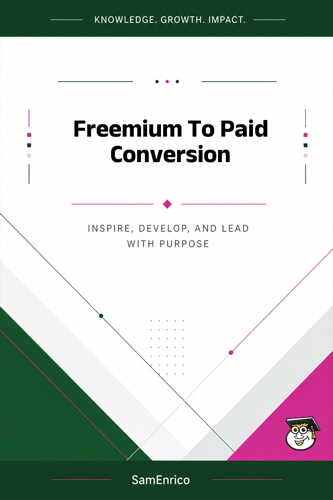 Freemium To Paid ConversionNguyen Homer$11.99
 Mariah Carey ChristmasNguyen Homer$11.99
 Nancy Reagan First LadyNguyen Homer$11.99
 Detox For First RespondersNguyen Homer$11.99
 Hippocrates and the Healing Light of KosNguyen Homer$11.99
 The Black Magic Murders: Ritual Killings in the English CountrysideNguyen Homer$11.99
 Ultimate Handbook Guide to Fuqing : (China) Travel GuideNguyen Homer$11.99
 How to Produce Signal JammersNguyen Homer$11.99