
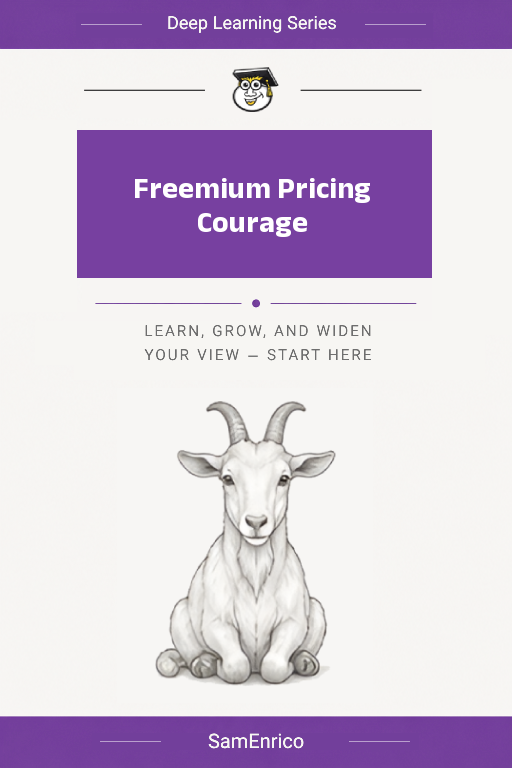
Non-FictionFirst 30 DaysFreemium
Freemium Pricing Courage eBook
Offer a free tier confidently knowing it converts
Offer a free tier confidently knowing it converts to paid without cannibalizing revenue.
Formats
Free sample
Chapter 1: The Conversion Trap--–- Most founders would kill for a 20% conversion rate. They dream about it in the shower, pitch it to their boards, and optimize every pixel of their pricing page to squeeze out one more percentage point. When Alex Chen, the founder of the calendar app Opal, saw his conversion rate drop from 20% to 9%, his head of growth called it a "catastrophe." His largest investor sent a terse email: "Explain the leakage." His CTO suggested adding more aggressive paywalls. His own mother asked if the company was in trouble.Alex did the opposite of what everyone expected. He celebrated.What his critics failed to understand—what this entire book will prove—is that the obsession with conversion rate is the single biggest killer of freemium growth.
The fear of "giving too much away" has destroyed more Saa S companies than bad product-market fit, broken code, or even running out of cash. It is the silent assassin of scale, disguised as fiscal responsibility.This chapter will dismantle the conversion rate obsession, introduce the paradox that separates billion-dollar companies from also-rans, and give you the courage to do what Alex Chen did: make your free tier so generous that your board questions your sanity.The Day Alex Chen Broke the Rules In 2019, Opal was a modest productivity app with a loyal but small user base. The company had 50,000 daily active users, a 20% conversion rate to paid, and annual recurring revenue of $2 million. By conventional Saa S metrics, this was a healthy business. Investors praised the "efficient funnel." Competitors envied the high conversion.
Everything was fine.But Alex noticed something troubling. When he interviewed users who had churned from the free tier, they said the same thing: "I couldn't really use it enough to know if I liked it." The free tier limited users to three scheduled events per day. Three events. For a calendar app. That is like a bookstore that only lets you read the first page of every book, or a gym that kicks you out after ten minutes on the treadmill.Alex made a decision that his board called "naive," his head of product called "reckless," and his CFO called "a donation to strangers." He removed almost every meaningful limit from the free tier.
Users could now schedule unlimited events, invite unlimited collaborators, and access all core features. The only things behind the paywall were advanced analytics, team management tools, and integration with other apps.The result was immediate and terrifying. Conversion rate plummeted from 20% to 9%. His head of growth sent a Slack message that read simply: "We're bleeding."But something else happened. Daily active users exploded from 50,000 to 500,000 in six months.
Then to one million within a year. And while the percentage of users paying had dropped, the absolute number of paying customers had more than doubled. Annual recurring revenue climbed from 2millionto2 million to 2millionto10 million.The math is simple but psychologically brutal: 9% of 1 million (90,000 paying users) is far larger than 20% of 50,000 (10,000 paying users). Alex had traded a high-converting thimble for a low-converting ocean. And the ocean made him rich.The Conversion Rate Lie Let me state this as clearly as possible: conversion rate is a vanity metric for freemium businesses.
It measures efficiency, not effectiveness. It tells you what percentage of the small number of people who found you decided to pay. It tells you nothing about how many people could have found you if you had given them a reason to stay.A stingy free tier is like a fisherman who uses a tiny net because he wants to catch only the biggest fish. Yes, every fish he catches is large. But he is ignoring the thousands of medium and small fish swimming right past him.
A generous free tier is a massive net that catches everything. Most of what you catch will be small fish that you throw back. But the sheer volume means you end up with more large fish than the fisherman with the tiny net ever could.The mistake that founders make is treating the free tier as a conversion funnel rather than a growth engine. They ask: "How many of these free users become paying customers?" The correct question is: "How many of these free users become evangelists, referrers, and future buyers?"Let me introduce a distinction that will appear throughout this book: cannibalizing revenue vs. expanding the funnel.Cannibalizing revenue happens when you give away something that a user would have paid for anyway.
If your product is so useful that users would happily pay $10 per month, and you give it away for free indefinitely, you are cannibalizing. This is bad.Expanding the funnel happens when you attract users who never would have paid in the first place, and some of them either convert later or refer others who do convert. If a high school student uses your product for free for two years, then graduates, gets a job, and convinces her employer to buy your enterprise plan, you have expanded the funnel. This is good.The fear of cannibalization causes founders to build stingy free tiers. The courage to embrace funnel expansion causes founders to build generous ones.
And the data is unambiguous: generous free tiers produce more revenue over the long term.The Habit Formation Diagnostic How do you know if your free tier is too stingy? There is a single diagnostic that answers this question better than any metric or dashboard. I call it the Habit Formation Diagnostic.Ask yourself: can a free user form a genuine daily or weekly habit using only your free tier? Not a "try it out" habit. Not a "once in a while" habit.
A genuine, integrated-into-their-life habit.If the answer is no, you do not have a freemium product. You have a demo. And demos are not growth engines. Demos are sales tools that require constant paid traffic to feed them. They convert at higher percentages but from much smaller audiences.
They feel safe but are actually fragile.Consider the difference between a demo and a true freemium product:A demo says: "Here is a taste. If you want to actually use this, pay us." It is designed to convert. It is optimized for the moment of payment. It treats free users as leads.A true freemium product says: "Here is a gift. Use it as much as you want.
When you outgrow it, we have a paid version that does even more." It is designed to delight. It is optimized for habit formation. It treats free users as an audience.Dropbox is the canonical example. When Dropbox launched, its free tier offered 2GB of storage—enough to form a genuine habit of saving files to the cloud. Users integrated Dropbox into their daily workflow.
They saved photos, documents, and work files. They became dependent on the product. Then, when they hit the 2GB limit, they faced a choice: delete files (painful) or pay for more storage (easy). The habit came first. The payment came second.Contrast this with a typical B2B Saa S demo that limits users to 14 days or 100 API calls.
What habit can you form in 14 days? What workflow can you integrate with only 100 calls? You cannot. You…
This is the end of the free sample. Get the eBook to keep going. Buy now
About this book
Details
- Author
- Matlock Adrien
- Publisher
- SamEnrico
- Language
- English
- Genre
- Non-Fiction, First 30 Days, Freemium
- Released
- 2026-06-01
- Pages (approx.)
- 126
- Available as
- eBook, Audiobook

Read better in the ZLOADR app
Your eBooks on your phone or tablet. Sign in with your SamEnrico account and start reading.
More by Matlock Adrien
 Pregnancy Loss For DoulasMatlock Adrien$11.99
 Self Hypnosis for Fear of Large SpacesMatlock Adrien$11.99
 Surgical Resident BurnoutMatlock Adrien$11.99
 Namibia SWAPO LiberationMatlock Adrien$11.99
 The Self Choking GuideMatlock Adrien$11.99
 Cynthia Erivo Rising StarMatlock Adrien$11.99
 Child Eulogy Writing GuideMatlock Adrien$11.99
 Alcohol Recovery for WomenMatlock Adrien$11.99
 The Poisoned Chalice: The Trial of Frederick and Rose Hodge (1924)Matlock Adrien$11.99
 The Navigators of the Eternal Empire: Rome's Uncharted HorizonsMatlock Adrien$11.99
 How to Produce FloorsMatlock Adrien$11.99
 How to Produce Roof and Foundation SealantMatlock Adrien$11.99
You may also like
 Hong Kong Handover 1997Dunn Johnnie$11.99
 Zumba For Postnatal Recovery CourseNeal Christian$11.99
 Zumba for BeginnersLadner Nikia$11.99
 YouTube Comment Mining GuideHumes Pandora$12.99
 Worry Box MeditationCarlin Rudy$11.99
 Workplace Stress MeditationNguyen Lynn$11.99
 Workplace Stress and Sleep RepairHawley Ivory$11.99
 Workplace Perfectionism CureDelaney Jeffry$11.99
 Workplace Injustice Anger GuideWallen Isabelle$11.99
 Work Addiction and Burnout LinkGreenwood Ester$11.99
 Women in Yoga and WellnessBeattie Galina$11.99
 Women in Stand Up ComedyChun Evangeline$11.99