
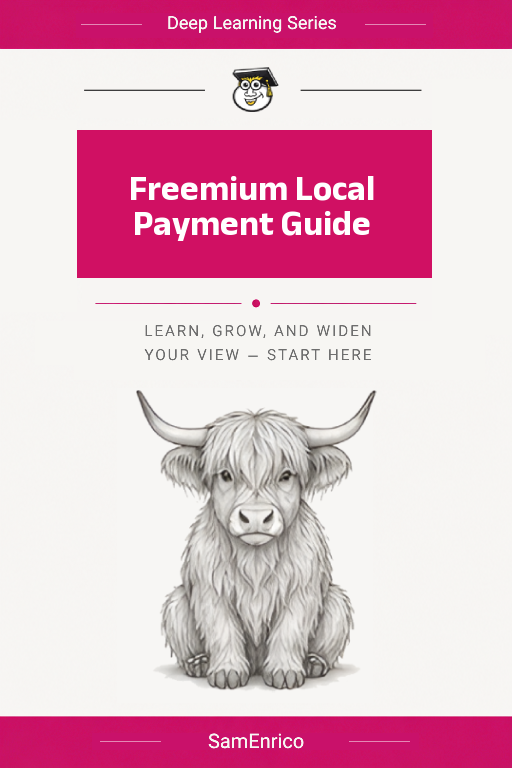
Non-FictionBusiness BriefLocal Payments
Freemium Local Payment Guide eBook
Integrate local payment methods for freemium to pr
Integrate local payment methods for freemium to premium upgrades in emerging markets.
Formats
Free sample
Chapter 1: The Jakarta Shock--–- In 2019, a promising Southeast Asian edtech startup called Lingua Learn launched its freemium language app in Indonesia with a perfect product-market fit. Their AI-powered lessons were localized in Bahasa Indonesia. Their pricing was set at a regional-friendly $4.99 per month, adjusted for Purchasing Power Parity. Their marketing campaign featured local influencers. Within three months, they had acquired 250,000 active free users—a staggering achievement for a bootstrapped company.
There was just one problem. Only 312 of those users ever converted to premium. That is a conversion rate of 0.12 percent.The founders were baffled. They ran user surveys, focus groups, and usability tests. The feedback was consistent and devastating.
"I wanted to upgrade," one user wrote, "but your payment page only asked for a credit card. I don't have a credit card. None of my friends do either. I thought maybe I could pay at an Alfamart [a local convenience store chain], but there was no option. So I just kept using the free version until I hit the lesson limit, then I stopped using the app entirely."Another user added a more pointed observation: "Your app feels like it was built for someone in America, not someone in Jakarta."This is the Jakarta Shock.
It is the moment a well-intentioned, well-designed freemium product crashes against the hard reality of emerging market payment infrastructure. It happens not because the product is bad, not because the price is wrong, and not because the marketing failed. It happens because the checkout page asks the wrong question. It asks for a credit card in a world where credit cards are a luxury of the few, not a tool of the many.The 80 Percent Invisibility Cloak Let us begin with a number that should terrify every product manager, founder, and growth strategist who dreams of expanding into emerging markets. In India, less than five percent of the population holds a credit card.
In Indonesia, that number is around six percent. In Nigeria, it is roughly two percent. In Vietnam, approximately four percent. In Egypt, less than three percent.These are not edge cases. These are the world's fastest-growing digital economies, home to over two billion people.
When you build a freemium-to-premium funnel that accepts only credit cards, you are not failing to serve these users. You are rendering yourself invisible to them. You are the digital equivalent of a store that posts a sign saying "No cash accepted" in a country where ninety-five percent of transactions happen in cash.But here is where the Jakarta Shock becomes truly painful. The users you are ignoring are not poor, uneducated, or technologically backward. They are young, digitally native, and hungry for premium digital experiences.
They pay for Spotify. They subscribe to Canva Pro. They buy virtual goods in mobile games. They simply do it through different rails.In India, a freelance graphic designer earning a comfortable middle-class income will pay for Canva Pro using UPI—the Unified Payments Interface that processes over ten billion transactions per month. She will never use a credit card.
In Brazil, a small business owner buying cloud storage will pay with Pix, the central bank's instant payment system that now handles more transactions than all credit cards combined. He has never owned a Visa or Mastercard. In Kenya, a university student subscribing to a meditation app will pay via M-Pesa, using nothing more than her phone number and a PIN. The concept of a "credit check" is foreign to her.These users are not the unbanked. They are the differently banked.
They have functional, efficient, and often superior payment systems that their governments and telecom companies built precisely because credit card networks never achieved critical mass. These systems are faster, cheaper, and more accessible than anything in the West. Pix settles in seconds with zero fees. UPI requires no card network and no interchange fees. M-Pesa works on any phone, even a $15 feature phone.And yet, most Western-built freemium products ignore these rails entirely.
They default to Stripe, Braintree, or Recurly, which default to cards. The result is a massive, self-inflicted conversion penalty.The 21 Percent Lift: Evidence That Local Methods Work The good news is that the solution is both proven and measurable. When businesses enable at least three local payment methods alongside cards, they see an average increase of twenty-one percent in freemium-to-premium conversion rates compared to card-only checkouts. This is not a hypothetical projection. It is a replicated finding across multiple industries, geographies, and company sizes.Consider the case of Spotify Brazil.
When the streaming giant first entered the Brazilian market in 2014, it relied almost exclusively on international credit cards. Conversion rates were painfully low. Brazilian users would download the app, enjoy the free tier, hit the paywall, and leave. In 2017, Spotify integrated Boleto Bancário—a cash voucher that users could print and pay at any lottery shop, supermarket, or post office. Within six months, premium subscribers in Brazil grew by thirty-four percent.
Two years later, when Pix launched and Spotify integrated it within ninety days, conversion rates jumped another twenty-two percent.The gaming industry offers an even starker example. A mid-sized mobile gaming studio based in Singapore launched a freemium game called Arena Legends across Southeast Asia. In the Philippines, the game offered credit card, Pay Pal, and Google Play Store billing. Conversion from free to paying user was 0.8 percent. The studio then integrated GCash—the dominant e-wallet in the Philippines, used by over eighty percent of internet users.
Conversion jumped to 1.6 percent. They added Pay Maya (now Maya) as a second local wallet. Conversion hit 2.1 percent. They did not change the game. They did not lower the price.
They simply allowed users to pay the way they already paid for everything else.The twenty-one percent lift is not a ceiling. It is an average. Some companies see forty, fifty, even one hundred percent improvements in conversion when they add the right local methods. The variance depends on how poorly the original card-only checkout performed relative to local expectations.The Three Categories of Emerging Market Payment Methods To understand why local methods drive such dramatic improvements, we must first understand what they are and how they work. Emerging market payment methods fall into three broad categories, each with distinct user behaviors, technical requirements, and conversion implications.Real-Time Bank Transfers (Instant, Synchronous)The first category includes systems like India's UPI, Brazil's Pix, Mexico's SPEI, and Thailand's Prompt Pay.
These are real-time, synchronous payment methods. The user authenticates directly with their bank (usually via a mobile app or biometric verification), approves the transaction, and the money moves instantly. The merchant receives immediate confirmation.These systems are the gold standard for freemium conversion. They are fast, cheap, and increasingly trusted. In India, UPI now processes over ten billion transactions per month—more than the combined volume of Visa and Mastercard in the country.
In Brazil, Pix has been adopted by over seventy percent of the adult population within three years of launch. The user experience is superior to cards: no entering sixteen-digit numbers, no expiry dates, no CVV codes. Just a QR code scan or a virtual payment address.For subscription-based freemium models, India's UPI e Mandate system is particularly…
This is the end of the free sample. Get the eBook to keep going. Buy now
About this book
Details
- Author
- Register Mellissa
- Publisher
- SamEnrico
- Language
- English
- Genre
- Non-Fiction, Business Brief, Local Payments
- Released
- 2026-05-29
- Pages (approx.)
- 135
- Available as
- eBook, Audiobook

Read better in the ZLOADR app
Your eBooks on your phone or tablet. Sign in with your SamEnrico account and start reading.
More by Register Mellissa
 Reading Habit Formation GuideRegister Mellissa$11.99
 Relapse Prevention Plan FoodRegister Mellissa$11.99
 Night Walking Meditation GuideRegister Mellissa$11.99
 Religious Setting Small Talk HandbookRegister Mellissa$11.99
 RAIN Meditation Self Compassion GuideRegister Mellissa$11.99
 The Vanishing of the Mary Celeste: The Ghost Ship That Haunts the SeasRegister Mellissa$11.99
 Frozen in Time: The Last Flight of the Doomed Arctic ExpeditionRegister Mellissa$11.99
 How to Become a Needle-felt-making-machine OperatorRegister Mellissa$11.99
 Escrow Service ManualRegister Mellissa$12.99
 Understanding Gordon Hyperkaliemia-hypertension SyndromeRegister Mellissa$17.99
 QA Automation LeadRegister Mellissa$11.99
You may also like
 Hong Kong Handover 1997Dunn Johnnie$11.99
 Zumba For Postnatal Recovery CourseNeal Christian$11.99
 Zumba for BeginnersLadner Nikia$11.99
 YouTube Comment Mining GuideHumes Pandora$12.99
 Worry Box MeditationCarlin Rudy$11.99
 Workplace Stress MeditationNguyen Lynn$11.99
 Workplace Stress and Sleep RepairHawley Ivory$11.99
 Workplace Perfectionism CureDelaney Jeffry$11.99
 Workplace Injustice Anger GuideWallen Isabelle$11.99
 Work Addiction and Burnout LinkGreenwood Ester$11.99
 Women in Yoga and WellnessBeattie Galina$11.99
 Women in Stand Up ComedyChun Evangeline$11.99