
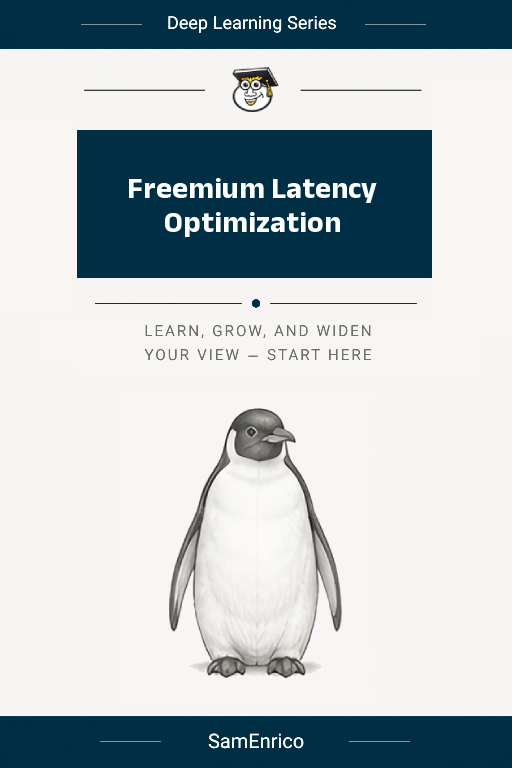
Freemium Latency Optimization Audiobook
Reduce server round trips and use local-first arch
Reduce server round trips and use local-first architecture to minimize perceived lag.
Formats
Free sample
Chapter 1: The 100ms Heist--–- In 2018, a promising freemium design tool called “Sketchboard” was dying. Not because of bad code, not because of a missing feature, and not because of a better-funded competitor. Sketchboard was dying because its users felt something was wrong—something most of them couldn’t articulate. The app felt “sluggish.” It felt “heavy.” One user wrote in a refund request: “Every click feels like waiting for an old printer. I don’t trust it.”Sketchboard’s engineering team ran every test they knew.
Their servers were at 30% capacity. Their database queries were optimized. Their CDN was global. By every internal metric, the app was “fast.” But users kept leaving.Then they did something unusual. They ran a latency audit focused not on their servers, but on the user’s experience.
What they found shocked them: the median API response time was 120ms—respectable. But the p99 latency (the slowest 1% of requests) was 1,800ms. Nearly two full seconds. Worse, every user action required a round trip to their Virginia data center before the UI would update. A simple “like” on a comment—a free-tier action—took 380ms on average.
In user tests, people described 380ms as “hesitant.” At 500ms, they called it “broken.”Sketchboard was suffering from what this book calls The Freemium Tax: the invisible revenue loss caused by latency in free-tier experiences. They calculated the damage. Their free-to-paid conversion rate was 2.1%. Industry average for design tools was 4.5%. That 2.4% gap represented $4.8 million in annual lost revenue.
The cause? Not features, not pricing. Latency.Within six weeks of deploying optimistic UI (which you’ll learn in Chapter 5), their conversion rate tripled to 6.3%. They didn’t add a single new feature. They just stopped making users wait.This chapter establishes the core business case for latency optimization in freemium models.
You will learn exactly how much latency costs you in dollars, why the human brain perceives waiting as a threat, the three physical limits that constrain every system, and the economic formula that determines how much you can spend on each free user. Most importantly, you will internalize the first of four mantras that evolve throughout this book: The network should be optional.The Economics of a Millisecond Let’s start with a number that should terrify every freemium founder: 100 milliseconds.Amazon famously reported that every 100ms of latency cost them 1% in sales. That was 2006. The tolerance for…
This is the end of the free sample. Get the Audiobook to keep going. Buy now
About this book
Details
- Author
- Toliver Vivien
- Publisher
- SamEnrico
- Language
- English
- Genre
- Non-Fiction, Business Brief, Latency
- Released
- 2026-06-01
- Pages (approx.)
- 136
- Available as
- eBook, Audiobook

Listen in the VoxFlicks app
Audiobooks and audio dramas wherever you go. Sign in with your SamEnrico account and press play.
More by Toliver Vivien
 The Observation Lead HandbookToliver Vivien$11.99
 Anger De escalation for 911 OperatorsToliver Vivien$11.99
 Disabled Child Self EsteemToliver Vivien$11.99
 Waiting Triggers GuideToliver Vivien$11.99
 Recurrent Loss TestingToliver Vivien$11.99
 Stimulant Use Disorder CourseToliver Vivien$11.99
 Procrastination Killer GuideToliver Vivien$11.99
 Appeals Based On ID ErrorToliver Vivien$11.99
 The Cursed Vows of Shakuntala and DushyantaToliver Vivien$11.99
 Whispers of the Deep: The Leviathan’s LamentToliver Vivien$11.99
 Understanding Zellweger SyndromeToliver Vivien$11.99
 How to Start a Amusement Goods (commission Agent) Business (Beginners Guide)Toliver Vivien$11.99