
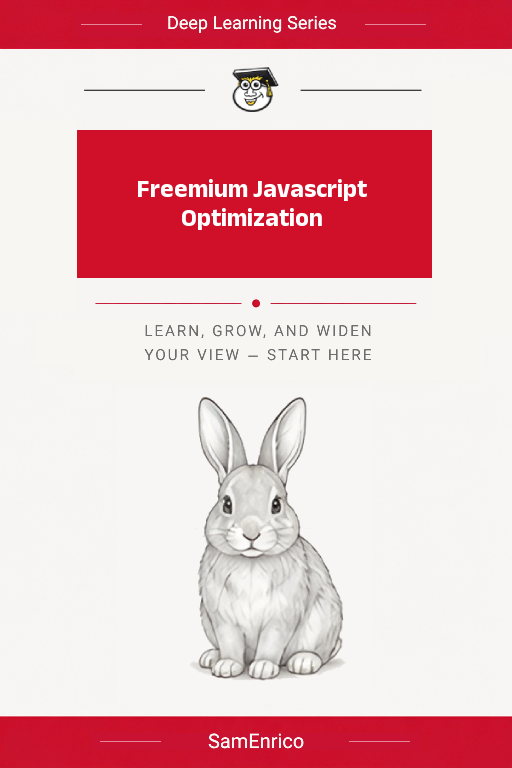
Non-FictionBusiness BriefJavascript
Freemium Javascript Optimization
Reduce bundle size, code-split, and defer non-crit
by Joyner Silas
Reduce bundle size, code-split, and defer non-critical JS for faster 2G rendering.
Formats
About this book
Free sample
Chapter 1: The Empathy Engine--In 2019, a developer named Priya watched her mother struggle to load a government benefits portal on a ₹3,000 smartphone in rural Maharashtra, India. The page took forty-seven seconds to become interactive. Her mother assumed the website was broken. She closed the tab and walked to a government office four kilometers away.That website was built by a team of twelve engineers using React, Redux, and three analytics libraries. They tested exclusively on Mac Book Pros connected to a corporate fiber line.
Their Lighthouse score was ninety-eight. They had never once simulated 2G.This book exists because of that gap. The gap between how we test and how the world connects. The gap between a ninety-eight Lighthouse score on fiber and a forty-seven-second Time-to-Interactive on a two-hundred-dollar phone. The gap between what we think is fast and what is actually usable.The Performance Delusion Here is an uncomfortable truth that the performance industry has danced around for a decade: most Java Script optimization advice is written by and for developers who have never experienced their own product on a slow network.We measure.
We profile. We split bundles and defer scripts and compress assets. And then we declare victory when our simulated 3G test finishes in three seconds on an i Phone fourteen Pro. But simulation is not reality. Throttling your Mac Book's network connection to 150 kilobits per second does not replicate the experience of a low-end ARM processor struggling to parse two megabytes of Java Script while competing with background processes and thermal throttling.The average webpage today weighs over two megabytes.
That is forty times larger than the average page in the year 2000, when the majority of home internet connections ran at fifty-six kilobits per second. We have used every speed increase of the past two decades—broadband, 3G, 4G, 5G—as permission to add more code, more frameworks, more dependencies, more everything. We have traded efficiency for convenience and called it progress.But here is the catch: the world did not upgrade uniformly.The Two Worlds At the same time that Silicon Valley was celebrating the arrival of 5G…
This is the end of the free sample. Get the eBook to keep going. Buy now
Contents
- Chapter 1
- Chapter 2
- Chapter 3
- Chapter 4
- Chapter 5
- Chapter 6
- Chapter 7
- Chapter 8
- Chapter 9
- Chapter 10
- Chapter 11
- Chapter 12
Details
- Author
- Joyner Silas
- Publisher
- SamEnrico
- Language
- English
- Genre
- Non-Fiction, Business Brief, Javascript
- Released
- 2026-06-01
- Pages (approx.)
- 130
- Available as
- eBook, Audiobook

Read better in the ZLOADR app
Your eBooks on your phone or tablet. Sign in with your SamEnrico account and start reading.
More by Joyner Silas
 Chronic Illness Childhood WorthJoyner Silas$11.99
 Anger De escalation for TeachersJoyner Silas$11.99
 Powder Cocaine AddictionJoyner Silas$11.99
 Blood Clot DisordersJoyner Silas$11.99
 The Question Ladder CourseJoyner Silas$11.99
 Exercise GH BoostJoyner Silas$11.99
 Chronic Pain and GamblingJoyner Silas$11.99
 Assertiveness Self EsteemJoyner Silas$11.99
 The Spice Kings: Portugal’s Golden FleetsJoyner Silas$11.99
 The Oscar Heist: The Night the Academy Lost Its Crown JewelJoyner Silas$11.99
 How to Start a Pile-extractors Business (Beginners Guide)Joyner Silas$11.99
 How to Produce Grains, Rice and CerealJoyner Silas$11.99
You may also like
 Hong Kong Handover 1997Dunn Johnnie$11.99
 Zumba For Postnatal Recovery CourseNeal Christian$11.99
 Zumba for BeginnersLadner Nikia$11.99
 YouTube Comment Mining GuideHumes Pandora$12.99
 Worry Box MeditationCarlin Rudy$11.99
 Workplace Stress MeditationNguyen Lynn$11.99
 Workplace Stress and Sleep RepairHawley Ivory$11.99
 Workplace Perfectionism CureDelaney Jeffry$11.99
 Workplace Injustice Anger GuideWallen Isabelle$11.99
 Work Addiction and Burnout LinkGreenwood Ester$11.99
 Women in Yoga and WellnessBeattie Galina$11.99
 Women in Stand Up ComedyChun Evangeline$11.99