
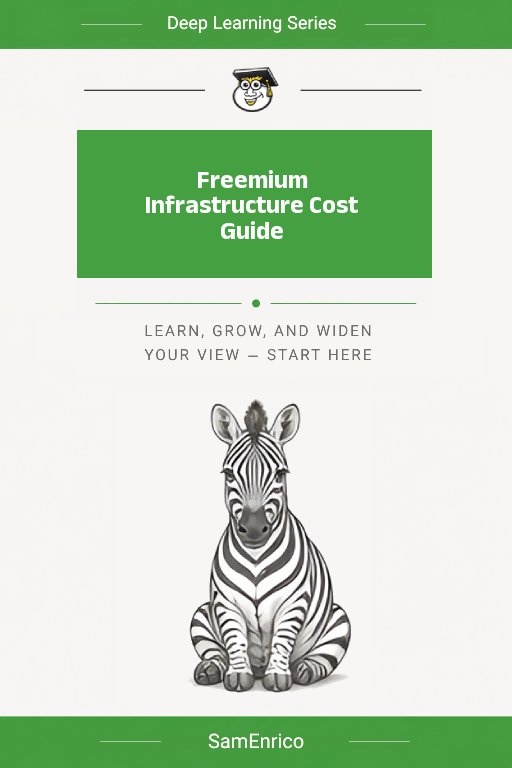
Freemium Infrastructure Cost Guide eBook
Balance freemium infrastructure costs against conv
by Yu Chastity
Balance freemium infrastructure costs against conversion value in low-income regions.
Formats
Free sample
Chapter 1: The Compute Tax--–- Mofe had done everything right. His startup, Afri Learn, offered free AI tutoring to students across Nigeria. Within six months, he had 2.3 million daily active users. Investors called him the "duolingo of West Africa." Local newspapers ran profiles with his beaming face. Then the API bill arrived.
Not the usual five-figure monthly burn he had budgeted for. This one was $347,000. For a single month. His free tier had become a debt machine, and every new user was pulling the lever on a slot machine that paid out in losses. By the time he figured out what went wrong, the money was gone, the investors had fled, and Afri Learn was a cautionary tale whispered in Lagos tech circles.The problem was not Mofe's product.
The problem was not his pricing strategy. The problem was that he, like thousands of founders before him, had fallen into what this book calls the Toll Booth Fallacy – the false assumption that a standard freemium model works universally, regardless of infrastructure costs or regional economics. He believed that if he gave away enough value for free, conversion would follow. He was wrong. And in low-income regions, where every fraction of a cent in compute cost matters, being wrong means bankruptcy.This chapter dismantles that fallacy.
It introduces the concept of the Compute Tax – the hidden reality that AI, API calls, and connectivity have high and often unpredictable marginal costs, unlike traditional software. It draws on real-world cases of apps with millions of daily active users going bankrupt because their infrastructure bills exceeded revenue. And it sets up the central tension that the rest of this book resolves: how to balance freemium access against infrastructure costs in markets where traditional pricing models collapse.The Bangladesh Water Study: A Parable of Fixed Costs To understand why freemium fails in low-income regions, we must first leave the world of software entirely. Travel to rural Bangladesh in the early 2000s, where a development organization attempted to solve a seemingly simple problem: providing clean drinking water to villages without it.The organization installed hand pumps – simple, mechanical devices that villagers could operate themselves. The cost per pump was fixed: approximately $200 for materials and installation.
The organization faced a classic economic dilemma. Should they charge users a small fee to recover costs and ensure sustainability, or should they provide the water for free to maximize access?They tried both models, and both failed – but for reasons that revealed something profound about infrastructure economics.When they charged even a tiny fee – the equivalent of 0.10permonthperfamily–adoptionplummeted.Notbecausefamiliescouldnotafford0.10 per month per family – adoption plummeted. Not because families could not afford 0.10permonthperfamily–adoptionplummeted.Notbecausefamiliescouldnotafford0.10, but because the transaction cost of collecting that fee exceeded the revenue. Sending someone to collect money, processing payments, tracking defaulters – all of this cost more than the $0.10 itself. The system bled money on administrative overhead.When they provided the water for free, a different problem emerged.
Villagers used the pumps for everything – drinking, washing, irrigation, even commercial resale. Demand outstripped supply. Pumps broke from overuse, and there was no revenue to repair them. Within a year, half the pumps were non-functional.The organization had created a false choice between equity (universal access) and efficiency (cost recovery). The fixed cost of the pump created a binary decision: either you exclude some users to manage demand, or you serve everyone and watch the infrastructure crumble.
There was no middle ground in their model.But then something unexpected happened. A different organization tried a hybrid approach. They installed the same pumps but partnered with a local bottled water company. The bottled water company paid for the pumps in exchange for the right to extract water during off-peak hours. Villagers received free water for drinking and cooking – their basic needs – while the bottled water company's commercial operations subsidized the infrastructure.
The pumps stayed maintained. Villagers had access. The system reached equilibrium.This is the Bangladesh water study, and it is the single most important case study for understanding freemium infrastructure in low-income regions. The lesson is not about water. The lesson is about fixed costs and marginal costs – and how digital infrastructure is following the exact same trap.The Compute Tax: Why Digital Infrastructure Is Not Software For most of the internet's history, software had a beautiful economic property: near-zero marginal cost.
Once you wrote a line of code, you could copy it a million times for almost nothing. This is why freemium worked in Silicon Valley. A company like Dropbox could give away 2GB of storage for free because the cost of serving that 2GB to an additional user was fractions of a cent. They could absorb the cost, wait for conversion, and profit.That era is over.We have entered the age of what this book calls The Compute Tax – the hidden, rising, and often catastrophic cost of delivering infrastructure that actually does something. Consider the difference between traditional software and modern AI-powered services.A traditional Saa S product – say, a project management tool – has simple infrastructure costs.
A database query. Some server time. A few kilobytes of text transferred. The marginal cost of serving one additional free user might be $0.001 per month. You could give away service to millions of users and barely notice the bill.Now consider an AI tutoring app like Mofe's Afri Learn.
Every time a student asks a question, the app sends a request to an LLM API – GPT-4, Claude, Gemini, or another provider. That API call costs real money: typically 0.01to0.01 to 0.01to0.10 per thousand tokens, depending on the model. A single student asking ten questions per day might cost 0.30permonthin APIfeesalone.Multiplythatby2.3milliondailyactiveusers,andyouarelookingatnearly0.30 per month in API fees alone. Multiply that by 2.3 million daily active users, and you are looking at nearly 0.30permonthin APIfeesalone.Multiplythatby2.3milliondailyactiveusers,andyouarelookingatnearly700,000 per month in compute costs – before you pay for hosting, bandwidth, storage, or staff.This is the Compute Tax. Unlike traditional software, modern infrastructure has high and variable marginal costs.
Every new user is not almost-free. Every new user is a direct, measurable, and often unpredictable expense.The problem is compounded by the nature of low-income regions. Users in these markets are famously price-sensitive, but they are also usage-sensitive. When something is free, they use it – a lot. They do not ration their API calls.
They do not worry about token limits. They behave rationally: they consume as much value as the free tier offers. And every single one of those calls costs you money.This is the trap that killed Afri Learn, and it is killing dozens of startups every year across Africa, South Asia, and Latin America. They build beautiful products. They acquire millions of users.
They celebrate their hockey-stick growth. And then they discover that their infrastructure bill is a hockey stick pointing in the wrong direction.The Dead DAU: Real Cases of Freemium Failure Let us be specific. These are not hypothetical scenarios. They are real companies that died – or nearly died – because they underestimated the Compute Tax.Case One: The AI Image Generator. In 2024, a well-funded startup launched a free AI image generation tool.
Users could create unlimited images during a 30-day free trial. The product went viral on Tik Tok. Within six weeks…
This is the end of the free sample. Get the eBook to keep going. Buy now
About this book
Details
- Author
- Yu Chastity
- Publisher
- SamEnrico
- Language
- English
- Genre
- Non-Fiction, Business Brief
- Released
- 2026-06-01
- Pages (approx.)
- 144
- Available as
- eBook, Audiobook

Read better in the ZLOADR app
Your eBooks on your phone or tablet. Sign in with your SamEnrico account and start reading.
More by Yu Chastity
 FCPA Extradition CasesYu Chastity$11.99
 Insomnia Therapy Without Medication GuideYu Chastity$11.99
 Delegation FAQYu Chastity$11.99
 The Sobriety Exercise PlanYu Chastity$11.99
 TM For Diabetes ManagementYu Chastity$11.99
 The Gacy Death CertificateYu Chastity$11.99
 Perfectionism and Imposter CycleYu Chastity$11.99
 Chunking Podcast GuideYu Chastity$11.99
 Hitler Mein KampfYu Chastity$11.99
 Whispers in the Wire: The Secret Love Letters of the Great EscapeYu Chastity$11.99
 The Last Message: The Titanic's Wireless Room SecretsYu Chastity$11.99
 The Quantum Wave: How a Pacific Lab Unlocked the Secrets of the UniverseYu Chastity$11.99
You may also like
 Hong Kong Handover 1997Dunn Johnnie$11.99
 Zumba For Postnatal Recovery CourseNeal Christian$11.99
 Zumba for BeginnersLadner Nikia$11.99
 YouTube Comment Mining GuideHumes Pandora$12.99
 Worry Box MeditationCarlin Rudy$11.99
 Workplace Stress MeditationNguyen Lynn$11.99
 Workplace Stress and Sleep RepairHawley Ivory$11.99
 Workplace Perfectionism CureDelaney Jeffry$11.99
 Workplace Injustice Anger GuideWallen Isabelle$11.99
 Work Addiction and Burnout LinkGreenwood Ester$11.99
 Women in Yoga and WellnessBeattie Galina$11.99
 Women in Stand Up ComedyChun Evangeline$11.99