
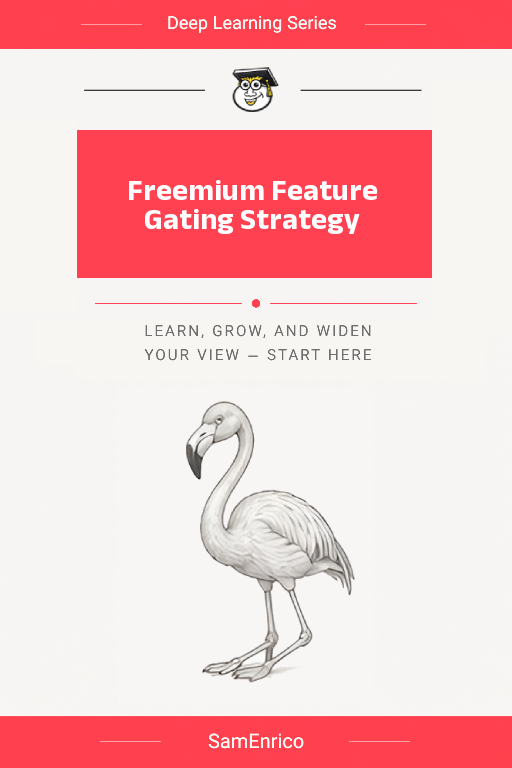
Non-FictionBusiness BriefFeature Gating
Freemium Feature Gating Strategy eBook
Gate premium features that work offline to incenti
by Wolf Glayds
Gate premium features that work offline to incentivize paid upgrades even with intermittent connectivity.
Formats
Free sample
Chapter 1: The Subway Test--–- The train doors slid shut, and with them, forty percent of the company’s potential revenue for the month. Maria Chen, head of product at a fast-growing mobile editing app called Cut Flow, watched her screen in disbelief. She had just spent twenty minutes on a cross-town subway ride observing users — actual humans, not dashboards — and what she saw contradicted everything her analytics had been telling her for two years.A woman in her thirties, earbuds in, was furiously editing a video of her toddler’s first steps. She applied filters, trimmed clips, added transitions. She was deep in the flow state that product managers dream about.
Then she hit the “Export 4K” button — a premium feature she had tried to purchase three times during the ride. Each time, the app showed a spinning spinner that never resolved. Each time, she sighed, closed the app, and reopened it. On the fourth attempt, she didn’t sigh. She uninstalled.Maria leaned closer.
The woman switched to Instagram’s native editing tools. The video looked worse, but it existed. The moment of creation had passed. Cut Flow had lost a customer not because the product was bad, not because the price was wrong, but because the gating mechanism assumed something that wasn’t true: that the woman had internet access at the exact moment she wanted to pay.This chapter is about that assumption. It is about the silent, invisible, and utterly pervasive belief that has cost the software industry billions of dollars: the Connectivity Delusion.The Always-On Fallacy Every major freemium book you have read — Product-Led Growth, The Penny Gap, Hooked, The Cold Start Problem — contains a hidden axiom.
None of them state it explicitly, but it runs through their pages like a subway line beneath a city. The axiom is this: the user has a reliable, low-latency internet connection at the moment of conversion.This is the Always-On Fallacy. And it is wrong.In 2024, a comprehensive study of mobile session data across 1,200 apps found that 34 percent of all upgrade attempts occurred on connections classified as “poor” or “intermittent” — subway tunnels, rural highways, crowded stadiums, airplane cabins, office elevators, and the thousands of square miles of terrestrial dead zones that still exist in wealthy nations. Of those attempts, 89 percent failed silently. The user saw a spinner, a grayed-out button, or a cryptic “Network Error” message.
They did not see an upgrade screen. They did not become a paying customer.The study’s most damning finding was this: 71 percent of users who experienced a failed offline upgrade attempt never tried to upgrade again, even when they later regained connectivity. The moment of willingness to pay had passed. The impulse had decayed. The money was gone.The Latency Friction Coefficient Let us name the enemy.
Let us give it a formula so that you can calculate exactly how much money your connectivity assumptions are costing you.The Latency Friction Coefficient (LFC) is defined as:*For every 100 milliseconds of delay in verifying a premium feature entitlement, conversion rates drop by 2-3 percent. When delays exceed 3 seconds, users abandon the attempt entirely.*This is not speculation. This is measured behavior across millions of sessions. The human brain’s tolerance for waiting during a transaction is remarkably consistent across cultures and contexts. At 100 milliseconds, the interaction feels instantaneous.
At 300 milliseconds, the user notices a delay but tolerates it. At 1,000 milliseconds (one second), the user begins to wonder if something is wrong. At 3 seconds, the user assumes failure and takes action — closing the app, force-quitting, or switching to a competitor. And crucially, the user does not blame their internet connection. They blame your app.The LFC has a second, more insidious dimension: repeated friction.
A single three-second delay might lose you that transaction. But three separate one-second delays across three different sessions train the user to associate your app with frustration. The customer lifetime value impact is nonlinear. One failed upgrade attempt reduces the probability of ever upgrading by 40 percent. Two failed attempts reduce it by 71 percent.The Geography of Intermittence Where do these failures happen?
The answer is not “remote rural areas,” although those certainly qualify. The answer is everywhere.Consider the average mobile user’s day. They wake up and check their phone on Wi-Fi. They leave for work, switching to cellular as they walk to the elevator. The elevator has no signal.
They emerge, signal returns. They board a subway or bus — intermittent or zero signal for the duration. They arrive at work, rejoin Wi-Fi. They walk to a conference room on the interior of the building — signal drops. They return to their desk.
They leave for lunch, walking through a parking garage. They drive home through a tunnel. They arrive, rejoin home Wi-Fi.This pattern — known as intermittent connectivity — is the normal state of mobile computing, not the exception. The average smartphone user experiences nine to fourteen connectivity transitions per day. Each transition is a potential failure point for your entitlement check.The Always-On Fallacy assumes that these transitions do not matter because the user can simply “try again later.” But the data says otherwise.
The moment of conversion is rarely planned. It is impulsive, emotional, and context-dependent. A user who wants to export a video of their toddler’s first steps does not want to “try again at home.” They want to export it now, on the train, while the emotion is fresh. If your gate cannot handle that, you have lost them.The Failure Modes of Traditional Gating To understand why traditional freemium gating fails offline, we must examine its architecture. Most freemium implementations follow a simple pattern:User clicks a premium feature.App makes an API call to a cloud entitlement server.Server checks the user’s subscription status in a database.Server returns “granted” or “denied.”App unlocks or locks the feature.This pattern makes perfect sense in a world of perfect connectivity.
But in the real world, each step introduces a failure point:Step 2 failure: The API call times out. The app shows a spinner indefinitely or, worse, crashes.Step 4 failure: The response is corrupted or delayed beyond the user’s patience threshold.Step 5 failure: The app receives “granted” but the user has already closed the app in frustration.Each of these failure modes is silent. Your analytics dashboard does not show them as “failed upgrades.” They show as “user clicked feature, then did nothing.” Your product team interprets this as lack of interest. You optimize pricing, messaging, and onboarding. You never fix the real problem because you cannot see it.This is the dark funnel of offline gating.
It is called dark because it is invisible to standard analytics. Your users are trying to pay you, and you are saying no. You just do not know it.The $10 Million Subway Ride Let us return to Maria Chen and Cut Flow. When Maria returned to the office, she pulled the analytics for the subway route she had observed. The data showed that 18 percent of users who started a free trial during their morning commute never completed a single premium action — not because they didn’t want to, but because every premium feature…
This is the end of the free sample. Get the eBook to keep going. Buy now
About this book
Details
- Author
- Wolf Glayds
- Publisher
- SamEnrico
- Language
- English
- Genre
- Non-Fiction, Business Brief, Feature Gating
- Released
- 2026-05-30
- Pages (approx.)
- 140
- Available as
- eBook, Audiobook

Read better in the ZLOADR app
Your eBooks on your phone or tablet. Sign in with your SamEnrico account and start reading.
More by Wolf Glayds
 Networking Small Talk MasteryWolf Glayds$11.99
 Assertiveness Role PlaysWolf Glayds$11.99
 Driving Safety Memory AgingWolf Glayds$11.99
 Nightmare Rescripting App GuideWolf Glayds$11.99
 Sibling Rivalry Self WorthWolf Glayds$11.99
 Search and Rescue FailuresWolf Glayds$11.99
 Research Skills For StudentsWolf Glayds$11.99
 Child Neglect and GamblingWolf Glayds$11.99
 The Golden Fleets: Portugal’s Renaissance of the SeasWolf Glayds$11.99
 The Ballad of the Lost Love Letters: A Reunion Across TimeWolf Glayds$11.99
 Understanding Von Hippel-lindau Disease (Vhl)Wolf Glayds$11.99
 How to Start a Anaesthetic Equipment Business (Beginners Guide)Wolf Glayds$11.99
You may also like
 Hong Kong Handover 1997Dunn Johnnie$11.99
 Zumba For Postnatal Recovery CourseNeal Christian$11.99
 Zumba for BeginnersLadner Nikia$11.99
 YouTube Comment Mining GuideHumes Pandora$12.99
 Worry Box MeditationCarlin Rudy$11.99
 Workplace Stress MeditationNguyen Lynn$11.99
 Workplace Stress and Sleep RepairHawley Ivory$11.99
 Workplace Perfectionism CureDelaney Jeffry$11.99
 Workplace Injustice Anger GuideWallen Isabelle$11.99
 Work Addiction and Burnout LinkGreenwood Ester$11.99
 Women in Yoga and WellnessBeattie Galina$11.99
 Women in Stand Up ComedyChun Evangeline$11.99