
Non-FictionBusiness BriefReferral Programs
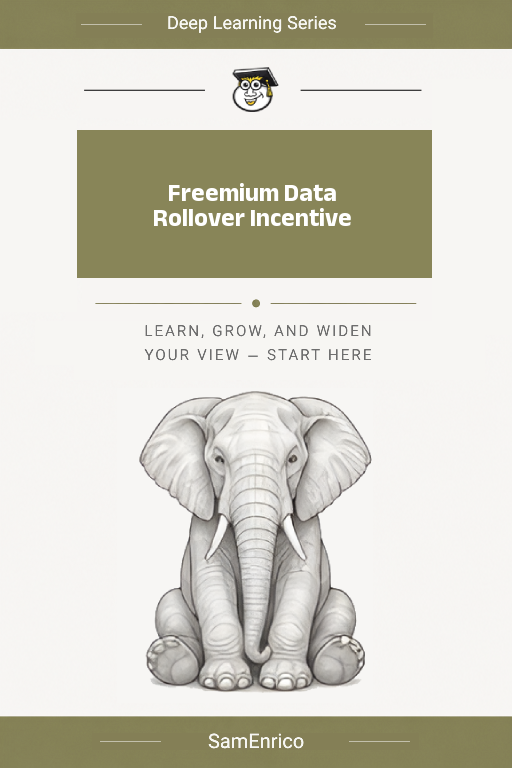
Freemium Data Rollover Incentive eBook
Offer free premium days for referring friends who
Offer free premium days for referring friends who then use the app on low bandwidth connections.
Formats
Free sample
Chapter 1: The Loss Ledger--It begins, as most things do in the digital economy, with a single number: 47.Not 47 million users. Not 47 percent growth. Forty-seven days. That was the balance a woman named Priya had accumulated over six months on a modest ride-hailing and payments app in Chennai, India. Forty-seven premium days, earned one by one, each time she referred a friend who then used the app on a slow, unreliable 3G connection.
She had never paid the app a single rupee. She had never needed to. Every month, her rollover balance covered her premium features—faster map loading, priority customer support, and zero ads during payment confirmations.Then the app introduced a cap.Users could now hold no more than thirty premium days at any time. Anything beyond that would vanish on the next billing cycle. Priya logged in to find her balance had been cut from forty-seven to thirty.
Seventeen days—nearly three weeks of premium access—had evaporated while she slept.She did not email customer support. She did not complain on social media. She simply stopped referring friends. Within sixty days, her referrals dropped to zero. Within ninety, she had uninstalled the app entirely.The product manager who had pushed for the cap was baffled.
"We gave away less free premium. Our costs went down. But our growth collapsed. Why?"Because he had violated the first law of freemium incentives: People do not value what you give them. They value what they can lose.This chapter introduces the central psychological engine of the Freemium Data Rollover model: the Loss Ledger.
It is not about how many premium days users can earn. It is about how many they can lose—and what that fear does to their behavior. We will examine why traditional freemium models fail when they ignore loss aversion, how the endowment effect turns a "free day" into a "personal asset," and why the most successful rollover systems are built not on abundance but on the carefully managed threat of absence.The Myth of the Free Lunch For two decades, the default freemium playbook was simple: give away enough value to hook users, then convert a small percentage to paid subscriptions. Spotify gives you ads and shuffle. Dropbox gives you 2GB.
Zoom gives you forty-minute meetings. The assumption is that users rationally evaluate the trade-off between free limitations and paid benefits, and a predictable fraction will upgrade.This assumption is wrong.Behavioral economists Richard Thaler and Cass Sunstein, in their foundational work Nudge, demonstrated that humans are not rational actors. We are loss-averse. We feel the pain of a loss approximately two to two-and-a-half times more intensely than the pleasure of an equivalent gain. Losing ten dollars hurts more than finding ten dollars feels good.
This asymmetry is not a bug in our psychology. It is a feature—an evolutionary adaptation that kept our ancestors from taking unnecessary risks.Traditional freemium models, however, treat loss aversion as irrelevant. When a free Spotify user hits a skippable ad, they experience a minor annoyance, not a loss. When a free Zoom user's call cuts off at forty minutes, they experience an interruption, not the disappearance of something they already possessed. These are frictions, not losses.The Freemium Data Rollover model inverts this.
By giving users premium days and then threatening to take them away (through expiration, caps, or streak resets), you transform a free benefit into a possessed asset. The user did not earn the first premium day through effort. They received it as a gift, a reward for signing up. But once they have it, loss aversion kicks in. They will refer friends, open the app daily, and engage with referral prompts—not to gain more days, but to avoid losing the days they already have.This is the Loss Ledger.
Every user has an implicit mental account of their accrued premium days. The balance in that ledger is not a number. It is an emotional weight. And the heavier the ledger, the more behavior it drives.The Endowment Effect: Why Your Free Day Is Not Free The loss ledger works because of a related psychological principle: the endowment effect, first rigorously demonstrated by Kahneman, Knetsch, and Thaler in 1990. In their famous experiment, researchers gave one group of participants a coffee mug and then gave another group the option to buy that mug.
The group that already owned the mug demanded roughly twice as much money to sell it as the second group was willing to pay to acquire it. Ownership had endowed the mug with extra value.Premium days work exactly the same way.Consider two identical users. User A receives a welcome email: "Here is one free premium day to try our features." User B receives: "You have earned one premium day by completing your profile. Keep it by making a referral within seven days." Which user is more likely to refer a friend? User B, by a wide margin.
User A sees the premium day as a promotional sample—nice to have, easy to ignore. User B sees it as a possession earned through effort (even minimal effort) and now threatened with loss.The Freemium Data Rollover model exploits the endowment effect at scale. Every earned day becomes a coffee mug. Every rollover balance becomes a shelf of mugs. And the threat of losing that shelf is a far more powerful motivator than the promise of adding another mug.This explains why the original cap of thirty days in our opening story was so destructive.
Priya had endowed her forty-seven days with value far beyond their objective worth. The app had not simply removed seventeen days of free premium. It had violated her psychological ownership. The loss was not 17 days. It was 17 assets.
And after that violation, she no longer trusted the system enough to invest more effort.The Soft Cap Solution: Diminishing Returns, Not Disappearing Days How do you prevent inflation of free premium without triggering the kind of backlash that killed Priya's engagement? Not with a hard cap. With a soft cap—a diminishing returns mechanism that preserves loss aversion while controlling costs.Here is the mechanism: set a soft cap at thirty days. Users can accrue up to thirty days normally. For every day earned beyond thirty, convert it to 0.5 days of a secondary currency—call them "Trust Points" or "Legacy Hours." Trust Points never expire and can be spent on cosmetic upgrades, but they do not grant premium access.
A user with forty-seven days would see: "30 Premium Days + 17 Trust Points (worth 8.5 days of cosmetic features)."The psychological effect is critical. The user has not lost anything. Their thirty premium days remain intact. Their seventeen excess days have been transformed, not deleted. Loss aversion is not triggered because no possession disappeared.
But the economic value of each additional referral is cut in half once the user exceeds thirty days, preventing infinite free premium.This soft cap can be tuned. A more aggressive app might convert excess days at 0.3x. A more generous app might use 0.7x. The key is the smooth transition. No sudden cliff.
No midnight deletion. The user sees their balance grow, then grow more slowly, but never shrink.A case study from a…
This is the end of the free sample. Get the eBook to keep going. Buy now
About this book
Details
- Author
- Lassiter Sherlene
- Publisher
- SamEnrico
- Language
- English
- Genre
- Non-Fiction, Business Brief, Referral Programs
- Released
- 2026-06-01
- Pages (approx.)
- 142
- Available as
- eBook, Audiobook

Read better in the ZLOADR app
Your eBooks on your phone or tablet. Sign in with your SamEnrico account and start reading.
More by Lassiter Sherlene
 Supplier Diversity Credit BoostLassiter Sherlene$11.99
 The Workplace Emotional RegulationLassiter Sherlene$11.99
 Drug Addiction and ADHDLassiter Sherlene$11.99
 Audiobooks for DriversLassiter Sherlene$11.99
 Self Talk For ParentsLassiter Sherlene$11.99
 Desk Workspace ReviewLassiter Sherlene$11.99
 Eddie Mabo Land RightsLassiter Sherlene$11.99
 Habit Formation for CreativesLassiter Sherlene$11.99
 The Boiler Room Scam: How Britain's Fraudsters Duped the WorldLassiter Sherlene$11.99
 The Jade Serpent’s Lament: A Dragon’s Forgotten VowLassiter Sherlene$11.99
 How to Produce Low-voc Interior PaintLassiter Sherlene$11.99
 Visa Interview Financial Proof GuideLassiter Sherlene$12.99
You may also like
 Hong Kong Handover 1997Dunn Johnnie$11.99
 Zumba For Postnatal Recovery CourseNeal Christian$11.99
 Zumba for BeginnersLadner Nikia$11.99
 YouTube Comment Mining GuideHumes Pandora$12.99
 Worry Box MeditationCarlin Rudy$11.99
 Workplace Stress MeditationNguyen Lynn$11.99
 Workplace Stress and Sleep RepairHawley Ivory$11.99
 Workplace Perfectionism CureDelaney Jeffry$11.99
 Workplace Injustice Anger GuideWallen Isabelle$11.99
 Work Addiction and Burnout LinkGreenwood Ester$11.99
 Women in Yoga and WellnessBeattie Galina$11.99
 Women in Stand Up ComedyChun Evangeline$11.99