
Non-FictionBusiness BriefSupport
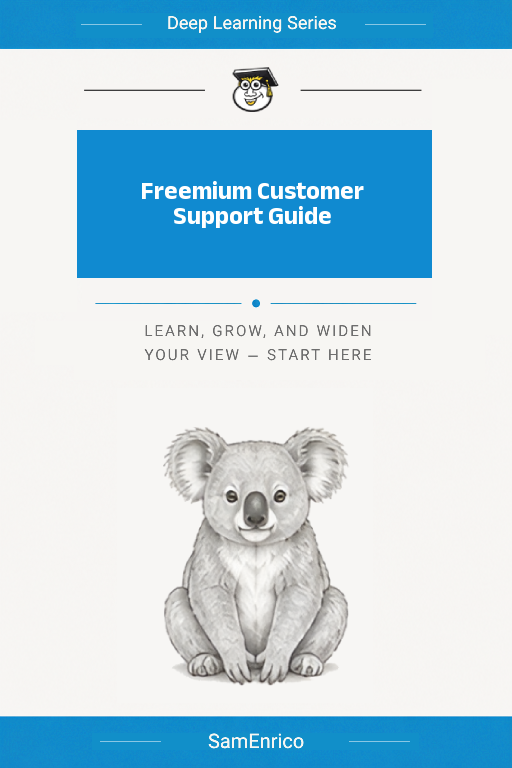
Freemium Customer Support Guide eBook
Offer offline FAQ, chatbot with limited intents, a
Offer offline FAQ, chatbot with limited intents, and email-based support for low-connectivity users.
Formats
Free sample
Chapter 1: The Freemium Death Spiral--–- When Rajiv Gupta, founder of a promising project management Saa S called Task Flow, walked into his board meeting in March 2019, he carried a spreadsheet that would haunt him for years. Task Flow had 850,000 free users. Their paid conversion rate was a respectable 4.2 percent. Revenue was growing 15 percent month over month. By every standard Saa S metric, Rajiv was winning.
Then the board asked a question that no one had prepared him for: "How much do our free users cost us in support?"Rajiv opened his laptop and revealed a number that emptied the room of its celebratory mood. Task Flow was spending 147,000permonthoncustomersupport.Ofthat,147,000 per month on customer support. Of that, 147,000permonthoncustomersupport.Ofthat,112,000—fully 76 percent—went to serving free users who had never paid a dollar and, according to cohort analysis, never would. The company employed eighteen full-time support agents, fourteen of whom spent most of their hours answering questions from people using the product for free. The average cost to resolve a single free-user ticket was $8.40.
The average lifetime value of a free user who never converted was, of course, zero.Task Flow was not alone. It was simply the first to run the numbers honestly.The Invisible Drain on Freemium Economics The freemium business model has produced some of the most valuable companies in software history. Spotify, Dropbox, Zoom, Slack, and Canva all grew their user bases into the hundreds of millions by offering a genuinely useful product for free, then converting a small percentage to paid plans. The math is seductive: acquire users at near-zero cost, let virality do its work, and convert 2 to 5 percent of them into paying customers who subsidize the rest.But there is a line item that almost every freemium founder forgets to model in their initial forecasts. It does not appear on standard Saa S dashboards.
Investors rarely ask about it during due diligence. And yet, it has killed more promising freemium startups than failed product-market fit ever did. That line item is customer support for free users.When a user signs up for a free plan, they gain access to features, storage, or functionality without exchanging money. But they also gain access to your support team. And human nature being what it is, the users who pay nothing often demand the most attention.
They have not invested financially, so they have less patience for self-service. They encounter the same bugs as paid users but generate tickets at twice the rate. They treat your support agents as proxies for product education, onboarding specialists, and sometimes even therapists.The problem is not that free users are malicious or entitled. The problem is structural. You have built a product that people use without paying, and you have built a support system that treats all users equally.
Those two decisions are fundamentally incompatible.Why Unlimited Live Chat Is the Fastest Path to Bankruptcy Let us be precise about the economics. A single live chat session, from first message to resolution, costs between 3and3 and 3and12 in agent time, depending on complexity and geography. If your support agents are in North America or Western Europe, you are closer to the high end. If you have outsourced to lower-cost regions, you are at the low end, but still not zero. Multiply that by the number of free users who initiate a chat.
A typical freemium product with 500,000 free users will generate, on average, 8,000 to 12,000 live chat sessions per month from free users alone. At 6persession,thatis6 per session, that is 6persession,thatis60,000 per month. Over a year, $720,000. For a startup that has not yet reached profitability, that number can be the difference between raising another round and shutting down.Live chat is expensive for three reasons that are not obvious to founders who have never managed a support organization. First, live chat demands real-time attention.
Unlike email, which can be batched and answered in order of priority, chat requires an agent to be present, focused, and responsive in the moment. That means agents cannot multitask efficiently. A single agent handling email can manage two to three times the ticket volume of an agent handling live chat. Second, live chat has a high cognitive switching cost. Every time an agent finishes a chat and moves to the next, they lose context and must reorient.
Email allows for deeper focus because interruptions are scheduled, not random. Third, live chat encourages scope creep. Users who have an agent's attention tend to ask follow-up questions, tangential issues, and sometimes completely unrelated problems. "While I have you on the line, can you also help me with…" is the most expensive sentence in freemium support.The solution is not to eliminate support for free users. That would be product suicide.
Free users are your acquisition engine, your word-of-mouth marketing, and your future paid customers. The solution is to fundamentally rethink what support means for users who do not pay.Resolution Autonomy: The Metric That Matters More Than Speed For the past decade, customer support leaders have been indoctrinated with a single obsession: speed. How fast do you answer the first message? How fast do you resolve the ticket? How fast do you close the loop?
These metrics emerged from the world of paid, enterprise software, where customers are paying thousands of dollars per month and expect white-glove treatment. They make sense in that context. A bank that pays $50,000 per year for fraud detection software has every right to demand a fifteen-minute response time.But freemium is not enterprise software. Your free users are not paying customers. They are not even customers yet.
They are prospects, evaluators, and sometimes free riders. Applying enterprise support metrics to freemium users is like applying Formula One pit stop standards to a family road trip. You are optimizing for the wrong thing.The metric that matters for freemium support is resolution autonomy—the percentage of user problems that are solved without any human intervention. When a free user encounters a problem and solves it by reading an offline FAQ, that resolution cost you nothing. When they ask a chatbot that successfully handles their intent, that resolution cost you pennies.
When they email support and receive an automated reply that contains a working link to the answer, that resolution cost you a fraction of a cent in server time. Only when they require a human-written email response do you incur significant cost. And you should never—under any circumstances—offer live chat to free users as a standard channel.Resolution autonomy is not about being unhelpful. It is about being strategic about where you deploy expensive human attention. A free user who cannot reset their password does not need a live agent.
They need a clear, offline-accessible FAQ entry with step-by-step instructions. A free user who wants to understand the difference between your free and paid plans does not need a chat session. They need a comparison table that loads instantly, even on a 2G connection. A free user who encounters a genuine bug that prevents core functionality does need a human—but that human can respond via email within 24 to 48 hours, not instantly.The shift from speed to autonomy requires retraining…
This is the end of the free sample. Get the eBook to keep going. Buy now
About this book
Details
- Author
- Talbott Katrice
- Publisher
- SamEnrico
- Language
- English
- Genre
- Non-Fiction, Business Brief, Support
- Released
- 2026-05-30
- Pages (approx.)
- 146
- Available as
- eBook, Audiobook

Read better in the ZLOADR app
Your eBooks on your phone or tablet. Sign in with your SamEnrico account and start reading.
More by Talbott Katrice
 Autoimmune Pregnancy LossTalbott Katrice$11.99
 Agency New Business GuideTalbott Katrice$11.99
 Housing Insecurity Self WorthTalbott Katrice$11.99
 Cocaine Craving ManagementTalbott Katrice$11.99
 The Listening Led Opener GuideTalbott Katrice$11.99
 Melatonin Rhythm GuideTalbott Katrice$11.99
 Assertiveness and EmpathyTalbott Katrice$11.99
 Professional Athlete GamblingTalbott Katrice$11.99
 The Silent Struggle: The First Fight for Equal Pay in SportsTalbott Katrice$11.99
 The Medici’s Alchemy: Gold, Genius, and the Birth of the RenaissanceTalbott Katrice$11.99
 A Collector's Handbook to the Daimler V8 250Talbott Katrice$11.99
 How to Produce Spot and Stain RemoverTalbott Katrice$11.99
You may also like
 Hong Kong Handover 1997Dunn Johnnie$11.99
 Zumba For Postnatal Recovery CourseNeal Christian$11.99
 Zumba for BeginnersLadner Nikia$11.99
 YouTube Comment Mining GuideHumes Pandora$12.99
 Worry Box MeditationCarlin Rudy$11.99
 Workplace Stress MeditationNguyen Lynn$11.99
 Workplace Stress and Sleep RepairHawley Ivory$11.99
 Workplace Perfectionism CureDelaney Jeffry$11.99
 Workplace Injustice Anger GuideWallen Isabelle$11.99
 Work Addiction and Burnout LinkGreenwood Ester$11.99
 Women in Yoga and WellnessBeattie Galina$11.99
 Women in Stand Up ComedyChun Evangeline$11.99