
Non-FictionFirst 30 DaysFreemium
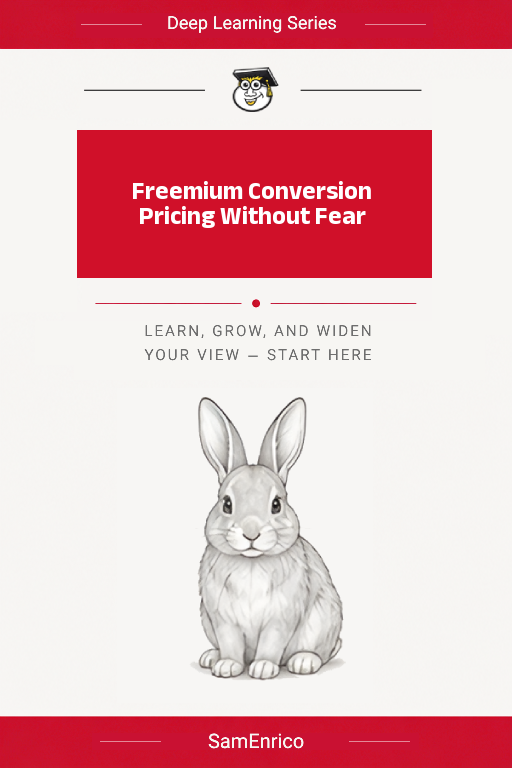
Freemium Conversion Pricing Without Fear eBook
Move free users to paid tiers using feature limits
Move free users to paid tiers using feature limits, usage caps, and time-limited trials effectively.
Formats
Free sample
Chapter 1: The Permission Asset--–- Every morning, thousands of founders open their analytics dashboards and feel a familiar pang of anxiety. They see thousands of free users actively using their product—creating projects, inviting teammates, uploading data—and yet their bank account tells a different story. The conversation in their head goes something like this: “These people are getting everything for free. When will they ever pay? Maybe we should start charging for more features.
Maybe we should kill the free tier entirely.”This fear is understandable. It is also completely wrong.The problem isn't that you have too many free users. The problem is that you don't have a system to convert them. Free users are not freeloaders. They are not your enemy.
They are, in fact, your greatest untapped asset—what I call the Permission Asset.This chapter will fundamentally reframe how you think about free. By the time you finish reading, you will stop apologizing for your free tier and start engineering it as the most powerful customer acquisition engine your business has ever seen.The Zero-Risk Bias: Why Your Brain Loves Free To understand why free is so powerful, we need to start with behavioral economics. In a series of famous experiments, researcher Dan Ariely demonstrated something that seems irrational but is consistently true: when something is free, our emotional response changes entirely.In one experiment, Ariely offered two types of chocolate: a high-quality Lindt truffle for 0.15andalow−quality Hershey′s Kissfor0.15 and a low-quality Hershey's Kiss for 0.15andalow−quality Hershey′s Kissfor0.01. At these prices, 73% of participants chose the Lindt truffle. The rational choice—better quality for only fourteen cents more—won the day.Then Ariely changed one thing.
He dropped the price of the Hershey's Kiss to $0.00. Free.Suddenly, 69% of participants chose the free Hershey's Kiss, even though it was objectively worse and the Lindt truffle was still an incredible deal at $0.15. The rational calculus disappeared. The word "free" triggered an emotional response that overrode logical decision-making.This is called the Zero-Risk Bias. Humans are hardwired to be loss-averse.
We feel the pain of a potential loss about twice as strongly as we feel the pleasure of an equivalent gain. A free product carries zero risk of loss. Even if it's worse, even if the paid alternative is clearly superior, free feels safe.This is not a bug in human psychology. It is a feature that you can use.Every time you put a price tag on your product—even $1—you introduce risk. The user must ask themselves: “Will this be worth the money?” That question creates friction.
That friction stops signups.When you offer a free tier, you remove that friction entirely. Users can sign up without asking permission from their brain's risk-assessment center. They can explore, experiment, and build habits before they ever have to make a financial decision.This is why free trials generate 3 to 10 times more signups than "lite" versions priced at even one dollar. It is why the world's most successful software companies—Spotify, Zoom, Canva, Slack, Dropbox—all have generous free tiers. They understand that the first job of pricing is not to extract value.
The first job of pricing is to remove barriers to entry.The Permission Asset: Reframing Your Free Users Here is where most founders go wrong. They look at a free user and see a cost center. A server bill. A support ticket waiting to happen. A freeloader.I want you to look at that same free user and see something entirely different: an asset.That free user has given you three things of immense value:First, their attention.
They are actively using your product. They are not scrolling past an ad or skimming an email. They are investing time and mental energy into your ecosystem. Attention is the scarcest resource in the digital economy, and your free users are giving it to you freely.Second, their behavioral data. Every click, every feature usage, every invitation they send—this is a treasure trove of information about what works and what doesn't.
You can see exactly which features drive retention, which usage patterns predict conversion, and where your product is falling short. Paid market research could never give you this level of insight.Third, their permission. They have given you their email address. They have agreed to receive communications from you. That is not a small thing.
In an era of spam filters and inbox zero obsession, permission to contact a user is a valuable asset. You can send them upgrade offers, feature announcements, and usage alerts. They have opted in.When you add these three things together—attention, data, permission—you realize that a free user is not a freeloader. A free user is a lead who has already raised their hand. They have already told you they are interested.
They have already started investing in your product.The only thing they haven't done is give you money. That is a conversion problem, not a free-tier problem.The Generosity Principle: Give Away Your Core Value If free users are assets, how should you treat them? The answer, counterintuitively, is with extreme generosity.Look at the most successful freemium companies in the world. They don't give away a cripped, useless version of their product. They give away the core value proposition.Spotify gives away unlimited streaming with ads.
Users can build playlists, follow artists, and create listening habits that become deeply embedded in their daily routines. The free tier is not a demo—it is a fully functional music service. The only friction is occasional ads and the inability to download songs for offline listening.Canva gives away over 250,000 templates, millions of free images, and powerful design tools that would have cost thousands of dollars a decade ago. Users can create professional-quality graphics without ever paying a cent. The free tier is so good that it has become the default design tool for non-designers around the world.Zoom gives away unlimited 40-minute calls with up to 100 participants.
That is enough to run most business meetings, family calls, and classroom sessions. The free tier does not feel like a trial—it feels like a complete product with a reasonable limit.Notice the pattern? These companies are not afraid to give away their core value. They understand that dependency drives conversion, not scarcity.A user who has built 50 playlists on Spotify is unlikely to switch to Apple Music, even if Apple Music offers a free trial. A team that has created 200 designs in Canva is unlikely to learn a new design tool.
A business that has run 500 Zoom meetings with the same link is unlikely to migrate to Google Meet.The free tier creates switching costs. Every action a user takes in your product—every project they create, every teammate they invite, every file they upload—makes it harder for them to leave. By the time they hit your usage cap or need a premium feature, leaving feels expensive. Not because you have locked their data, but because they have invested time, attention, and mental energy.This is the Generosity Principle: give away enough value to create genuine dependency, then monetize through scale, premium features, or enterprise upsells.The Free-to-Paid Funnel…
This is the end of the free sample. Get the eBook to keep going. Buy now
About this book
Details
- Author
- Keeling Kathlyn
- Publisher
- SamEnrico
- Language
- English
- Genre
- Non-Fiction, First 30 Days, Freemium
- Released
- 2026-05-29
- Pages (approx.)
- 117
- Available as
- eBook, Audiobook

Read better in the ZLOADR app
Your eBooks on your phone or tablet. Sign in with your SamEnrico account and start reading.
More by Keeling Kathlyn
 Pre Talk Journaling ProtocolKeeling Kathlyn$11.99
 Delegation Cost AnalysisKeeling Kathlyn$11.99
 Sitting Meditation MBSR GuideKeeling Kathlyn$11.99
 IBD Fatigue ProtocolKeeling Kathlyn$11.99
 Shadows of the Commission: The Beirut Hostage Rescue That Shook the UnderworldKeeling Kathlyn$11.99
 How to Produce Cash Registers and Pos TerminalsKeeling Kathlyn$11.99
 10 Ways to Use Almond Bark (Recipe Book)Keeling Kathlyn$11.99
 Mordenite MiningKeeling Kathlyn$11.99
You may also like
 Hong Kong Handover 1997Dunn Johnnie$11.99
 Zumba For Postnatal Recovery CourseNeal Christian$11.99
 Zumba for BeginnersLadner Nikia$11.99
 YouTube Comment Mining GuideHumes Pandora$12.99
 Worry Box MeditationCarlin Rudy$11.99
 Workplace Stress MeditationNguyen Lynn$11.99
 Workplace Stress and Sleep RepairHawley Ivory$11.99
 Workplace Perfectionism CureDelaney Jeffry$11.99
 Workplace Injustice Anger GuideWallen Isabelle$11.99
 Work Addiction and Burnout LinkGreenwood Ester$11.99
 Women in Yoga and WellnessBeattie Galina$11.99
 Women in Stand Up ComedyChun Evangeline$11.99