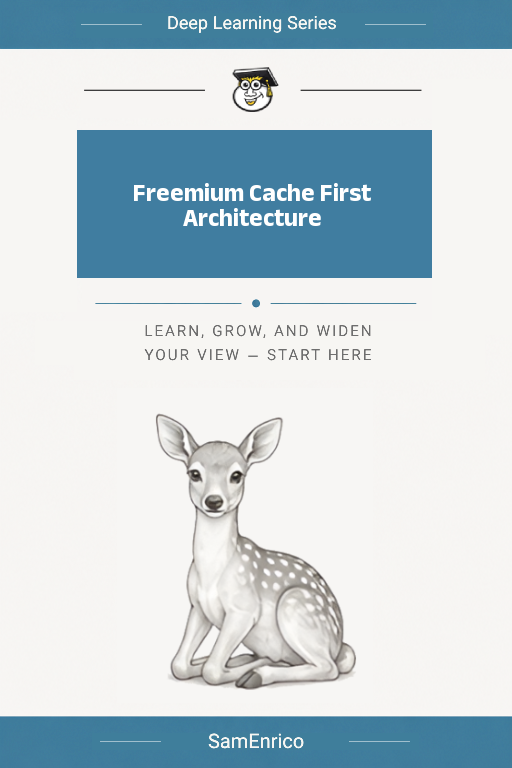
Freemium Cache First Architecture eBook
Build cache-first freemium apps serving stale data
Build cache-first freemium apps serving stale data during disconnection. Refresh when online and let users interact without internet dependency.
Formats
Free sample
Chapter 1: The 84% Tipping Point--–- The phone felt like a brick. Sarah, a product manager heading into the subway, had exactly twelve minutes to review the analytics dashboard before her meeting with the executive team. She opened the app. The spinner appeared. White screen.
"No Internet Connection." She tried again. Same result. By the time she emerged from the underground, she had already downloaded a competitor's app that worked offline. She never opened the original again.This story repeats itself 84 times out of every 100 users after just two failed loading attempts. Not three.
Not five. Two.The data comes from Google's internal research on mobile web abandonment, subsequently validated by dozens of independent studies across e-commerce, Saa S, and media applications. The pattern is so consistent that it has earned a name in product circles: the Two-Strike Rule. Users will forgive one failure as bad luck. The second failure is a betrayal of trust.
By the third failure, they have already left, and they are telling their colleagues about their negative experience.The Spinning Wheel Is Not a Technical Problem Engineers have been trained to think of network failures as edge cases. "Assume reliable connectivity" is baked into every tutorial, every boilerplate project, every default configuration. The implicit promise of cloud computing is that the network is always there, always fast, always reliable. This promise is a lie.Consider the reality of modern connectivity. A user in New York City experiences dead zones in subway tunnels, elevators, and basement offices.
A user in rural Kansas experiences variable LTE that drops to 2G. A user on an airplane experiences no connectivity at all for hours. A user in a coffee shop experiences unreliable public Wi Fi that requires a captive portal login. A user in a developing economy experiences intermittent connectivity measured in minutes of uptime per hour.The sum total is this: every application that assumes continuous connectivity is an application that will fail for every user, eventually. The question is not whether your app will encounter a network failure.
The question is whether your app will survive it.The Hidden Cost of the Spinning Wheel Most product teams understand that network failures cause user frustration. What they do not understand is the magnitude of the business impact. The 84% abandonment statistic is not an abstract metric. It is a direct drain on every growth lever a business has.Acquisition costs are the first casualty. Every dollar spent on user acquisition is wasted if the user cannot complete their first session due to a network hiccup.
If your paid acquisition campaign costs 3perinstalland843 per install and 84% of users abandon after two failures, your effective cost per retained user skyrockets. A 3perinstalland843 CPI becomes effectively $18.75 for a retained user—assuming the user ever returns.Retention curves are the second casualty. The standard Saa S retention curve shows steep drop-off in days 1, 7, and 30. Network failures accelerate this drop-off dramatically. A user who experiences a single network failure in their first week is 3x more likely to churn than a user who does not.
A user who experiences two failures is 7x more likely to churn.Conversion rates are the third casualty. Freemium businesses depend on converting free users to paid subscribers at predictable rates. Network failures disrupt the conversion funnel at every stage. A user who cannot load the pricing page will not upgrade. A user who cannot complete the purchase flow due to a network timeout will abandon the transaction.
A user who upgrades but then sees "still free" due to a sync failure will request a refund and never return.The Paradigm Shift: From Online-First to Cache-First The traditional architecture of mobile and web applications is Online-First. In this model, the cloud is the source of truth. The device is a thin client that displays whatever the server sends. Every user action triggers a network request. Every screen load waits for a server response.
This architecture worked reasonably well in the era of reliable broadband and unlimited data plans. That era is over.Cache-First architecture inverts this relationship. The device becomes the source of truth. The cloud becomes a replica—a backup copy that exists for synchronization, not for authority. Every user action writes to the local database first, updates the UI instantly, and queues the network request for later.
Every screen load reads from the local database first, displaying whatever is available, and updates from the network in the background.The difference is not incremental. It is transformational.In Online-First architecture, latency is a UX problem. The user waits. In Cache-First architecture, latency is a design assumption. The user never waits because the data is already there.
The network is for synchronization, not for rendering.The Whats App Precedent In 2014, Whats App was acquired for $19 billion. At the time, it had 450 million monthly active users and a team of only 55 engineers. The company's most valuable technical asset was not its encryption or its protocol. It was its cache-first architecture.Whats App was built for India, Brazil, and Indonesia—markets where 2G networks were the norm and connectivity was measured in minutes of uptime per hour. The application stored every message locally before attempting to send it.
The user interface updated instantly when a message was typed and sent. The network layer worked in the background, retrying failed deliveries with exponential backoff. Users never saw a "sending..." spinner. They saw "sent" instantly, and the app handled the rest.The result was an application that worked everywhere, for everyone, regardless of network quality. Whats App grew to billions of users not because it had better features than its competitors, but because it was the only messaging app that never failed.
In a world of unreliable networks, reliability became the killer feature.The Freemium Connection Freemium businesses face a unique version of the network problem. Free users generate no direct revenue but consume server resources with every API call. A free user who opens the app every day, loads the home screen, refreshes the feed, and views content generates hundreds of server requests per month. Multiply by millions of free users, and the server bill becomes unsustainable.The traditional solution is to rate-limit free users or degrade their experience. This solves the cost problem but creates a product problem.
Free users become frustrated and churn before ever converting to paid.Cache-First architecture offers a third path. Free users can be served almost entirely from local cache. The 95% Rule, introduced in Chapter 2, states that 95% of free user read operations should never hit the origin server. The device stores content locally, serves it instantly, and revalidates in the background on Wi Fi. The result is a free user experience that is faster than a paid user experience on a traditional architecture, while costing nearly nothing in server resources.This is the economic engine of modern freemium.
Free users become a sustainable acquisition channel rather than a cost center. The server bill scales with paying users, who generate revenue. Free users scale with cache storage, which is free.The Core Inversion Every architecture decision flows from a single question: where is the source of truth?Online-First answers: the cloud. The device asks permission to do anything. The device…
This is the end of the free sample. Get the eBook to keep going. Buy now
About this book
Details
- Author
- Fulton Evelin
- Publisher
- SamEnrico
- Language
- English
- Genre
- Non-Fiction, Business Brief, Caching
- Released
- 2026-05-30
- Pages (approx.)
- 127
- Available as
- eBook, Audiobook

Read better in the ZLOADR app
Your eBooks on your phone or tablet. Sign in with your SamEnrico account and start reading.
More by Fulton Evelin
 NVC For Executive TeamsFulton Evelin$11.99
 The Missionary's DaughterFulton Evelin$11.99
 Merger Acquisition BankerFulton Evelin$11.99
 Oil Rig Driller Stress GuideFulton Evelin$11.99
 The Golden Hooves of Athens: Pheidippides and the Sacred Mares of the ParthenonFulton Evelin$11.99
 How to Produce Bird Cage Food and Water DishesFulton Evelin$11.99
 Animal Control DispatcherFulton Evelin$11.99
 How to Become a Glass-cutter HelperFulton Evelin$11.99