
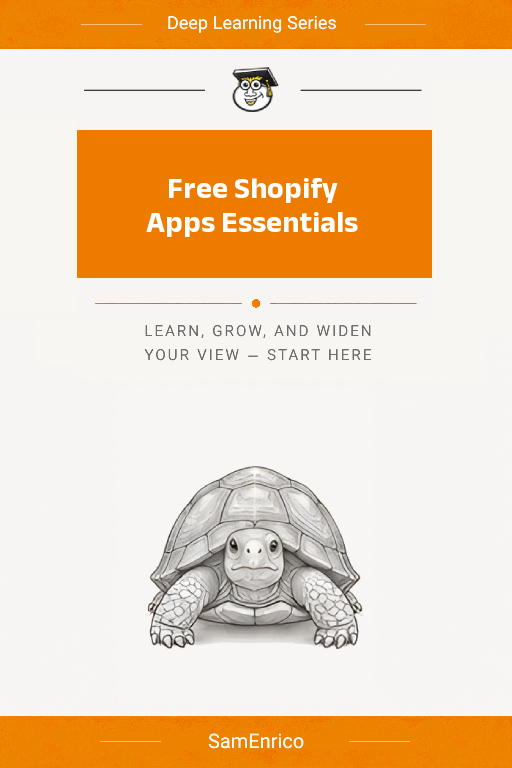
Free Shopify Apps Essentials eBook
Use only free apps for email popups reviews and cu
by Croft Neva
Use only free apps for email popups reviews and currency conversion.
Formats
Free sample
Chapter 1: The Free Paradox...--–- When Maria launched her skincare brand last January, she did what every successful entrepreneur on You Tube told her to do. She installed Klaviyo for email (45/month),Looxforreviews(45/month), Loox for reviews (45/month),Looxforreviews(29/month), and Bold Multi-Currency (29/month).Totalmonthlyappbill:29/month). Total monthly app bill: 29/month).Totalmonthlyappbill:103. Within six months, she was paying 247monthlyafter"necessary"upgrades.Herstorewasslow,herprofitmarginswereshrinking,andshewasnoclosertoherfirst247 monthly after "necessary" upgrades. Her store was slow, her profit margins were shrinking, and she was no closer to her first 247monthlyafter"necessary"upgrades.Herstorewasslow,herprofitmarginswereshrinking,andshewasnoclosertoherfirst10,000 month than when she started.
Meanwhile, her competitor—a one-woman operation in Nebraska—was doing $18,000 monthly using exactly zero paid apps. Maria's story is not unusual. It is the silent epidemic of the Shopify ecosystem: the belief that you must spend money to make money, even when the tools you need exist for free.This book exists because that belief is wrong.The $2,400 Mistake Let me tell you about my own 2,400mistake.Inmyfirstyearon Shopify,Ipaidforevery"essential"appthatgurusrecommended.Ididn′tquestionit.Iassumedthatifanappcostmoney,itmustbebetter.Iwasterrifiedoflooking"unprofessional"byusingfreetools.Lookingback,thatfearcostme2,400 mistake. In my first year on Shopify, I paid for every "essential" app that gurus recommended. I didn't question it.
I assumed that if an app cost money, it must be better. I was terrified of looking "unprofessional" by using free tools. Looking back, that fear cost me 2,400mistake.Inmyfirstyearon Shopify,Ipaidforevery"essential"appthatgurusrecommended.Ididn′tquestionit.Iassumedthatifanappcostmoney,itmustbebetter.Iwasterrifiedoflooking"unprofessional"byusingfreetools.Lookingback,thatfearcostme2,400—money I could have spent on inventory, ads, or simply kept as profit.The wake-up call came during Black Friday. A friend of mine, running a similar store, outsold me 3-to-1. We had the same theme, similar products, and comparable ad spend.
The only difference? She used free apps for everything while I was paying $200+ monthly. Her site loaded faster. Her popups converted better. And she had zero monthly bills eating into her margins.That night, I audited every paid app I was using.
What I discovered shocked me: over 80% of the features I was paying for, I never touched. The remaining 20% were available in free alternatives with minimal trade-offs. I had been paying for convenience, not capability. I had been paying for the illusion of professionalism, not actual performance.The App Industrial Complex Here is what the gurus won't tell you: the Shopify app ecosystem has evolved into a massive recurring revenue machine. App developers have mastered the art of the "freemium funnel"—offer just enough value for free to get you hooked, then charge for features that should be basic.
But here is the dirty secret: most of those "premium" features are psychological upsells, not performance drivers.Consider the average paid email popup app. They will charge you 29monthlyfor"advancedtargeting."Whatdoesthatinclude?Exit−intentdetection,timedelays,andscrolltriggers.Alloftheseareavailableinfreeapps.Theywillchargeanother29 monthly for "advanced targeting." What does that include? Exit-intent detection, time delays, and scroll triggers. All of these are available in free apps. They will charge another 29monthlyfor"advancedtargeting."Whatdoesthatinclude?Exit−intentdetection,timedelays,andscrolltriggers.Alloftheseareavailableinfreeapps.Theywillchargeanother19 for "A/B testing." You can run A/B tests manually with Google Analytics for free.
They will charge $49 for "segmentation." Shopify's native customer tagging does this for free.The pattern repeats across every category. Paid review apps charge for "photo reviews" and "video reviews"—features that free apps now include as standard. Paid currency converters charge for "auto-detection" and "rounded pricing"—both available in free tiers. The only real difference is marketing budgets and fear-based selling.The Three-Category Rule Throughout this book, we will follow a simple principle that I call the Three-Category Rule. You only need three types of apps to build a high-converting international store:Email popups – To capture the 97% of visitors who leave without buying Customer reviews – To provide social proof and SEO benefits Currency conversion – To sell internationally without confusing customers That is it.
You do not need a separate wishlist app. You do not need a separate upsell app. You do not need a separate trust badge app. Every additional app you install slows your store, complicates your life, and increases your monthly bill.But here is the critical clarification that most books get wrong: three categories does not mean three apps total forever. It means one app per category at any given time.
You might evaluate two different popup apps before choosing one. You might switch from one review app to another as your needs change. But you should never have two popup apps installed simultaneously. That creates conflicts, duplicates functionality, and slows your store unnecessarily.Why Free Apps Often Outperform Paid Ones Let me share a counterintuitive truth: free apps often perform better than paid alternatives for early-stage stores. Here is why.Forced Discipline.
When you pay for an app, you feel entitled to use every feature. You enable exit-intent popups, spin-to-win wheels, countdown timers, and floating announcement bars all at once. Your store becomes a carnival of distractions. Free apps, with their simpler feature sets, force you to focus on what actually works. You cannot afford to be distracted by shiny objects because there are no shiny objects.Lighter Code.
Free apps have commercial incentive to stay lean. They know you can leave anytime with zero financial penalty. Paid apps, especially expensive ones, assume you will tolerate bloat because you are locked into a subscription. This is why many paid apps add hundreds of milliseconds of load time while free alternatives add thirty or forty.Better Alignment. Free apps survive by earning your loyalty through performance, not contracts.
Their developers know that the only way to convert you to a paid plan is to prove value first. Paid apps, especially those with long-term contracts, can afford to be mediocre because leaving is a hassle.The Math of Freemium Understanding how free apps make money is essential to using them effectively. Most free apps operate on one of three models:The Limited Tier Model. The app is free up to a certain usage limit (e.g., 10,000 popup views per month, 50 review requests, 5 currencies). Beyond that, you pay.
For most new stores, these limits are generous. A store doing 5,000 monthly visitors will never hit a 10,000-view cap. A store with 100 monthly orders will never hit a 500-review-request cap. The limits are designed to catch scaling stores, not punish beginners.The Branded Upgrade Model. The app is fully functional for free but includes small branding (e.g., "Powered by [App Name]").
You pay to remove the branding. This is the most honest model. You get full functionality forever at zero cost, and the developer gets exposure. For most store owners, a small "Powered by" line in the footer is a reasonable trade-off for saving $30 monthly.The Feature-Gated Model. Basic features are free; advanced features are paid.
This is the most common model and the one requiring the most careful evaluation. You must distinguish between "advanced features you will never use" (e.g., multi-language review forms) and "basic features that should be free" (e.g., photo reviews). This book will teach you that distinction.Real-World Case Study: From 0to0 to 0to50,000 Monthly Let me introduce you to Sarah. She runs a store selling sustainable home goods. When she started, she had exactly 500instartupcapital.Shecouldnotafford500 in startup capital.
She could not afford 500instartupcapital.Shecouldnotafford200 in monthly app fees. So she committed to the free stack.She installed Convercy for currency…
This is the end of the free sample. Get the eBook to keep going. Buy now
About this book
Details
- Author
- Croft Neva
- Publisher
- SamEnrico
- Language
- English
- Genre
- Non-Fiction, First 30 Days
- Released
- 2026-05-30
- Pages (approx.)
- 142
- Available as
- eBook, Audiobook

Read better in the ZLOADR app
Your eBooks on your phone or tablet. Sign in with your SamEnrico account and start reading.
More by Croft Neva
 CRE Investor Tax DeductionsCroft Neva$11.99
 Grief Journal For Complicated LossCroft Neva$11.99
 1031 Exchange Drop and Swap StrategyCroft Neva$11.99
 Meth Recovery Nutrition HandbookCroft Neva$11.99
 Reed Hastings NetflixCroft Neva$11.99
 Pattern Recognition for BusinessCroft Neva$11.99
 Resume Singapore GuideCroft Neva$11.99
 Female Veteran Master GuideCroft Neva$11.99
 Cedar Sauna RelaxationCroft Neva$11.99
 The Unstoppable Rise: How a Teenage Girl Defied the Odds and Won the World CupCroft Neva$11.99
 Silk and Secrets: The Bribery That Built VeniceCroft Neva$11.99
 Dust to Gold: The Untold Story of the Dust Bowl's Last Living WitnessCroft Neva$11.99
You may also like
 Website Launch For New LLCStrunk Tracee$12.99
 Shopify Market Expansion GuideGaffney Jude$12.99
 Power Backup Solutions for Philippine VAsPearce Eldon$12.99
 Feedback License Clause TemplateCrum Ashli$12.99Feedback License Clause TemplateCrum Ashli$12.99Feedback License Clause TemplateCrum Ashli$12.99Feedback License Clause TemplateCrum Ashli$12.99Feedback License Clause TemplateCrum Ashli$12.99Feedback License Clause TemplateCrum Ashli$12.99Feedback License Clause TemplateCrum Ashli$12.99Feedback License Clause TemplateCrum Ashli$12.99
 Channel Distribution On One PagePetersen Narcisa$12.99