
Non-FictionSelf-Help / Consumer
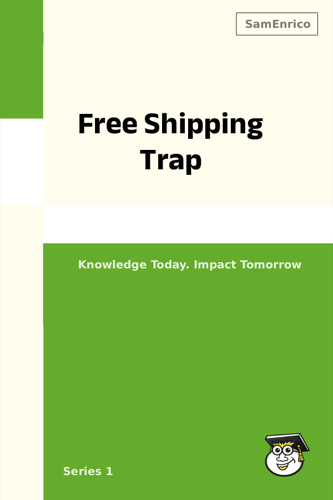
Free Shipping Trap eBook
Stops adding unnecessary items to qualify for free
Stops adding unnecessary items to qualify for free delivery.
Formats
Free sample
Chapter 1: The Six-Dollar Lie--–- I once bought a sixty-dollar air fryer to save six dollars and ninety-nine cents in shipping. I did not need an air fryer. I did not want an air fryer. I had never once in my thirty-eight years of existence said to myself, “You know what would improve my life? A miniature convection oven that takes up counter space and requires its own dedicated cleaning brush.” And yet, there it was.
Ordered. Paid for. Delivered. Unopened for eleven months. Finally donated to a thrift store with the original styrofoam still intact.That air fryer cost me sixty dollars.
It cost me the mental energy of looking at it every day. It cost me the guilt of knowing I had been outsmarted by a checkout screen. And it cost me something far more insidious than money: the quiet, creeping realization that I could not trust my own brain when a progress bar told me I was “only $6.99 away from FREE shipping.”This book exists because of that air fryer. And because of the garlic press I bought the month before. And the magnetic spice tins that didn’t fit my spice rack.
And the three identical phone cases, still in their original packaging, that I discovered while moving apartments. Every single one of those purchases shared a common origin story. I didn’t want the item. I wanted the free shipping. The item was just the price I paid to get it.If you are reading this, you already know exactly what I am talking about.
You have been there. Maybe last week. Maybe this morning. You added a necessary item to your cart—a coffee maker, a winter coat, a replacement charger for your laptop. The price was reasonable.
You were ready to click “checkout.” Then you saw it. That little progress bar. That irresistible, infuriating, brilliantly designed progress bar.“You are $12.50 away from FREE shipping.”And something inside you shifted. The rational part of your brain—the part that manages your budget, tracks your savings goals, and knows exactly how much clutter you already own—whispered, “Just pay the shipping. It’s seven dollars.
You’ll spend more than that on lunch tomorrow.” But another part of your brain, a louder and more persuasive part, answered back: “Why would you throw away seven dollars? That’s stupid. Just add one small thing. You’ll use it eventually.”So you added something. Maybe a phone case.
Maybe a pack of pens. Maybe a silicone baking mat that you saw on Tik Tok and thought looked satisfying to peel. And in that moment, you felt something that retailers have spent billions of dollars to manufacture: you felt smart. You had beaten the system. You had gotten your coffee maker AND free shipping AND a bonus item, all for just a few extra dollars.Except you didn’t beat the system.
The system beat you. And it beats you every single time.The Anatomy of a Six-Dollar Lie Let me show you the math that the progress bar does not want you to see.You need a coffee maker. It costs $28. You are $7 away from free shipping. You add a $12 phone case that you don’t need.
Your total is now $40. You have “saved” $6.99 in shipping. Congratulations? No. Here is what actually happened.You spent $12 to save $6.99.
Your net loss is $5.01. And you now own a phone case that will sit in a drawer until you move, at which point you will throw it away or donate it. You did not save money. You lost money. You also lost drawer space.
You also lost the time you will eventually spend looking at that phone case and feeling mildly annoyed at yourself.The retailers call this the “Free Shipping Threshold” or FST. I call it the Six-Dollar Lie, because that’s the typical spread between the cheapest filler item and the actual shipping cost. Six dollars. That’s all it takes to trick your brain into spending twelve, fifteen, or twenty dollars more than you intended.But the lie goes deeper than simple arithmetic. The lie lives in your psychology.
And to understand why we fall for it again and again—even after we know better—we have to understand how the brain processes spending and saving in two completely different ways.The Two Bank Accounts in Your Head Behavioral economists have known for decades that humans don’t treat all money equally. We use something called “mental accounting,” which is a fancy term for a very simple phenomenon: we put money into different mental buckets, and we treat each bucket differently.Money in your checking account feels different from money in your savings account. A twenty-dollar bill feels different from a twenty-dollar credit card swipe. A five-dollar monthly subscription feels different from a sixty-dollar annual payment, even though they cost the same. These distinctions aren’t logical, but they are real.
And retailers know exactly how to exploit them.Here is the specific mental accounting trick that makes the Free Shipping Threshold so effective. When you see “Add $12.50 for FREE shipping,” your brain does something remarkable. It categorizes the shipping cost as a “loss” and categorizes the filler item as a “purchase.” And your brain hates losses much more than it enjoys purchases. In fact, behavioral economists have quantified this asymmetry. Losses hurt about twice as much as equivalent gains feel good.
Psychologists call this “loss aversion,” and it is one of the most replicable findings in the history of social science.So when you face a choice between paying $6.99 for shipping (a certain loss) or spending $12 on a filler item (a purchase that also eliminates the loss), your brain chooses the filler item every time. Not because it’s rational. Because it’s painful to accept a loss, and easy to justify a purchase that makes the loss disappear.The retailers have built their entire checkout experience around this single cognitive bias. They don’t want you to think about whether you need the filler item. They want you to think about whether you want to “lose” six dollars to shipping.
And because loss aversion is so powerful, you will almost always choose to spend more money to avoid the feeling of losing.The Progress Bar Is a Slot Machine Let me tell you about a study that changed how I think about online shopping. In 2018, a team of researchers at the University of Southern California analyzed the checkout behavior of over 5,000 online shoppers. They found something astonishing: shoppers were significantly more likely to add a filler item when the progress bar showed a specific visual cue—a moving animation that filled the bar from left to right as they approached the threshold.The researchers called this the “goal gradient effect.” It’s the same psychological mechanism that makes you walk faster when you’re almost at the finish line of a race. It’s why loyalty cards give you two free stamps to start. It’s why video games show experience bars filling up as you approach the next level.
When you can see progress toward a goal, you accelerate your effort to reach it.The checkout progress bar is not…
This is the end of the free sample. Get the eBook to keep going. Buy now
About this book
Details
- Author
- Ames Brittaney
- Publisher
- SamEnrico
- Language
- English
- Genre
- Non-Fiction, Self-Help / Consumer
- Released
- 2026-06-08
- Pages (approx.)
- 128
- Available as
- eBook, Audiobook

Read better in the ZLOADR app
Your eBooks on your phone or tablet. Sign in with your SamEnrico account and start reading.
More by Ames Brittaney
 Pitta Cooling Healing GuideAmes Brittaney$11.99
 Zero Hour Decision MakingAmes Brittaney$11.99
 The Anger and Exercise GuideAmes Brittaney$11.99
 Incontinence Caregiving RealityAmes Brittaney$11.99
 The Self Ban Success GuideAmes Brittaney$11.99
 Low Sodium Cooking GuideAmes Brittaney$11.99
 Situational ExposureAmes Brittaney$11.99
 The Healers of Nubia: Ancient Medicine and the Secrets of the NileAmes Brittaney$11.99
 The Silent Architects: Rome's Forgotten InnovatorsAmes Brittaney$11.99
 How to Produce Hole SawsAmes Brittaney$11.99
 A Collector's Handbook to the Ford Corsair V4Ames Brittaney$11.99
 Mastering The Art of Yuejiaquan (岳家拳) Yue Family Fist/boxingAmes Brittaney$11.99
You may also like
 Hong Kong Handover 1997Dunn Johnnie$11.99
 Zumba For Postnatal Recovery CourseNeal Christian$11.99
 Zumba for BeginnersLadner Nikia$11.99
 YouTube Comment Mining GuideHumes Pandora$12.99
 Worry Box MeditationCarlin Rudy$11.99
 Workplace Stress MeditationNguyen Lynn$11.99
 Workplace Stress and Sleep RepairHawley Ivory$11.99
 Workplace Perfectionism CureDelaney Jeffry$11.99
 Workplace Injustice Anger GuideWallen Isabelle$11.99
 Work Addiction and Burnout LinkGreenwood Ester$11.99
 Women in Yoga and WellnessBeattie Galina$11.99
 Women in Stand Up ComedyChun Evangeline$11.99