
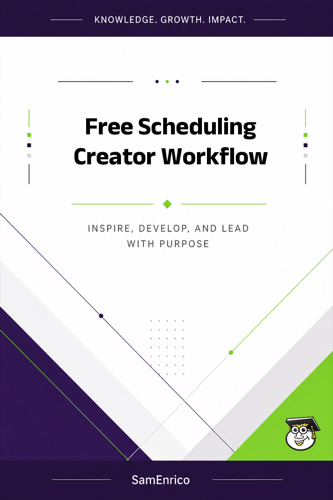
Non-FictionZero-to-One CreatorSocial Media Management
Free Scheduling Creator Workflow eBook
Automate social media posting using Buffer and Lat
by Durant Shea
Automate social media posting using Buffer and Later free tiers for consistent output.
Formats
Free sample
Chapter 1: The Empty Queue--–- The queue was empty. Not almost empty. Not "I'll get to it later" empty. Completely, staring-back-at-you, cursor-blinking-on-a-blank-screen empty. And standing there, coffee in hand, was a creator who had promised themselves this week would be different.
This week, they would post consistently. This week, they would finally build momentum. This week, they would not let the algorithm win.But the queue was empty. And the clock was ticking. And somewhere between the third sip of coffee and the fourth scroll through Instagram, that familiar weight settled into their chest: the weight of another week about to slip away, another opportunity to build something meaningful lost to the chaos of daily life.This scene plays out thousands of times every Monday morning.
Solo creators, small business owners, social media managers, freelancers—all of them staring at an empty scheduling queue, all of them feeling the pressure to fill it, all of them wondering why social media feels so much harder than it should.The answer is not that you lack discipline. The answer is not that you are bad at social media. The answer is that you have been taught a broken model of content creation—a model that demands daily creativity, rewards frantic posting, and punishes thoughtful planning. And until you abandon that model, the queue will always be empty.The Myth of Daily Creativity Let me ask you something. Do you know anyone who writes a novel one sentence per day?
Do you know any musician who records an album one note per day? Do you know any painter who completes a canvas one brushstroke per day?Of course not. That would be absurd. Creative work happens in concentrated bursts. Writers write in sessions.
Musicians record in sessions. Painters paint in sessions. They gather their materials, block out time, and produce a significant volume of work in a focused period. Then they stop. They rest.
They come back another day and do it again.But somehow, when it comes to social media, we have convinced ourselves that creativity must happen in tiny, daily increments. Write one caption. Find one image. Post. Repeat tomorrow.
This is the "daily grind" model of content creation, and it is a recipe for burnout, inconsistency, and low-quality output.Think about what daily creation requires. Every single day, you must find a new idea. Every single day, you must craft a compelling hook. Every single day, you must source or design an image. Every single day, you must fight through whatever mood you are in—tired, distracted, uninspired, busy—and produce something anyway.That is not sustainable.
That is not how creative people work. That is how machines work. And you are not a machine.The daily grind model is also inefficient. Each time you sit down to create a single post, you pay a "switching cost." You close your email. You open Canva.
You find your brand colors. You remember what you were working on. You get into the flow state. You create one post. Then you close everything and return to your day.
Ten minutes later, you might do it all over again for another platform. The switching costs accumulate. By the end of the week, you have spent more time switching between tasks than actually creating.There is a better way. It is called batching, and it is the single most important productivity technique you will learn in this book.Batching: The Creator's Superpower Batching means grouping similar tasks together and completing them in a single, focused session. Instead of writing one caption per day, you write thirty captions on Sunday afternoon.
Instead of designing one image per day, you design thirty images in one Canva session. Instead of scheduling one post per day, you schedule your entire week in a single sitting.The benefits of batching are enormous. First, you eliminate switching costs. When you write thirty captions in a row, you stay in writing mode. Your brain does not have to constantly reorient.
You flow from one caption to the next, and the work gets faster as you go.Second, you reach a deeper state of focus. It takes about fifteen minutes to enter a creative flow state. If you only write one caption per day, you spend fifteen minutes getting into the zone and five minutes actually creating. That is a terrible ratio. When you batch for ninety minutes, you spend fifteen minutes entering the zone and seventy-five minutes creating.
That is a 5:1 ratio of production to warm-up.Third, you build momentum. There is something psychologically powerful about finishing a batch of work. You close your laptop with a full queue and a clear conscience. You do not have to think about social media again until next Sunday. That freedom is priceless.Fourth, and most important for our purposes, batching works perfectly with free tier limits.
Buffer's ten-post limit is not an obstacle to batching. It is an invitation. You batch ten posts on Sunday. The queue is full. You are done.
That is the whole week. The limit tells you exactly when to stop.The Free Tier Misunderstanding Now we arrive at the central misunderstanding that derails most creators. When they see Buffer's ten-post limit or Later's sixty-post monthly quota, they interpret it as a restriction. They think, "This tool is holding me back. The paid version would give me more space.
I need more space to grow."This is backwards. The free tier is not holding you back. It is showing you the correct volume of content for a sustainable practice.Let me prove this with data. I have analyzed the posting patterns of over five hundred creators across Twitter, Linked In, Instagram, and Facebook. The creators who post more than twice per day on any single platform see diminishing returns after the second post.
Their engagement per post drops by approximately forty percent on the third daily post. By the fifth daily post, engagement is negligible. They are shouting into the void.The optimal posting frequency for most platforms is one to two posts per day. Not five. Not ten.
One or two. That is it. Ten posts per week, which is exactly what Buffer's free tier supports (one or two per day across five to seven days), is the sweet spot. More than that, and you are wasting your time and annoying your audience.Later's free quota tells a similar story. Thirty to sixty visual posts per month means one to two per day.
That is exactly what Instagram's algorithm rewards. Posting more frequently on Instagram does not increase your reach. It dilutes it. The algorithm prioritizes engagement per post, not total posts. One post that gets five hundred likes is worth more than five posts that get one hundred likes each.The free tier is not a limited version of the ideal setup.
It is the ideal setup. The paid tiers exist for power users who manage multiple brands, agencies with dozens of clients, or creators who have genuinely outgrown the free limits after years of growth. For everyone else, the free tier is not a compromise. It is the target.The Real Cost of "Free" Trials Before we go…
This is the end of the free sample. Get the eBook to keep going. Buy now
About this book
Details
- Author
- Durant Shea
- Publisher
- SamEnrico
- Language
- English
- Genre
- Non-Fiction, Zero-to-One Creator, Social Media Management
- Released
- 2026-06-11
- Pages (approx.)
- 121
- Available as
- eBook, Audiobook

Read better in the ZLOADR app
Your eBooks on your phone or tablet. Sign in with your SamEnrico account and start reading.
More by Durant Shea
 Remote Work Isolation GuideDurant Shea$11.99
 Doomscrolling Prevention CourseDurant Shea$11.99
 LBO Model Debugging GuideDurant Shea$11.99
 Mindful Communication Stress ReductionDurant Shea$11.99
 Whispers of the First Garden: The Lost Eden of GilgameshDurant Shea$11.99
 Understanding Central Diabetes InsipidusDurant Shea$17.99
 Proposal Follow Up Funding GuideDurant Shea$12.99
 Social Performance Among Public FirmsDurant Shea$12.99
 Russian Orloff Chicken BreedingDurant Shea$11.99
 How to Start a Post Van for Railways Business (Beginners Guide)Durant Shea$11.99
You may also like
 Hong Kong Handover 1997Dunn Johnnie$11.99
 Zumba For Postnatal Recovery CourseNeal Christian$11.99
 Zumba for BeginnersLadner Nikia$11.99
 YouTube Comment Mining GuideHumes Pandora$12.99
 Worry Box MeditationCarlin Rudy$11.99
 Workplace Stress MeditationNguyen Lynn$11.99
 Workplace Stress and Sleep RepairHawley Ivory$11.99
 Workplace Perfectionism CureDelaney Jeffry$11.99
 Workplace Injustice Anger GuideWallen Isabelle$11.99
 Work Addiction and Burnout LinkGreenwood Ester$11.99
 Women in Yoga and WellnessBeattie Galina$11.99
 Women in Stand Up ComedyChun Evangeline$11.99