
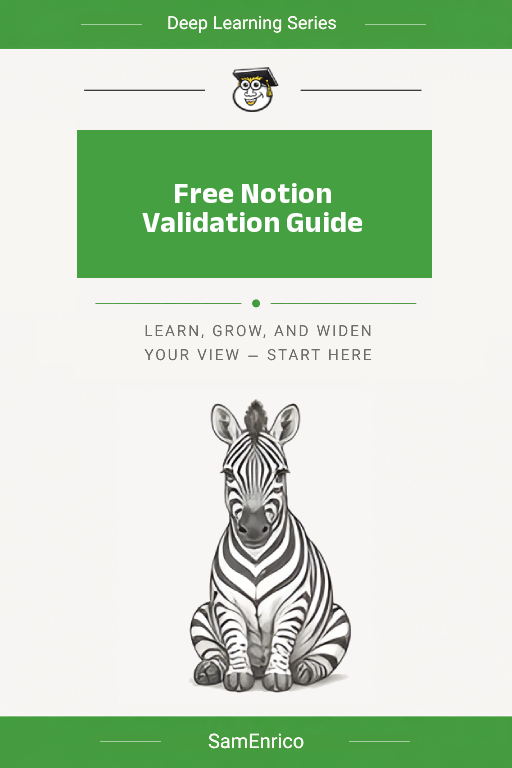
Non-FictionStartup GuideLean Methodology
Free Notion Validation Guide eBook
Use free Notion pages to validate content demand.
Use free Notion pages to validate content demand. Share and measure interest.
Formats
Free sample
Chapter 1: The $10,000 Guess--Every morning, thousands of creators wake up and open their laptops to build something nobody asked for.They sketch wireframes. They write course outlines. They record video intros. They design logos. They set up email marketing sequences.
They build waitlist landing pages. They spend weeks, sometimes months, sometimes years, pouring their energy into a product that feels so obviously valuable that surely the world will beat a path to their door.Then they launch.And nothing happens.A trickle of friends and family leave encouraging comments. Maybe a few strangers stumble in from a social media post. A handful of people join the email list. But the flood of paying customers?
The enthusiastic word-of-mouth? The exponential growth? It never comes. The creator stares at their analytics dashboard, watching the flat line of zero sales, and whispers to themselves: "But I built something good. Why isn't anyone buying?"This chapter is going to answer that question.
More importantly, it's going to save you from becoming that person.The answer is painful but simple: you built the wrong thing. Not because you're bad at building. Not because you're not talented. Not because the market is unfair. You built the wrong thing because you confused enthusiasm for evidence, opinions for data, and hope for strategy.The good news is that you're about to learn a completely different way to operate.
A way that flips the entire creative process on its head. A way that costs almost nothing, takes days instead of months, and gives you the one thing that actually matters before you write a single line of code or record a single video: proof that someone will pay.This book is called The Free Notion Validation Guide because the tool you're going to use is already sitting in your browser, completely free, more powerful than most expensive software, and tragically misunderstood by almost everyone who uses it. Notion is not just a note-taking app. It's not just a project management tool. It's a fully functional, shareable, database-driven validation engine that can simulate a Saa S product, collect behavioral data, and prove market demand before you invest a single dollar.Let me tell you a story.
It's the story that became the seed of this entire book.The Creator Who Built Nothing and Won A few years ago, a freelance writer named Sarah noticed something strange happening in her Twitter feed. Every day, three or four people would ask the same question: "What are the best AI tools for writers right now?" The replies were always chaotic—random lists, personal favorites, outdated recommendations.Sarah had an idea: what if she curated the best AI writing tools in one place, updated daily, and sent it as a newsletter? The problem was that she didn't know how to build a newsletter backend. She didn't know how to set up automations. She didn't know how to code a website.
She had exactly zero technical skills and maybe two hundred dollars to invest.Most people in her situation would have given up. Or worse, they would have started learning to code, spent six months building a complicated web app, and launched to silence.Sarah did something else.She opened Notion. She created a simple database with columns for tool name, category, price, and a short review. She called it "The AI Tools Tracker." She set the page to public. Then she went to Linked In and wrote a post: "I was wasting an hour every day finding AI tools for my writing.
So I built a free tracker. Here's the link."She didn't ask for feedback. She didn't ask for opinions. She didn't say "would anyone use this?" She just shared a solution to a problem she knew existed.Within 48 hours, two thousand people had visited her Notion page. Five hundred of them clicked a button she added that said "Send me weekly updates"—a button that went nowhere, connected to nothing, because she hadn't built anything.
It was a fake door. And five hundred people walked through it.Sarah had validation. Not opinions. Not "great idea" comments. Five hundred people had raised their hands and said "yes, I want this in my inbox every week."She spent the next three months manually sending those five hundred people a weekly email.
Every Sunday night, she copied and pasted the five best tools from her Notion database into an email. That was it. No automation. No fancy tech. No code.By month four, she had two thousand subscribers.
By month six, she added a paid tier for $29 per month—access to her private database of advanced tools, updated daily. Fifty people signed up in the first week.Sarah was now making over $1,500 per month from a Notion page she built in two hours, a "fake" button she never coded, and a manual email process that took her ninety minutes every Sunday. She never wrote a line of code. She never built a real product. She just validated demand first, then delivered value manually, then added automation only when the manual process became unsustainable.Today, that business does over five thousand dollars per month.
The "product" is still mostly a Notion database. The "automation" is still partially manual. And the entire thing exists because Sarah understood something that most creators never learn: you don't need to build anything to start selling.The Myth That Destroys More Dreams Than Failure Let me name the enemy.The "Build It and They Will Come" myth is the most expensive lie in the history of digital creation. It's whispered by well-meaning friends ("Just launch it and see what happens!"). It's amplified by hustle culture influencers ("Stop overthinking and start building!").
It's reinforced by survivor bias (the one creator who succeeded after years of blind building becomes a case study, while the ninety-nine who failed quietly disappear).Here's what the data actually says. According to a study of over 2,500 digital product launches across Gumroad, Podia, and Teachable, more than eighty percent of products fail to generate more than five hundred dollars in their first year. Eighty percent. That's not a bad run. That's a catastrophe.And here's the killer: the vast majority of those failures were not bad products.
They were good products built for markets that didn't exist, audiences that weren't ready, or problems that weren't urgent. The quality of the product had almost nothing to do with the outcome. The only thing that predicted success was whether there was existing, measurable demand before the creator started building.Think about that for a moment. You can build the most beautiful course in the world, with Hollywood-quality production and Nobel Prize-winning insights, and if nobody is actively searching for a solution to the problem you're solving, you will fail. Conversely, you can build a janky, ugly, barely functional prototype, and if you've validated that people are desperate for the solution, you will succeed.The creators who succeed are not better builders.
They are better validators.Why Your "Great Idea" Is Probably Wrong I want you to do something uncomfortable. I want you to think about the last three product ideas you had. The ones you were excited about. The ones you almost started…
This is the end of the free sample. Get the eBook to keep going. Buy now
About this book
Details
- Author
- Hamrick Joshua
- Publisher
- SamEnrico
- Language
- English
- Genre
- Non-Fiction, Startup Guide, Lean Methodology
- Released
- 2026-05-29
- Pages (approx.)
- 141
- Available as
- eBook, Audiobook

Read better in the ZLOADR app
Your eBooks on your phone or tablet. Sign in with your SamEnrico account and start reading.
More by Hamrick Joshua
 Jealousy for MenHamrick Joshua$11.99
 The Self Esteem Rewiring GuideHamrick Joshua$11.99
 Underwriter Stress GuideHamrick Joshua$11.99
 The Pet Loss and Guilt GuideHamrick Joshua$11.99
 TM for Divorce RecoveryHamrick Joshua$11.99
 The Poisoned Punch: Buenos Aires' Deadly Duplicity (1890)Hamrick Joshua$11.99
 Understanding Tibiae Bowed Radial Anomalies Osteopenia FractureHamrick Joshua$17.99
 Pakistan Invoice Factoring GuideHamrick Joshua$12.99
 Selling SupervisorHamrick Joshua$11.99
 How to Become a Plate WorkerHamrick Joshua$11.99
You may also like
 Hong Kong Handover 1997Dunn Johnnie$11.99
 Zumba For Postnatal Recovery CourseNeal Christian$11.99
 Zumba for BeginnersLadner Nikia$11.99
 YouTube Comment Mining GuideHumes Pandora$12.99
 Worry Box MeditationCarlin Rudy$11.99
 Workplace Stress MeditationNguyen Lynn$11.99
 Workplace Stress and Sleep RepairHawley Ivory$11.99
 Workplace Perfectionism CureDelaney Jeffry$11.99
 Workplace Injustice Anger GuideWallen Isabelle$11.99
 Work Addiction and Burnout LinkGreenwood Ester$11.99
 Women in Yoga and WellnessBeattie Galina$11.99
 Women in Stand Up ComedyChun Evangeline$11.99