
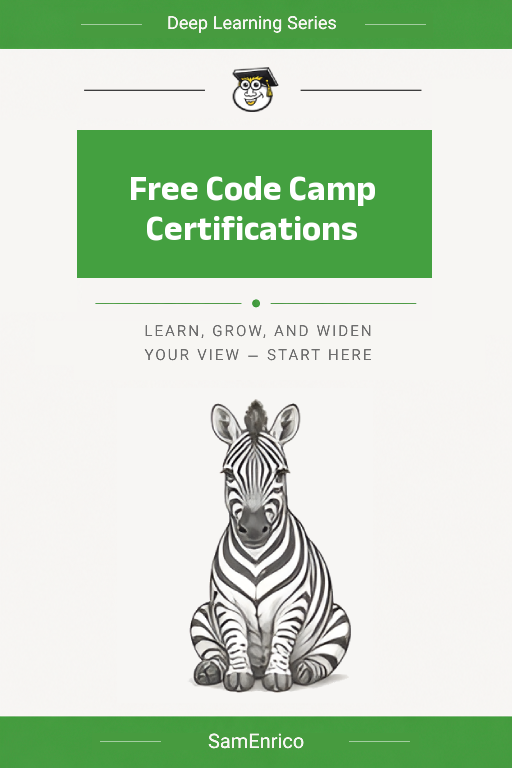
Free Code Camp Certifications eBook
Turn freeCodeCamp's responsive web design and Java
by Morse Wes
Turn freeCodeCamp's responsive web design and JavaScript certificates into junior developer interviews.
Formats
Free sample
Chapter 1: The $15,000 Lie--–- The first thing you need to understand about your free Code Camp certification is that it is not a ticket to a job. It is not a diploma. It is not a credential that will impress a hiring manager the way a computer science degree from a state university might. In fact, if you present it as proof of your abilities, you will likely be met with a polite nod and a silent rejection. This is not because free Code Camp is不值得—it is one of the finest educational resources ever created.
The problem is that you have been sold a lie, and you have been selling it to yourself.The lie is subtle, seductive, and repeated constantly in coding forums, You Tube tutorials, and even within the free Code Camp community itself. The lie is this: Finish the curriculum, earn the certifications, and the job offers will come. It sounds reasonable. It sounds like every other educational promise you have heard since kindergarten. Do the work, get the grade, receive the reward.
But the software industry does not operate on the academic model. It never has.You are not a student anymore. You are a product. And your certification is not proof of value—it is packaging.The Graveyard of Finished Certifications Let me tell you about someone I will call Marcus. Marcus completed the free Code Camp Responsive Web Design certification in forty-seven days.
He finished the Java Script Algorithms and Data Structures certification in another sixty-three. He had the green checkmarks, the sharable PDFs, the Linked In badges. He was proud, and he should have been. He had done what thousands of aspiring developers only dream of doing.Then Marcus applied for jobs. He sent out one hundred and forty applications over four months.
He received exactly three responses. Two were automated rejections. One was a request to complete a coding assessment, which he failed because the assessment asked him to build a feature he had never touched—state management in a React-like environment. free Code Camp had not covered that. Or rather, it had, but only in a way that required him to connect the dots himself, and he had not known which dots to connect.Marcus is not lazy.
He is not stupid. He is not a cautionary tale about the limits of self-taught developers. Marcus is the rule, not the exception. The forums are filled with his story. Reddit is drowning in it.
Discord servers have dedicated channels for it, usually named something like "#job-hunting-venting."The problem Marcus faced—and the problem you face right now, whether you know it or not—is that free Code Camp teaches you how to complete lessons. It does not teach you how to get a job. These are opposite skills.Completing lessons requires patience, diligence, and the ability to follow instructions. Getting a job requires marketing, positioning, storytelling, and the ability to translate technical knowledge into business value. One is a student skill.
The other is an entrepreneur skill. And you have been training for the wrong sport.What "Done" Actually Looks Like Let me ask you a brutal question, and I want you to answer it honestly before you read the next paragraph. Do not skip this. Pause. Think.If a recruiter called you right now and said, "Tell me what you can build for our company," what would you say?If your answer includes the words "certification," "curriculum," "lessons," or "I learned," you are in trouble.
Recruiters do not care what you learned. They care what you can do. They care about problems solved, not modules completed. They care about user needs met, not syntax memorized.Here is the difference. A student says: "I completed the free Code Camp Responsive Web Design certification.
I learned Flexbox, Grid, and media queries." An entrepreneur says: "I built a responsive e-commerce product page that adapts seamlessly from a 4K monitor to an i Phone SE. I reduced the company's bounce rate on mobile by 15% in a simulated A/B test." One of these people gets an interview. The other gets a form letter.The brutal truth is that your certification, by itself, is worth approximately nothing to an employer. It signals that you have persistence and basic literacy. It does not signal that you can deliver value under deadline.
It does not signal that you can collaborate on a codebase with four other developers. It does not signal that you can take a vague requirement from a product manager and turn it into working software that real humans use.This is the gap. This entire book exists to close it.The Entrepreneur Mindset Shift The single most important transformation you will make in this book is not technical. It is not learning async/await or mastering Git rebase. It is a shift in identity.
You must stop thinking of yourself as a student who needs to learn enough to get hired and start thinking of yourself as a business that produces value for clients, one of which is your future employer.This is not motivational fluff. This is a practical framework for every decision you will make from this page forward.Ask yourself, for every hour you spend coding: Is this activity producing something that demonstrates value to an employer, or is it just checking a box?Reading a tutorial: usually box-checking. Applying that tutorial to rebuild a real project with your own twist: value-producing. Fixing a bug in a deployed application: value-producing. Rewatching a video you have already seen because you are afraid to start coding: box-checking.The entrepreneur mindset also changes how you talk about your work.
A student says, "I struggled with the Java Script calculator project but eventually got it working." An entrepreneur says, "I built a calculator that handles floating-point precision errors better than the default Java Script math operations, which is a real user need in financial applications." Same project, different framing. One sounds like homework. One sounds like a product.You will practice this shift constantly throughout this book. By Chapter 12, it will feel natural. But for now, I want you to do something concrete.The Git Hub Foundation (Not the History—That Comes Later)Most job-seeking advice tells you to "build a Git Hub portfolio" without telling you how.
This chapter is where you lay the foundation. Note carefully: we are not cleaning your commit history yet. That is Chapter 5's job, and it requires Git skills you do not currently have. Right now, you are just establishing presence.Open your Git Hub account. If you do not have one, create it now.
I will wait.Now, look at your profile. Does it have a pinned repository containing your best completed free Code Camp project? Not your most recent project—your best project. The one that works reliably, looks decent, and demonstrates at least some attention to user experience. Pin that repository to the top of your profile.Next, write a README file for that project that answers exactly three questions:What problem does this project solve for a user?
(Not "this is my tribute to Ruth Bader Ginsburg" but "this page helps users learn about a historical figure through…
This is the end of the free sample. Get the eBook to keep going. Buy now
About this book
Details
- Author
- Morse Wes
- Publisher
- SamEnrico
- Language
- English
- Genre
- Non-Fiction, Student's Shortcut
- Released
- 2026-05-29
- Pages (approx.)
- 125
- Available as
- eBook, Audiobook

Read better in the ZLOADR app
Your eBooks on your phone or tablet. Sign in with your SamEnrico account and start reading.
More by Morse Wes
 Long COVID Fatigue Sleep AidMorse Wes$11.99
 Forensic Odontology TextbookMorse Wes$11.99
 Francis Love for AnimalsMorse Wes$11.99
 From Isolation To BelongingMorse Wes$11.99
 The Opioid Pain Management GuideMorse Wes$11.99
 The Divine Harmonies: Bach’s Baroque RevolutionMorse Wes$11.99
 Learn to Play the Tambor HuacanaMorse Wes$11.99
 Pivot Success MetricsMorse Wes$12.99
 How to Start a Fire Service Business (Beginners Guide)Morse Wes$11.99
 AI-Enhanced Decision Support SystemsMorse Wes$11.99
You may also like
 Hong Kong Handover 1997Dunn Johnnie$11.99
 Zumba For Postnatal Recovery CourseNeal Christian$11.99
 Zumba for BeginnersLadner Nikia$11.99
 YouTube Comment Mining GuideHumes Pandora$12.99
 Worry Box MeditationCarlin Rudy$11.99
 Workplace Stress MeditationNguyen Lynn$11.99
 Workplace Stress and Sleep RepairHawley Ivory$11.99
 Workplace Perfectionism CureDelaney Jeffry$11.99
 Workplace Injustice Anger GuideWallen Isabelle$11.99
 Work Addiction and Burnout LinkGreenwood Ester$11.99
 Women in Yoga and WellnessBeattie Galina$11.99
 Women in Stand Up ComedyChun Evangeline$11.99