
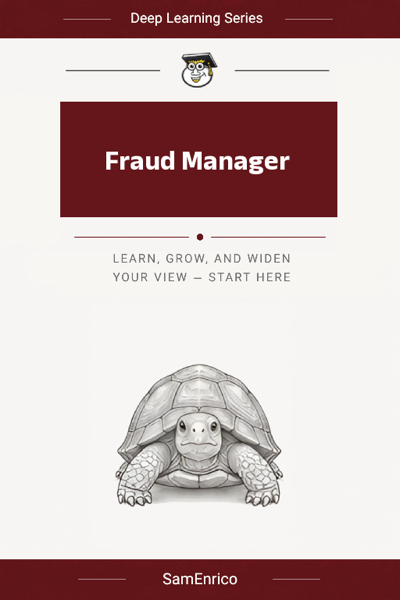
Non-FictionInformativeEducational
Fraud Manager eBook
A Coursebook on Fraud Manager
A Coursebook on Fraud Manager
Formats
Free sample
Chapter 1: The Blade’s Edge...--–- The phone rang at 11:47 PM on a Tuesday. I was halfway through a bowl of cold pasta, staring at a dashboard that showed approval rates dropping like a stone. Three hours earlier, I had flipped a switch. I had raised the fraud threshold on all international transactions after spotting a pattern of card testing from a Southeast Asian IP range. It was the right call.
The data was clear. The fraud rate had dropped to near zero within ninety minutes. I felt smart. I felt effective. I felt like a fraud manager doing exactly what I was paid to do.By 11:47 PM, I had destroyed my company.The head of customer support was screaming into my voicemail.
"What did you do? We have four hundred customers on Twitter saying they can't buy anything. Four hundred. In three hours. The CEO is asking questions." I refreshed the dashboard.
Approval rates had fallen from 94% to 62%. That 32-point drop represented roughly $180,000 in lost revenue over a single evening. Every single one of those declined transactions was a legitimate customer who would never come back.I had blocked the fraudsters. I had also blocked everyone else.That night taught me something that no certification, no textbook, and no compliance manual had ever conveyed. The fraud manager does not sit on the side of angels fighting demons.
The fraud manager sits on the edge of a blade. Lean too far toward prevention, and you starve the business of revenue. Lean too far toward approval, and you bleed out from losses. The goal is not to catch every thief. The goal is to catch enough thieves while letting almost every good customer through.This book is about learning to walk that blade's edge.The Old Story: Fraud Manager as Gatekeeper For most of corporate history, the fraud manager was understood as a kind of digital bouncer.
The job was simple: keep bad people out. If a transaction looked suspicious, you blocked it. If an employee submitted an expense report with anomalies, you rejected it. If a new customer triggered a red flag, you froze their account. Every block was a victory.
Every decline was a trophy. The fraud manager measured success by how much fraud they stopped.This "gatekeeper" mindset made sense in a slower, simpler world. Transactions took days. Verification was manual. Fraudsters were amateurs.
A rule-based system that flagged anything over $10,000 or any transaction from a high-risk country was genuinely effective. The cost of blocking a legitimate customer was relatively low because the customer had few alternatives. If your bank declined their card, they could not simply open an account with a competitor in thirty seconds.That world is gone.Today, customers expect instant approval, seamless verification, and frictionless experiences. They have dozens of alternatives. If you decline their legitimate transaction, they do not call customer service.
They close the tab and go to your competitor. The cost of a false positive—blocking a good customer—has skyrocketed. Meanwhile, fraudsters have become sophisticated, organized, and technologically advanced. They use machine learning to probe your defenses. They deploy synthetic identities that look more real than real customers.
They share attack strategies in real time on dark web forums.The gatekeeper model cannot survive in this environment. A bouncer who blocks everyone who looks suspicious does not protect the club. They empty it.The New Story: Fraud Manager as Business Enabler This book argues for a fundamental reorientation of the fraud manager's role. You are not a gatekeeper. You are a business enabler.
Your job is not to say no. Your job is to say yes to the right risks.What does that mean in practice? It means every fraud control you implement must be justified not only by the fraud it stops but by the friction it creates. It means you measure success not by how many transactions you decline but by how many good transactions you approve. It means you see yourself as a partner to product, sales, and customer success—not a roadblock.Consider the difference between two fraud managers at two different companies.
Both work for fintech startups. Both process millions of dollars in transactions. Both have the same fraud detection software. But they operate from completely different assumptions.The first fraud manager—call her the Gatekeeper—has a default posture of suspicion. Every transaction is potentially fraudulent until proven otherwise.
She maintains a long list of rules that decline anything unusual. Her fraud rate is impressively low. But her approval rate for new customers in emerging markets is only 67%. The sales team hates her. Product managers have stopped inviting her to meetings.
The company is losing market share to a competitor with a more forgiving fraud policy.The second fraud manager—call him the Enabler—has a default posture of verification. He assumes most transactions are legitimate but builds systems to identify the small fraction that are not. He uses machine learning models that adapt to new fraud patterns rather than static rules. He works with the product team to design authentication that feels helpful rather than hostile. His fraud rate is slightly higher than the Gatekeeper's.
But his approval rate for new customers in emerging markets is 94%. The sales team loves him. The CEO credits him with enabling international expansion.Which fraud manager would you rather be?The Fraud Risk Management Ecosystem To become an Enabler, you must first understand the full ecosystem in which fraud lives. Fraud does not occur in a vacuum. It emerges from the interaction of four domains: people, processes, technology, and external threats.People include your employees (who may commit internal fraud), your customers (who may commit first-party fraud or friendly fraud), and external fraudsters (who may attack your systems).
Each group has different motivations, capabilities, and attack patterns. Understanding the psychology of deception—which we will explore in Chapter 2—is essential to designing effective controls.Processes include the workflows through which money, data, and authority flow. Every process is an opportunity for fraud: onboarding, payments, expense reimbursement, vendor management, payroll. The more complex the process, the harder it is to monitor. The more manual the process, the easier it is to manipulate.Technology includes the tools you use to detect and prevent fraud: rule-based systems, machine learning models, identity verification services, device fingerprinting, behavioral analytics.
Technology is neither good nor bad. It is a lever. The same machine learning model that catches fraud can also generate false positives that destroy revenue.External threats include the fraudsters themselves, but also the broader environment: regulatory requirements, industry standards, economic conditions, and the fraud prevention strategies of your competitors. A fraud control that works in isolation may fail when fraudsters adapt or when regulators change the rules.The fraud manager's job is to understand how these four domains interact and to design controls that balance prevention with enablement. That is the subject of this book.Strategic vs.
Tactical Responsibilities One of the most common mistakes new fraud managers make is confusing activity with impact. They spend their days reviewing alerts, adjusting rules, and investigating cases. These are tactical responsibilities. They are necessary. But they are not sufficient.A fraud manager who…
This is the end of the free sample. Get the eBook to keep going. Buy now
About this book
Details
- Author
- Hermann Stormy
- Publisher
- SamEnrico
- Language
- English
- Genre
- Non-Fiction, Informative, Educational
- Released
- 2026-06-02
- Pages (approx.)
- 140
- Available as
- eBook, Audiobook

Read better in the ZLOADR app
Your eBooks on your phone or tablet. Sign in with your SamEnrico account and start reading.
More by Hermann Stormy
 Pitching To Family And Friends GuideHermann Stormy$11.99
 Hidden Sugar DetectorHermann Stormy$11.99
 Genetic Testing for Rare DiseasesHermann Stormy$11.99
 Meiji Land Tax Reform GuideHermann Stormy$11.99
 Coping Mechanisms Self Worth GuideHermann Stormy$11.99
 The Silent Codebreakers: The Untold Story of the Navajo Code TalkersHermann Stormy$11.99
 The Djinn of the Empty Quarter: A Merchant's BargainHermann Stormy$11.99
 RSPO Palm Oil ExportHermann Stormy$12.99
 Jeff Bezos Cash Reinvestment PrimerHermann Stormy$12.99
 Understanding Giant Congenital NeviHermann Stormy$17.99
 How to Start a Brown Stone Pottery Business (Beginners Guide)Hermann Stormy$11.99
You may also like
 Hong Kong Handover 1997Dunn Johnnie$11.99
 Zumba For Postnatal Recovery CourseNeal Christian$11.99
 Zumba for BeginnersLadner Nikia$11.99
 YouTube Comment Mining GuideHumes Pandora$12.99
 Worry Box MeditationCarlin Rudy$11.99
 Workplace Stress MeditationNguyen Lynn$11.99
 Workplace Stress and Sleep RepairHawley Ivory$11.99
 Workplace Perfectionism CureDelaney Jeffry$11.99
 Workplace Injustice Anger GuideWallen Isabelle$11.99
 Work Addiction and Burnout LinkGreenwood Ester$11.99
 Women in Yoga and WellnessBeattie Galina$11.99
 Women in Stand Up ComedyChun Evangeline$11.99