

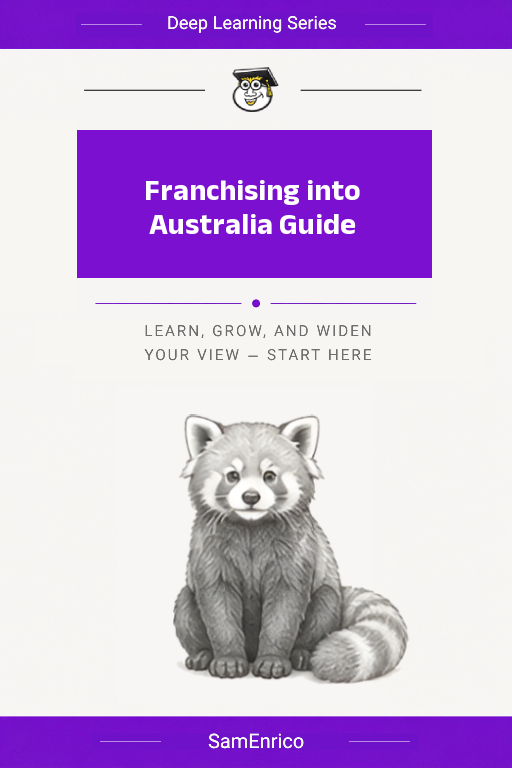
Non-FictionBusiness BriefAustralia
Franchising into Australia Guide eBook
Expands franchise into Australia including Franchi
Expands franchise into Australia including Franchising Code of Conduct, disclosure requirements, and understanding the Australian market.
Formats
Free sample
Chapter 1: The Graveyard of Ambition--–- In 2019, a successful American smoothie chain with over 300 locations across the United States made a decision that its founders believed would cement their legacy. They had conquered the US market, survived the 2008 recession, and built a brand that franchisees loved. Australia seemed like the logical next step—English-speaking, politically stable, and culturally similar to the United States. What could possibly go wrong? Within eighteen months, the company had spent 2.3milliononmarketentry,signedsixfranchiseesacross Sydneyand Melbourne,andwatchedeverysingleonefail.Butthenightmarewasjustbeginning.Thefranchiseesbandedtogether,filedaclassactionlawsuitallegingmisleadingconduct,andproducedevidencethatthefranchisorhadusedthesamedisclosuredocumentsfrom Ohiowithoutadjustingfor Australianwagelaws,leasestructures,orconsumerpreferences.Thecourtawardedthefranchisees2.3 million on market entry, signed six franchisees across Sydney and Melbourne, and watched every single one fail.
But the nightmare was just beginning. The franchisees banded together, filed a class action lawsuit alleging misleading conduct, and produced evidence that the franchisor had used the same disclosure documents from Ohio without adjusting for Australian wage laws, lease structures, or consumer preferences. The court awarded the franchisees 2.3milliononmarketentry,signedsixfranchiseesacross Sydneyand Melbourne,andwatchedeverysingleonefail.Butthenightmarewasjustbeginning.Thefranchiseesbandedtogether,filedaclassactionlawsuitallegingmisleadingconduct,andproducedevidencethatthefranchisorhadusedthesamedisclosuredocumentsfrom Ohiowithoutadjustingfor Australianwagelaws,leasestructures,orconsumerpreferences.Thecourtawardedthefranchisees4.7 million in damages. Two directors received personal bans from franchising in Australia. The brand never recovered—not just in Australia, but globally, as the negative publicity spread.
The founder later admitted in a deposition: "We thought Australia was America with kangaroos. We were wrong about everything."This chapter exists to ensure you do not become the next cautionary tale.The $174 Billion Dollar Question Australia's franchise sector is enormous by any measure. According to the 2023 Franchising Australia Survey conducted by Griffith University—the most comprehensive longitudinal study of the sector—there are approximately 1,200 franchise networks operating 94,000 outlets and generating $174 billion AUD in combined annual revenue. To put that in perspective, Australia's franchise sector is larger than the entire economy of New Zealand. It employs nearly 600,000 people, or about 4.5 percent of the national workforce.
For international franchisors looking to expand beyond saturated markets in North America and Europe, Australia represents a rare combination of wealth, stability, and under-penetration.But here is the statistic that should give every international franchisor pause: Australia has the highest level of franchising regulation in the world. Not "one of the highest." The highest. A 2024 comparative study by the International Franchise Association ranked twenty-two countries on regulatory burden, enforcement intensity, and franchisee protections. Australia ranked first—meaning most regulated—by a significant margin. The United States, by contrast, ranked fourteenth.
The United Kingdom ranked eleventh. Germany ranked ninth. What does this mean in practical terms? A franchise agreement that is perfectly legal in Ohio, Texas, or Florida may be completely unenforceable—or even criminal—in New South Wales.This chapter establishes the "why now" for international franchisors while immediately dispelling the myth that Australia is simply a smaller, sunnier version of home. We will explore the size and shape of the market, the cultural forces that shape Australian business, the graveyard of failed international entries, and the regulatory reality that makes Australia both attractive and treacherous.The Fair Go Economy: Understanding the Australian Business Soul Every country has a cultural operating system—a set of unspoken rules that govern how business is conducted.
In the United States, that operating system is individualism and at-will employment. In Japan, it is consensus and lifetime loyalty. In Germany, it is precision and process. In Australia, the operating system is the "Fair Go."The Fair Go is not a law. It is not written in any constitution or code.
It is a deeply embedded cultural commitment to equity, second chances, and the belief that no one—not the wealthiest corporation, not the most powerful individual—should be able to tilt the playing field unfairly. The term originated in Australian sporting culture, where the "fair go" meant giving every player an equal chance to succeed. It migrated into politics, then into labor relations, and finally into consumer protection and franchising law.What does the Fair Go mean for a franchisor? It means that Australian franchisees expect to be treated as partners, not as subordinates. They expect transparency, consultation, and a genuine opportunity to succeed.
They expect that the franchisor will not change the rules arbitrarily, hide fees in marketing funds, or enforce non-compete clauses that prevent a franchisee from making a living after the agreement ends. And when these expectations are violated, Australian franchisees do not suffer in silence. They form associations, hire lawyers, lobby politicians, and, increasingly, file class actions.The data bears this out. According to the Australian Competition and Consumer Commission (ACCC), franchise-related complaints increased by 47 percent between 2020 and 2024. The majority of complaints involved three issues: inadequate disclosure of costs (31 percent), misuse of marketing funds (28 percent), and unreasonable restraints of trade (22 percent).
Notably, complaints against international franchisors were 3.2 times more likely to result in ACCC enforcement action than complaints against domestic franchisors. The ACCC does not officially disclose this differential, but internal documents obtained through Freedom of Information requests suggest a clear pattern: international franchisors are seen as more likely to "test the limits" of Australian law, and the ACCC has made an example of several high-profile cases.The 85 Percent Reality: Single-Unit Owner-Operators Another critical cultural and structural difference between Australia and other franchise markets is the size and sophistication of franchisees. In the United States, multi-unit franchisees—operators who own five, ten, or even fifty locations—dominate the landscape. According to FRANdata, multi-unit franchisees account for over 60 percent of all franchise units in the US. These are sophisticated business operators with legal teams, accountants, and the capital to absorb losses.
They are not easily intimidated by a franchisor's legal threats.Australia is the opposite. A staggering 85 percent of Australian franchisees are single-unit owner-operators. They are small business owners who have invested their life savings—often including their home equity or superannuation (Australia's mandatory retirement savings system)—into a single location. They work the counter, manage the staff, and clean the bathrooms. They are not sophisticated business operators.
They are not backed by legal teams. But they are deeply invested, emotionally and financially, in the success of their franchise.This creates a unique dynamic. On one hand, single-unit franchisees are less likely to litigate than multi-unit operators—lawsuits are expensive and time-consuming. On the other hand, when single-unit franchisees do litigate, they often do so with a passion and moral outrage that resonates with Australian judges and juries. A multi-unit operator suing over lost profits is a business dispute.
A single-unit owner-operator suing because they lost their home and their retirement savings is a human tragedy. Australian courts respond accordingly.The chapter will return to this dynamic repeatedly. For now, the key takeaway is this: your Australian franchisees are likely to be smaller, less sophisticated, and more personally invested than your franchisees in other markets. They will expect more support, more transparency, and more patience. If your system is designed for multi-unit operators who can "figure it out themselves," you will fail in Australia.The Graveyard of American Dreams: Failed International Entries No discussion of franchising into Australia would be complete without a tour of the graveyard.
Many of the world's most successful brands have tried and failed to establish a foothold in Australia. Their failures are not mysteries—they are case studies in what not to do.Starbucks: The $105 Million Lesson Starbucks…
This is the end of the free sample. Get the eBook to keep going. Buy now
About this book
Details
- Author
- Hammer Jewell
- Publisher
- SamEnrico
- Language
- English
- Genre
- Non-Fiction, Business Brief, Australia
- Released
- 2026-06-01
- Pages (approx.)
- 157
- Available as
- eBook, Audiobook

Read better in the ZLOADR app
Your eBooks on your phone or tablet. Sign in with your SamEnrico account and start reading.
More by Hammer Jewell
 Values And Mission Alignment Office Politics Reduction CourseHammer Jewell$11.99
 The Early Retirement Stress GuideHammer Jewell$11.99
 Political Argument Workplace GuideHammer Jewell$11.99
 Labeling Emotions PersuasionHammer Jewell$11.99
 The Shower Effect Creative BoostHammer Jewell$11.99
 The Brush of the Sky: Benjamin Banneker's Celestial WondersHammer Jewell$11.99
 Bridge Tender OperationHammer Jewell$11.99
 How to Start a Camping Sites Business (Beginners Guide)Hammer Jewell$11.99
 WPS Office Business Plan GuideHammer Jewell$12.99
 Understanding Trigger FingerHammer Jewell$17.99
You may also like
 Hong Kong Handover 1997Dunn Johnnie$11.99
 Zumba For Postnatal Recovery CourseNeal Christian$11.99
 Zumba for BeginnersLadner Nikia$11.99
 YouTube Comment Mining GuideHumes Pandora$12.99
 Worry Box MeditationCarlin Rudy$11.99
 Workplace Stress MeditationNguyen Lynn$11.99
 Workplace Stress and Sleep RepairHawley Ivory$11.99
 Workplace Perfectionism CureDelaney Jeffry$11.99
 Workplace Injustice Anger GuideWallen Isabelle$11.99
 Work Addiction and Burnout LinkGreenwood Ester$11.99
 Women in Yoga and WellnessBeattie Galina$11.99
 Women in Stand Up ComedyChun Evangeline$11.99