
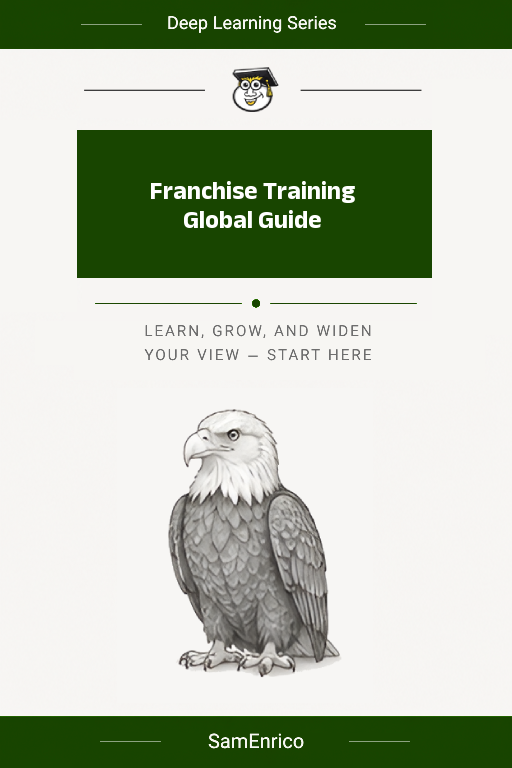
Non-FictionBusiness BriefInternational Expansion
Franchise Training Global Guide eBook
Train international franchisees on your brand stan
Train international franchisees on your brand standards. Remote training and cultural adaptation.
Formats
Free sample
Chapter 1: The Carbon Copy Trap--–- In 2016, a beloved American sandwich franchise opened its first location in Bangkok. The CEO flew in for the ribbon-cutting. Corporate trainers had spent three weeks teaching local staff the exact procedures used in Cleveland: the same greeting ("Welcome to [Brand]! Can I take your order?"), the same portion sizes (three ounces of meat, one ounce of cheese), the same shift schedules (eight hours with two fifteen-minute breaks), and the same quality assurance checklist (tables wiped every thirty minutes, restrooms checked hourly). The opening day was a triumph.
Lines wrapped around the block. Local media raved about the authentic American experience.Eighteen months later, all five Bangkok locations had closed. The franchisee lost $4.7 million. Lawsuits were filed. The brand's reputation in Southeast Asia was so damaged that a planned expansion to Singapore was cancelled.
In the post-mortem investigation, the franchisee said something that haunted the franchisor's CEO: "You taught us to run an American store in Thailand. But our customers are Thai. Your training never asked us what they wanted."This chapter dismantles the most dangerous assumption in international franchising: the belief that a successful domestic model can be exported unchanged. It is an assumption that feels safe. It is an assumption that feels efficient.
It is an assumption that has destroyed more international franchise expansions than any other single cause.The Seduction of Sameness Why do smart, experienced franchisors fall into the carbon copy trap? The answer lies in three psychological biases that affect even the most rational executives.The first is the home court illusion. When you have built a successful business in your home market, every element of your operating system feels necessary. The way you greet customers feels like the only polite way to greet customers. The way you schedule shifts feels like the only logical way to schedule shifts.
The way you train employees feels like the only effective way to train employees. You mistake familiarity for universality. Because it worked in Chicago, you assume it will work in Shanghai.The second is the control comfort zone. Franchising is built on consistency. The entire legal and operational framework of franchising—the Franchise Disclosure Document, the operations manual, the quality assurance system—is designed to ensure that a customer walking into any location anywhere in the world has a predictable experience.
This is a genuine strength of the franchising model. But when consistency becomes an idol rather than a tool, franchisors start treating every deviation from home-market standards as a threat. They forget that consistency in brand promise does not require identicality in execution.The third is the scalability shortcut. Expanding internationally is expensive and stressful. The easiest path—the path that requires the least additional thinking, the least additional investment, the least additional time—is to simply hand your existing training materials to a translator and ship them overseas.
This feels like execution. It is actually procrastination disguised as action.Consider the restaurant chain that trained its Thai franchisees to ask "Would you like fries with that?" The question made perfect sense in a culture where meals are individual and upselling is expected. In Thailand, where meals are often shared family-style and aggressive upselling can cause loss of face, the question felt rude and pushy. The franchisee knew this. The local staff knew this.
But the training manual said to ask the question, and the compliance audit checked for the question, so they asked the question and watched customers wince.Consider the automotive service franchise that trained its Brazilian mechanics to follow the exact step-by-step troubleshooting sequence used in Germany. The sequence was logical, efficient, and thorough. It was also designed for a culture with low uncertainty avoidance, where technicians are comfortable following a linear process without deviation. Brazil has higher uncertainty avoidance. Brazilian mechanics wanted more context, more explanation, more "why" behind each step before they felt confident proceeding.
The German-style training left them feeling anxious and underprepared, even though they had memorized the steps perfectly.Consider the hotel chain that trained its Japanese front-desk staff to greet every guest with direct eye contact and a firm handshake. In Japan, direct eye contact can be perceived as aggressive, and a firm handshake is not the traditional greeting. The staff felt uncomfortable. The guests felt uncomfortable. But the training video showed an American manager doing it exactly that way, so that is what they did.These are not failures of effort.
They are failures of imagination.The Global Brand Bible: Separating Sacred from Secular If you cannot copy-paste your entire operating model across borders, what can you keep? The answer is the Global Brand Bible—a living document that defines the non-negotiable elements of your brand versus the flexible elements that can and should adapt to local markets.The Global Brand Bible has three sections.Section One: The Sacred (Non-Negotiable)These are the elements that define your brand's identity and promise. They must be identical in every location worldwide, regardless of local culture or regulation. The Sacred includes:Logo and visual identity. Your logo, color palette, and primary brand marks do not change from country to country.
A golden arch is a golden arch in Chicago and Chengdu.Core quality standards. The minimum acceptable quality for your product or service is non-negotiable. If your burger must be served at 165 degrees Fahrenheit internally, that temperature does not drop to 155 in a market with looser food safety regulations. If your hotel sheets must have a 300-thread count, that standard does not waver.Signature customer promises. If your brand promises "free delivery within thirty minutes or it's free," that promise means the same thing in every market.
Diluting a signature promise dilutes the brand itself.Safety and compliance protocols. Any procedure that protects customer or employee safety is non-negotiable. Fire exits, food handling, equipment shut-off procedures, data privacy—these do not adapt.Brand story and values. Why your company exists, what it believes, and how it treats people—these are not up for local reinterpretation. A brand that stands for sustainability in Sweden cannot abandon that stance in Singapore.Section Two: The Flexible (Locally Adaptable)These are elements that can and should change to fit local markets.
The Flexible includes:Pricing. Local purchasing power, competition, taxes, and import duties all affect pricing. What works in Zurich will not work in Manila.Hiring practices. Local labor laws, cultural norms around work schedules, and available talent pools determine how you recruit, schedule, and manage staff.Marketing channels. The platforms and messengers that reach customers vary wildly by market.
We Chat in China, Whats App in Brazil, Line in Thailand, email in Germany—your training must adapt to the tools your franchisees actually use.Customer service scripts. The words, tone, and gestures that convey warmth and professionalism vary by culture. A greeting that feels friendly in New York may feel aggressive in Tokyo. The brand promise stays the same; the delivery adapts.Menu or service offerings. Within the boundaries of core quality standards, local tastes and ingredient availability should influence what you sell.
Mc Donald's serves Mc Aloo Tikki in India and Teriyaki Burgers in Japan.Training delivery methods. The chapter you are reading now will explore…
This is the end of the free sample. Get the eBook to keep going. Buy now
About this book
Details
- Author
- Milligan Nathanial
- Publisher
- SamEnrico
- Language
- English
- Genre
- Non-Fiction, Business Brief, International Expansion
- Released
- 2026-05-30
- Pages (approx.)
- 151
- Available as
- eBook, Audiobook

Read better in the ZLOADR app
Your eBooks on your phone or tablet. Sign in with your SamEnrico account and start reading.
More by Milligan Nathanial
 The Post Conviction DNA RevolutionMilligan Nathanial$11.99
 Choosing Divorce Lawyer GuideMilligan Nathanial$11.99
 The Prostate Genetic Testing GuideMilligan Nathanial$11.99
 Naturopathy for Chronic FatigueMilligan Nathanial$11.99
 Mpondo Initiation MasterMilligan Nathanial$11.99
 The Visionary Merchant: How Madam C.J. Walker Built an EmpireMilligan Nathanial$11.99
 Radiography Source HandlingMilligan Nathanial$11.99
 European Masters in AI RankingsMilligan Nathanial$12.99
 Understanding SclerotylosisMilligan Nathanial$17.99
 How to Start a National Trust Garden (property) Business (Beginners Guide)Milligan Nathanial$11.99
You may also like
 Hong Kong Handover 1997Dunn Johnnie$11.99
 Zumba For Postnatal Recovery CourseNeal Christian$11.99
 Zumba for BeginnersLadner Nikia$11.99
 YouTube Comment Mining GuideHumes Pandora$12.99
 Worry Box MeditationCarlin Rudy$11.99
 Workplace Stress MeditationNguyen Lynn$11.99
 Workplace Stress and Sleep RepairHawley Ivory$11.99
 Workplace Perfectionism CureDelaney Jeffry$11.99
 Workplace Injustice Anger GuideWallen Isabelle$11.99
 Work Addiction and Burnout LinkGreenwood Ester$11.99
 Women in Yoga and WellnessBeattie Galina$11.99
 Women in Stand Up ComedyChun Evangeline$11.99