
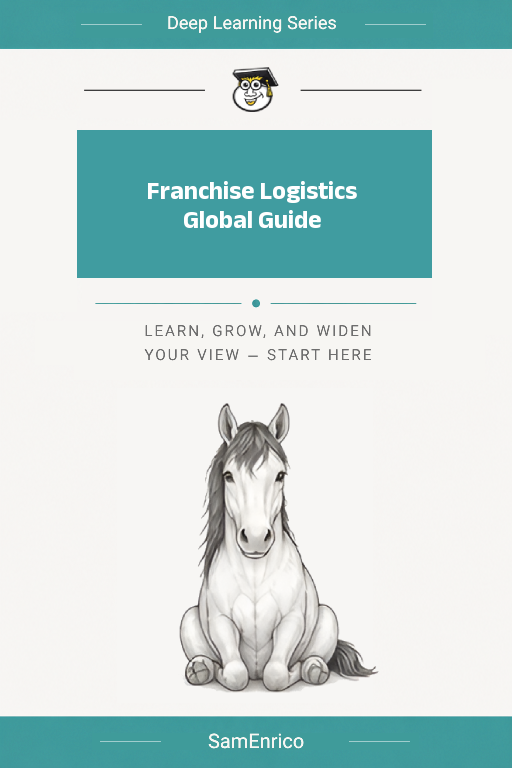
Non-FictionBusiness BriefInternational Expansion
Franchise Logistics Global Guide eBook
Manage logistics for international franchise netwo
Manage logistics for international franchise network. Distribution, inventory, and shipping.
Formats
Free sample
Chapter 1: The Franchise Paradox--–- Every morning, Maria checks two screens. On her left screen is a dashboard showing inventory levels, shipment tracking numbers, and supplier performance metrics for her 120-unit coffee franchise spanning fourteen countries. On her right screen is her email inbox, which contains exactly forty-seven unread messages from franchisees. Twenty-three of them are complaints about logistics. Seven are from franchisees asking if they can buy paper cups from a local supplier who charges twenty percent less than the approved vendor.
Three are from franchisees threatening to withhold royalty payments because a container of espresso beans arrived two weeks late. The remaining fourteen are polite inquiries about when the next shipment of branded merchandise will arrive, none of which she can answer with certainty.Maria is not a fictional character. She is a composite of every franchisor I have worked with over the past fifteen years. She is also proof of a fundamental truth that this book will explore across twelve chapters: in an international franchise network, logistics is not a back-office function. It is the physical expression of the brand promise.
And it is almost always broken.This chapter is about why that brokenness exists, why it is not your fault, and why pretending otherwise is the fastest path to failure. It is about the unique tension that makes franchise logistics different from every other form of supply chain management. And it is about the framework that will guide you through the rest of this book.The Core Problem: Two Masters, One Supply Chain Let us begin with a simple observation that most franchise executives never articulate out loud: a franchisee is not your employee. This seems obvious, yet most logistics systems are designed as if franchisees were company stores. Corporate-owned chains like Starbucks or Mc Donald's (in their corporate locations) have a single profit center.
When headquarters mandates a supplier, the store manager complies because their bonus depends on it. When inventory sits too long, the regional manager intervenes. When a shipment is late, the corporate logistics team absorbs the cost.A franchise is fundamentally different. Every franchisee is an independent business owner with their own profit and loss statement, their own bank loan, and their own survival instinct. When you mandate a specific supplier, they ask: "Is this the cheapest way?" When you require a specific shipping method, they ask: "Is this the fastest way?" When you demand that they follow your inventory guidelines, they ask: "Is this helping my bottom line?"These are not unreasonable questions.
They are the questions of a rational business owner. The problem is that the answers are often "no." Central supply chains are frequently more expensive than local alternatives because they include the franchisor's markup, international freight costs, and customs duties. Central shipping is often slower because ocean freight takes sixty days while a local truck takes two. Central inventory guidelines are often wrong because they are designed for averages, not for the specific demand patterns of a single store in a single market.This tension creates what I call The Franchise Paradox: the more you try to control the supply chain to protect the brand, the more you incentivize franchisees to defect. And the more they defect, the more the brand dilutes.
It is a vicious cycle that has killed more franchise expansions than bad products or weak marketing ever have.The Three Symptoms of a Broken Franchise Logistics System Before we solve the problem, we must diagnose it. Across hundreds of franchise networks, I have observed three predictable symptoms that indicate The Franchise Paradox is active in your organization.Symptom One: Rogue Sourcing Rogue sourcing occurs when franchisees buy from unauthorized suppliers. On the surface, this looks like rebellion. In reality, it is almost always economic rationality. When a franchisee can buy paper cups for twenty percent less from a local restaurant supply company than from your approved vendor, they will do so.
When they can source cleaning supplies from the local big-box store for half the price and receive them tomorrow instead of next month, they will do so.The franchisor's natural response is enforcement. Send a cease-and-desist letter. Threaten to revoke the franchise agreement. Deduct the cost from marketing funds. But enforcement without economic alignment is like trying to hold water in a sieve.
The franchisee will comply just long enough to get you off their back, then quietly return to the local supplier. Or worse, they will begin hiding their sourcing—ordering from approved vendors just enough to pass an audit, then supplementing with local purchases.I have seen one franchise network spend $200,000 on legal enforcement against rogue sourcing over eighteen months. At the end of that period, rogue sourcing had decreased by only seven percent. When they finally conducted a price audit, they discovered that their approved vendor was charging thirty-two percent more than local alternatives. The enforcement had been fighting economics, not behavior.Symptom Two: Chronic Stockouts The second symptom is the opposite of rogue sourcing.
Some franchisees stay within the approved system but constantly run out of inventory. They order too little, too late. They blame the franchisor for slow shipping, but the real problem is their own forecasting. Or rather, it is the system's failure to help them forecast.A franchisee in a tourist town may need four times the normal inventory during summer months. A franchisee near a stadium may need ten times the normal inventory on game days.
A franchisee in a new market may have no historical data at all. The centralized logistics system, designed for averages, treats all of these as outliers. The franchisee, left to their own devices, either over-orders (creating dead stock) or under-orders (creating stockouts).The stockout franchisee does not blame themselves. They blame you. And they are not entirely wrong.
Your system failed to provide them with the tools, the data, or the lead time visibility they needed to make good decisions.Symptom Three: The Frozen Middle The third symptom is the most insidious because it is invisible to most franchisors. The frozen middle occurs when franchisees stop complaining. They have given up on the central supply chain. They have found their own workarounds—local suppliers for some items, hoarding inventory for others, informal sharing networks with neighboring franchisees. They pay their royalties on time and never call the support line.
On paper, they look like perfect franchisees.In reality, they have mentally checked out of your logistics system. They are not rogue—they still order enough from approved vendors to pass an audit. But they are not engaged. They have built a shadow supply chain that you cannot see, cannot optimize, and cannot leverage for volume discounts. Your network purchasing power is fractured.
Your brand consistency is eroding. And you have no idea because no one is complaining.I once consulted for a 300-unit franchise where management proudly reported ninety-two percent compliance with the approved vendor list. When we conducted on-site audits of twenty randomly selected franchisees, we discovered that the real compliance rate was fifty-three percent. The frozen middle had learned exactly how much they needed to order from approved vendors to avoid triggering an audit flag. The rest came from…
This is the end of the free sample. Get the eBook to keep going. Buy now
About this book
Details
- Author
- Self Maryland
- Publisher
- SamEnrico
- Language
- English
- Genre
- Non-Fiction, Business Brief, International Expansion
- Released
- 2026-06-01
- Pages (approx.)
- 145
- Available as
- eBook, Audiobook

Read better in the ZLOADR app
Your eBooks on your phone or tablet. Sign in with your SamEnrico account and start reading.
More by Self Maryland
 Pattern Recognition in BehaviorSelf Maryland$11.99
 Guyanese Rice ExporterSelf Maryland$11.99
 Nuer Earth Priest Leopard SkinSelf Maryland$11.99
 The Chinese Tech Talent DispersionSelf Maryland$11.99
 The Phantom of Park Avenue: The First Ransomware Heist (1928)Self Maryland$11.99
 Understanding Segmental NeurofibromatosisSelf Maryland$17.99
 Reliability LeaderSelf Maryland$11.99
 Research Experience for AI Master'sSelf Maryland$12.99
 How to Start a National Library for The Blind Business (Beginners Guide)Self Maryland$11.99
You may also like
 Hong Kong Handover 1997Dunn Johnnie$11.99
 Zumba For Postnatal Recovery CourseNeal Christian$11.99
 Zumba for BeginnersLadner Nikia$11.99
 YouTube Comment Mining GuideHumes Pandora$12.99
 Worry Box MeditationCarlin Rudy$11.99
 Workplace Stress MeditationNguyen Lynn$11.99
 Workplace Stress and Sleep RepairHawley Ivory$11.99
 Workplace Perfectionism CureDelaney Jeffry$11.99
 Workplace Injustice Anger GuideWallen Isabelle$11.99
 Work Addiction and Burnout LinkGreenwood Ester$11.99
 Women in Yoga and WellnessBeattie Galina$11.99
 Women in Stand Up ComedyChun Evangeline$11.99