
Non-FictionBusiness BriefInternational Expansion
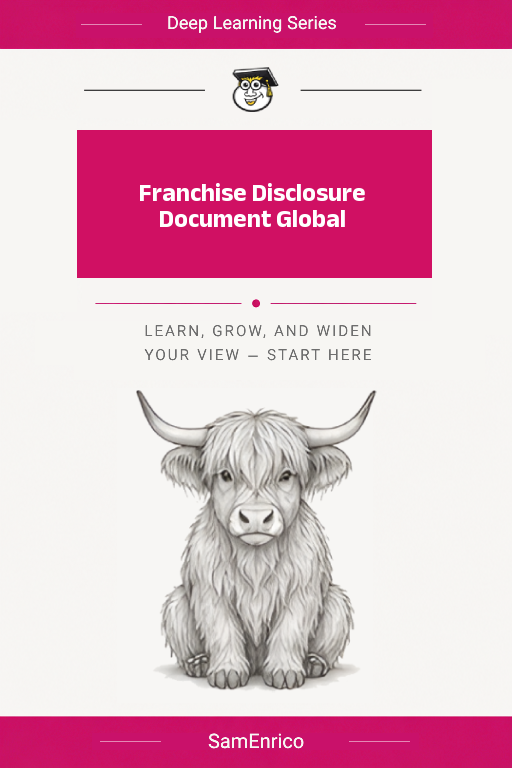
Franchise Disclosure Document Global eBook
Create Franchise Disclosure Documents for cross-bo
Create Franchise Disclosure Documents for cross-border expansion. Country-specific requirements explained.
Formats
Free sample
Chapter 1: The Map Is Not the Territory...–- Every year, hundreds of otherwise sophisticated franchisors learn the same expensive lesson: their beautifully drafted, litigator-approved, twenty-three-item US Franchise Disclosure Document is about as useful in São Paulo or Shanghai as a snow tire in the Sahara. They arrive at foreign borders clutching a document that has protected them for years, confident that translation software and a local notary will suffice. Within eighteen months, many are staring down six-figure legal claims, rejected registrations, or franchisees who have simply stopped paying royalties because the disclosure document never told them they actually had to pay.The problem is not bad intentions. The problem is a fundamental category error. Most US franchisors believe that franchise disclosure is a universal concept—that every country has something roughly like the FTC Rule, just with different delivery deadlines and language requirements.
This belief is wrong, and it is expensive. The truth is that the world operates under at least three fundamentally different legal philosophies about what a disclosure document should do, how it should be structured, and what happens when you get it wrong. Until you understand these philosophies, you cannot draft a single page of a cross-border FDD without exposing your entire system to catastrophic risk.This chapter is not a gentle warm-up. It is a demolition of the assumption that the US FDD is a portable template. We will map the standard US structure (Items 1 through 23) as a baseline, then systematically dismantle the idea that this framework works internationally.
You will learn the critical distinction between disclosure regimes, pre-contractual information regimes, and hybrid registration regimes—a classification system that does not appear in any single existing text but that experienced international franchise lawyers use implicitly. By the end of this chapter, you will understand why copying your US FDD into a new language is not merely ineffective but affirmatively dangerous, and you will have a decision matrix to classify any country before you write a single word of your new disclosure document.The Anatomy of the American Beast Before we can understand why the US model fails abroad, we must understand what it actually requires. The FTC Amended Franchise Rule (effective July 1, 2008) mandates a disclosure document organized into twenty-three specific items. These items are not suggestions; they are prescriptive requirements. Item 1 identifies the franchisor and any predecessors.
Item 2 lists business experience of key executives. Item 3 discloses litigation history. Item 4 reveals bankruptcy filings. Item 5 outlines initial franchise fees. Item 6 covers other fees.
Item 7 estimates the initial investment. Item 8 restricts sources of products and services. Item 9 describes franchisee obligations. Item 10 addresses financing arrangements. Item 11 provides detailed information about the franchisor’s assistance, training, and advertising.
Item 12 defines territory rights. Item 13 discloses trademarks. Item 14 covers patents and copyrights. Item 15 requires franchisee participation in operations. Item 16 restricts goods and services the franchisee may sell.
Item 17 governs renewal, termination, transfer, and dispute resolution. Item 18 addresses public figures. Item 19 allows (but does not require) financial performance representations. Item 20 discloses outlet information and franchisee contacts. Item 21 requires audited financial statements.
Item 22 mandates a copy of all franchise agreements. Item 23 provides a receipt page.This structure reveals the underlying philosophy of the US approach: disclosure as fraud prevention. The FTC Rule assumes that if you give a prospective franchisee enough specific information in a standardized format, they can make an informed decision, and any deviation from that format signals potential fraud. The emphasis is on pre-sale delivery—the famous fourteen-day rule requiring that the FDD be delivered at least fourteen calendar days before the franchisee signs any binding agreement or pays any consideration. The enforcement mechanism is primarily private litigation (franchisee lawsuits) and state-level registration requirements in fourteen states that add another layer of pre-clearance.Crucially, the US model treats the FDD as a disclosure document only.
It does not require government approval of the content before the document can be used (except in registration states, and even there the review is largely ministerial). The franchisor drafts, the franchisee receives, and the court sorts out disputes later. This is a common law solution to a commercial problem: give the parties information, let them contract, and clean up the mess afterward.This works reasonably well in the United States because the legal system is predictable, franchisee lawsuits are common enough to deter gross misconduct, and the FTC has enforcement authority. But export this model to a country with a different legal tradition, and the entire framework collapses.The Three Global Regimes: A New Classification System After analyzing franchise laws across more than forty countries, a clear pattern emerges. Despite the surface diversity, every jurisdiction falls into one of three fundamental regimes.
Understanding which regime governs your target country is the single most important step in drafting a compliant disclosure document. The regime tells you what the document must contain, how it must be delivered, who reviews it before use, and what happens if you make a mistake.Regime One: Prescriptive Disclosure (United States, Canada, Brazil, China, Vietnam, South Korea)These countries mandate a specific, itemized disclosure document with mandatory contents enumerated by statute or regulation. The format is largely non-negotiable. If the law says you must disclose the franchisor’s litigation history for the past ten years, you must disclose it exactly as specified. If the law says you must use a particular cover page with particular font sizes, you use that cover page.
These regimes often require government registration or filing before the document can be used, and failure to comply can void the franchise agreement entirely or bar the franchisor from enforcing any rights in court.Brazil’s Lei de Franquias (Law 13.966/2019) is a textbook example. The COF (Circular de Oferta de Franquia) must include specific financial statements, the litigation history of both the franchisor and any master franchisee, a detailed description of the territory, and an arbitration clause that complies with Brazilian arbitration law. The format is prescribed; you cannot add creative flourishes or omit sections because you think they are irrelevant. The penalty for non-compliance is rescission—the franchisee can unwind the entire deal and recover all fees paid.China’s MOFCOM regulations operate similarly. The disclosure document must be filed with the Ministry of Commerce, and until that filing is accepted, you cannot legally offer or sell a franchise.
The required contents include proof that the franchisor has operated at least two company-owned units in China for more than one year—a requirement that has no analogue in US law. Disclose a US trademark registration without also disclosing the status of your Chinese application, and the MOFCOM filing will be rejected.Regime Two: Pre-Contractual Information (European Union member states, United Kingdom, Australia, Japan, UAE)These jurisdictions take a fundamentally different approach. Rather than prescribing a specific document format, they impose a general duty to provide all material information that a reasonable franchisee would need to make an informed decision. The format is flexible; the liability for omissions is strict. If a court later determines that you failed to disclose something a reasonable franchisee would consider important—even if that something is not listed in any statute—you can be liable for rescission, damages, or both.France’s Loi Doubin (actually codified in the Commercial Code) requires…
This is the end of the free sample. Get the eBook to keep going. Buy now
About this book
Details
- Author
- Burgess Caroline
- Publisher
- SamEnrico
- Language
- English
- Genre
- Non-Fiction, Business Brief, International Expansion
- Released
- 2026-06-01
- Pages (approx.)
- 155
- Available as
- eBook, Audiobook

Read better in the ZLOADR app
Your eBooks on your phone or tablet. Sign in with your SamEnrico account and start reading.
More by Burgess Caroline
 The Eyewitness Identification AppBurgess Caroline$11.99
 Mapuche Machi Healing TableBurgess Caroline$11.99
 Divorce Litigation SurvivalBurgess Caroline$11.99
 Naturopathy for Hormone BalanceBurgess Caroline$11.99
 The Prostate Chemotherapy GuideBurgess Caroline$11.99
 The Dubai Gold Scam: How a Billionaire's Betrayal Shattered Trust in the Middle EastBurgess Caroline$11.99
 UK Masters in AI Program GuideBurgess Caroline$12.99
 How to Start a Petting Zoos BusinessBurgess Caroline$11.99
 Quantitative AnalystBurgess Caroline$11.99
 Understanding Sclerosing MesenteritisBurgess Caroline$17.99
You may also like
 Hong Kong Handover 1997Dunn Johnnie$11.99
 Zumba For Postnatal Recovery CourseNeal Christian$11.99
 Zumba for BeginnersLadner Nikia$11.99
 YouTube Comment Mining GuideHumes Pandora$12.99
 Worry Box MeditationCarlin Rudy$11.99
 Workplace Stress MeditationNguyen Lynn$11.99
 Workplace Stress and Sleep RepairHawley Ivory$11.99
 Workplace Perfectionism CureDelaney Jeffry$11.99
 Workplace Injustice Anger GuideWallen Isabelle$11.99
 Work Addiction and Burnout LinkGreenwood Ester$11.99
 Women in Yoga and WellnessBeattie Galina$11.99
 Women in Stand Up ComedyChun Evangeline$11.99