
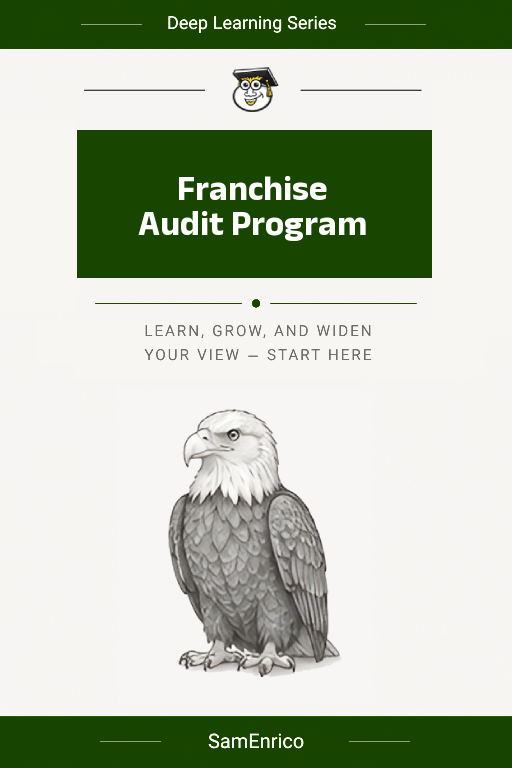
Franchise Audit Program eBook
Conduct international franchise audits for complia
by Held Magan
Conduct international franchise audits for compliance, operations, and financial reporting. Schedule remote and in-person audits across time zones efficiently.
Formats
Free sample
Chapter 1: The Fraud You Don't See...--I watched the franchisee's hands tremble as I slid the forty-three-page audit report across the sticky plastic table. The fluorescent lights of his donut shop hummed overhead, casting a sickly yellow glow on the stack of evidence I had spent the past six weeks assembling. He had been in the system for eleven years. He owned seven locations. He drove a new Porsche.
He was also, I had just proven, stealing approximately $147,000 per year in underreported royalties."You can't prove anything," he whispered, his eyes darting from the report to the door, calculating his escape.I clicked my laptop. The screen lit up with a spreadsheet I had built from three different data sources: his POS system, his vendor purchase records, and his own bank deposits. The columns told a story his mouth could not deny."Your POS shows you sold 84,000 donuts last month," I said quietly. "Your vendor invoice shows you bought enough flour and sugar for 112,000 donuts. That gap of 28,000 donuts is approximately 11,200inunrecordedcashsales.Ata6percentroyaltyrate,youoweus11,200 in unrecorded cash sales.
At a 6 percent royalty rate, you owe us 11,200inunrecordedcashsales.Ata6percentroyaltyrate,youoweus672 for that month alone. Multiply by twelve months. Multiply by three years. Then add interest and penalties."He stopped trembling. His face went pale, then red, then slack.
"What do you want me to do?""Pay what you owe. Fix your systems. Or I come back next month with a termination notice."That franchisee paid $412,000 within fourteen days. He also installed a cloud-based POS that reported every transaction in real time. Two years later, he thanked me.
Not because he enjoyed being caught, but because the audit forced him to run an honest business, and his profits went up when he stopped hiding cash and started managing operations.That is the paradox of the franchise audit. Franchisees fear it. Franchisors dread administering it. And yet, when done right, the audit is the single most profitable, relationship-building, brand-protecting tool in the entire franchising toolkit.But most franchisors never discover that truth. They treat audits as a necessary evil, a reactive weapon deployed only when royalties dip or complaints rise.
They audit the angry franchisee, the one who stopped paying, the one who opened a competing concept. By then, the relationship is already poisoned, the money is already gone, and the lawyer is already billing.This book exists because I have seen the alternative. I have seen a 500millionfranchisesystemrecover500 million franchise system recover 500millionfranchisesystemrecover2.3 million in a single year just by auditing consistently. I have seen a franchisee who was caught stealing become the top performer in the system after remediation. I have seen brands expand across six continents with a fraction of the legal disputes their competitors faced, all because they mastered the art and science of the global franchise audit.But I have also seen the disasters.I have seen a US-based franchisor face criminal charges in Germany because their auditor accessed employee data without consent under GDPR.
I have seen a Canadian franchisee win a wrongful termination lawsuit because the franchisor's audit documentation was a pile of handwritten notes on unlined paper. I have seen a brand lose $400 million in market capitalization because a single franchisee's dirty bathroom went viral on social media and the franchisor had no audit system in place to catch it before the customer did.This book is the playbook I wish I had twenty years ago. It distills everything I have learned from conducting, defending, and teaching international franchise audits across thirty-seven countries, six continents, and twelve time zones. It is not a theoretical treatise. It is a field guide.
Every chapter contains templates, scripts, checklists, and case studies you can adapt to your system tomorrow.But before we get to the how, we must confront the why. And the why begins with a distinction that most franchise professionals never make, a distinction that will determine whether you read this book as a defensive manual or an offensive weapon.The Three Franchisees You Will Audit Most people think of franchisees as a single category: business owners who have bought the right to operate under your brand. Some are good. Some are bad. That is the limit of the analysis.This binary thinking is why most audit programs fail.In reality, franchisees fall into three distinct categories, each requiring a completely different audit approach, a completely different auditor demeanor, and a completely different post-audit process.
Confuse the categories, and you will either terrorize your best operators or go soft on your worst cheaters.Type A: The Well-Intentioned Inconsistent (Approximately 70 percent of franchisees)These franchisees want to comply. They believe in the brand. They pay their royalties on time, mostly. They follow the operations manual, mostly. Their failures are not malicious; they are the result of poor training, unclear standards, or simple human error.The Type A franchisee might miss a marketing deadline because they were busy managing a family emergency.
They might underreport sales because their POS system is outdated and they do not know how to run the correct report. They might fail a cleanliness inspection because their night crew quit and they have been working double shifts for two weeks.When you audit a Type A franchisee, the correct response is coaching. Your tone should be collaborative. Your findings should come with solutions. Your post-audit follow-up should include training resources and check-in calls.If you treat a Type A franchisee like a criminal, you will create a Type B franchisee.
They will stop trusting you. They will start hiding problems instead of solving them. They will become adversarial because you made them adversarial.Type B: The Calculated Corner-Cutter (Approximately 25 percent of franchisees)These franchisees know the rules and choose to bend them. They are not malicious, exactly. They are opportunistic.
They have done the mental math: the probability of getting caught is low, and the penalty for getting caught is manageable, so the expected value of cheating is positive.The Type B franchisee might underreport cash sales by 10 percent, just enough to boost their bottom line without triggering obvious flags. They might skip required maintenance, hoping the equipment holds out one more quarter. They might pay royalties late because the float gives them interest-free working capital.When you audit a Type B franchisee, the correct response is deterrence. Your tone should be professional and neutral, not friendly and not hostile. Your audit should be thorough and unpredictable.
Your findings should be accompanied by clear calculations of what they owe, plus interest and penalties. Your post-audit follow-up should include increased audit frequency until they demonstrate sustained compliance.Type B franchisees will stop cheating when the expected value flips negative. That only happens when the probability of getting caught is high and the penalty is certain. Consistency is your weapon. If you audit them once and then disappear for two years, they will revert.
If you audit them quarterly, they will comply.Type C: The Active Fraudster (Approximately 5 percent of franchisees)These franchisees are not partners in your brand; they are predators. They have two sets of books. They maintain off-the-books cash drawers. They have relationships with vendors who will falsify invoices. They may have…
This is the end of the free sample. Get the eBook to keep going. Buy now
About this book
Details
- Author
- Held Magan
- Publisher
- SamEnrico
- Language
- English
- Genre
- Non-Fiction, Business Brief
- Released
- 2026-06-01
- Pages (approx.)
- 146
- Available as
- eBook, Audiobook

Read better in the ZLOADR app
Your eBooks on your phone or tablet. Sign in with your SamEnrico account and start reading.
More by Held Magan
 Step Ten Spot Check InventoryHeld Magan$11.99
 Sleep HGH Optimization CourseHeld Magan$11.99
 Metta for Unborn ChildHeld Magan$11.99
 Walton's Vendor PartnershipsHeld Magan$11.99
 The Forgotten Spans: Britain's Bridge Builders and the Cold War's Hidden BattlegroundsHeld Magan$11.99
 How to Become a Batch-and-furnace OperatorHeld Magan$11.99
 Collecting Conifer ConesHeld Magan$11.99
 How to Produce BowlsHeld Magan$11.99
You may also like
 Hong Kong Handover 1997Dunn Johnnie$11.99
 Zumba For Postnatal Recovery CourseNeal Christian$11.99
 Zumba for BeginnersLadner Nikia$11.99
 YouTube Comment Mining GuideHumes Pandora$12.99
 Worry Box MeditationCarlin Rudy$11.99
 Workplace Stress MeditationNguyen Lynn$11.99
 Workplace Stress and Sleep RepairHawley Ivory$11.99
 Workplace Perfectionism CureDelaney Jeffry$11.99
 Workplace Injustice Anger GuideWallen Isabelle$11.99
 Work Addiction and Burnout LinkGreenwood Ester$11.99
 Women in Yoga and WellnessBeattie Galina$11.99
 Women in Stand Up ComedyChun Evangeline$11.99