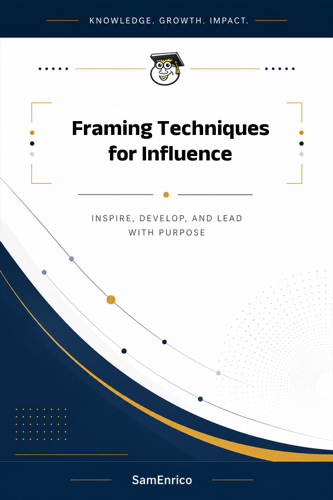
Framing Techniques for Influence eBook
Present choices to highlight preferred option.
by Bedard Zelda
Present choices to highlight preferred option.
Formats
Free sample
Chapter 1: The Architect's Mirror--–- Every morning, you wake up and make choices. What to eat for breakfast. Which route to take to work. What to read first on your phone. You experience these decisions as free, autonomous acts of will.
But here is the uncomfortable truth that this entire book rests upon: someone has already shaped every single one of those choices before you arrived.The layout of your grocery store was designed by a team of merchandising experts who know that placing milk at the back forces you to walk past hundreds of other products. The default settings on your phone were chosen by engineers who decided that push notifications should be on by default because that drives engagement. The order of candidates on your ballot was determined by a rule that gives primacy to incumbents or alphabetically favored names. Even the question “Paper or plastic?” at checkout was written to imply those are the only two options worth considering.You are swimming in an ocean of choice architecture. And you have never seen the water.This chapter introduces the single most important shift in perspective you will make as a reader of this book: the realization that there is no neutral way to present choices.
Every menu, every form, every pricing page, every email, every conversation—every single one is a piece of choice architecture that systematically influences outcomes. Refusing to design is still designing, just poorly. Ignoring framing is not avoiding manipulation; it is surrendering control to whoever set the defaults first.Welcome to the architect’s mirror. Look into it, and you will never see decisions the same way again.The Myth of the Neutral Option Let us begin with a thought experiment. Imagine you are responsible for designing a voter registration form for a new democracy.
The form asks one question: “Do you wish to register to vote?” There is a checkbox for “Yes” and a checkbox for “No.” Simple, neutral, unbiased. Or so it seems.Now consider two versions. Version A has the “Yes” box checked by default. Version B has neither box checked. Version C has the “No” box checked by default.
All three forms contain exactly the same words, the same options, the same legal effect. But they will produce wildly different registration rates. In Version A, registration might hit 90 percent because inertia carries people forward. In Version B, it might drop to 60 percent because people have to make an active choice. In Version C, it might plummet to 40 percent because unchecking a box feels like work.Which version is neutral?
None of them. The very act of arranging the form—deciding whether to pre-select an option, deciding which option goes first, deciding which font size to use, deciding where to place the instruction text—each of these micro-decisions tilts the outcome in a direction. The designer cannot escape responsibility. Even the choice to leave the form blank is a choice: the choice to let whatever random factors exist (laziness, distraction, fatigue) determine the result.This is the central insight of choice architecture, a term popularized by Nobel laureate Richard Thaler and legal scholar Cass Sunstein in their seminal work Nudge. A choice architect is anyone who structures the context in which others decide.
That includes web designers, product managers, parents, doctors, politicians, teachers, and you. The moment you arrange options for another human being—even if that arrangement is as simple as saying “Would you like coffee or tea?” instead of “Would you like tea or coffee?”—you are acting as a choice architect.The myth of neutrality is seductive because it absolves us of responsibility. “I’m just presenting the facts,” people say. “I’m not manipulating anyone.” But facts do not present themselves. Facts are framed.
A speed limit sign that says “Maximum Speed 65 MPH” is not the same as a sign that says “Minimum Speed 45 MPH” even though both describe the same law. A doctor who says “Ninety percent of patients survive this surgery” is not saying the same thing as “Ten percent of patients die,” even though the numbers are mathematically identical.The question is never whether you are framing. The question is whether you are framing consciously, ethically, and effectively—or haphazardly, ignorantly, and dangerously.The Cafeteria That Changed Everything Perhaps the most famous demonstration of choice architecture in action comes from an unlikely place: a corporate cafeteria. Before we dive into the details, note that this case study has been adapted and verified across multiple behavioral economics texts, including Thaler and Sunstein’s original work and subsequent field studies.Carolyn, a newly hired director of dining services at a large technology company, faced a problem. The company had invested heavily in wellness programs, but employees continued to choose burgers, fries, and sodas over salads, grilled chicken, and water.
The cafeteria offered both sets of options, yet the unhealthy choices dominated. Carolyn’s predecessor had tried education—posters about nutrition, calorie counts on menus, even mandatory wellness seminars. Nothing worked.So Carolyn tried something different. She did not remove a single unhealthy item. She did not raise prices.
She did not ban anything. Instead, she rearranged the cafeteria. She moved the salad bar from the back corner to the front, directly in the flow of traffic as employees entered. She placed the burger station in a side room, out of the main sightline. She put bottled water and fruit at eye level in the refrigerators and moved sodas to the bottom shelf.
She replaced the default side option from fries to a small salad—employees could still ask for fries, but they had to make an active request.The results were staggering. Salad consumption tripled. Burger sales dropped by 40 percent. Soda purchases fell by nearly a third. Water and fruit sales soared.
And here is the critical detail: when surveyed, employees overwhelmingly reported that they had made their own choices freely. Few noticed the layout changes. None felt manipulated. They simply believed they had decided to eat healthier.Carolyn understood something profound. People want to make good choices, but they are busy, distracted, and influenced by their environment.
By changing the architecture of the cafeteria, she did not force anyone to eat a salad. She simply made the healthy choice the easy choice, the visible choice, the default choice. She preserved autonomy while guiding behavior.This is the essence of ethical framing. It is not about tricking people. It is about recognizing that people already have preferences, goals, and values—and then designing the choice environment so that their behavior aligns with those deeper commitments.
The employees wanted to be healthy. Carolyn helped them act on that desire. She did not implant a new preference; she removed friction from an existing one.Coercion, Nudging, and the Critical Distinction Before we go any further, we must draw a bright ethical line. There is a world of difference between framing and forcing. That difference is the difference between influence and coercion.Coercion removes options or imposes costs so severe that choice becomes illusory.
A dictator who says “Vote for me or go to prison” is not framing; he is threatening. A company that cancels your account without…
This is the end of the free sample. Get the eBook to keep going. Buy now
About this book
Details
- Author
- Bedard Zelda
- Publisher
- SamEnrico
- Language
- English
- Genre
- Non-Fiction, Self-Help, Framing
- Released
- 2026-06-10
- Pages (approx.)
- 146
- Available as
- eBook, Audiobook

Read better in the ZLOADR app
Your eBooks on your phone or tablet. Sign in with your SamEnrico account and start reading.
More by Bedard Zelda
 Stress Perfectionism Health CostBedard Zelda$11.99
 Problem Statement WorkbookBedard Zelda$11.99
 Sexual Sobriety Affirmations AudioBedard Zelda$11.99
 Embers of the First Flame: How Fire Shaped HumanityBedard Zelda$11.99
 Learn to Play the Irish BouzoukiBedard Zelda$11.99
 Manager Financial Planning & AnalysisBedard Zelda$11.99
 Remote Presentation Vocal TipsBedard Zelda$12.99
 How to Become a MailerBedard Zelda$11.99