
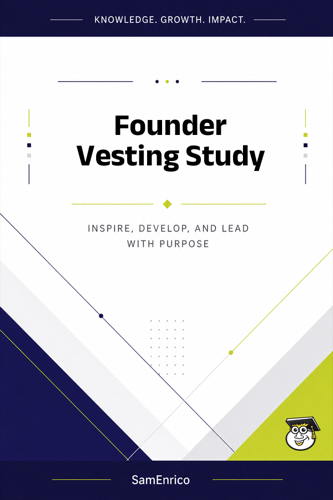
Non-FictionCapital & Valuation RegisterFounder Terms
Founder Vesting Study Audiobook
Cliff and vesting schedules for founders across 1,
by Mccurdy Suzy
Cliff and vesting schedules for founders across 1,000 VC deals.
Formats
Free sample
Chapter 1: The Four-Year Lie--–- Most founders believe they understand founder vesting. They have heard the mantra repeated at startup accelerators, in VC pitch meetings, and across every term sheet they have ever seen: “Four years with a one-year cliff. It’s market. It’s standard. Don’t worry about it.”This is a lie.
Not a malicious one, necessarily, but a dangerous oversimplification that has cost founders more than one billion dollars in forfeited equity over the past decade.The truth is that the “standard” four-year vesting schedule is anything but standard once you look beyond the first page of a term sheet. In the dataset of one thousand Seed to Series B deals analyzed for this book, four-year vesting appeared in eighty-nine percent of initial proposals. But here is the statistic that should keep every founder awake at night: only seventy-two percent of final executed deals retained that four-year structure. The other seventeen percent of deals shifted to three, five, or even six-year vesting schedules after negotiation. And in many of those cases, founders did not realize they had conceded years of additional service until long after the documents were signed.This chapter dismantles the Four-Year Lie.
It explains where the four-year standard came from, why it is breaking apart in today’s extended liquidity environment, and how founders can protect themselves from the creeping expansion of vesting periods. More importantly, it introduces the concept of the “Vesting Gap”—the difference between your vesting period and your actual time to exit—and shows why closing that gap is the single most important negotiation you will ever have with your investors.The Historical Accident: Why Four Years Became “Standard”The four-year vesting schedule was not designed by a committee of wise elders who calculated the optimal retention period for startup founders. It was an accident of history, borrowed from public company executive compensation plans in the 1980s and 1990s.During that era, the average time from a company’s initial public offering to a senior executive’s departure was approximately four years. Stock option plans for public company executives adopted four-year vesting schedules to align incentives—executives would stay long enough to see their grants mature. When venture capital began booming in the late 1990s, lawyers simply copied these public company templates into private startup term sheets.
No one stopped to ask whether the logic applied to founders who had already been working for two years before…
This is the end of the free sample. Get the Audiobook to keep going. Buy now
About this book
Details
- Author
- Mccurdy Suzy
- Publisher
- SamEnrico
- Language
- English
- Genre
- Non-Fiction, Capital & Valuation Register, Founder Terms
- Released
- 2026-06-08
- Pages (approx.)
- 142
- Available as
- eBook, Audiobook

Listen in the VoxFlicks app
Audiobooks and audio dramas wherever you go. Sign in with your SamEnrico account and press play.
More by Mccurdy Suzy
 The Old Oak Tree RestMccurdy Suzy$11.99
 The Cybersecurity Analyst StressMccurdy Suzy$11.99
 Group Hypnosis Script WritingMccurdy Suzy$11.99
 Chloride Electrolyte Balance GuideMccurdy Suzy$11.99
 The Toastmasters CompanionMccurdy Suzy$11.99
 OCD Apps GuideMccurdy Suzy$11.99
 Time Blocking For RetirementMccurdy Suzy$11.99
 The Silk Throne: How a Female Crime Boss Ruled Hong Kong’s UnderworldMccurdy Suzy$11.99
 The Unseen Hand: The Mysterious Disappearance of Louis Le PrinceMccurdy Suzy$11.99
 Prompt Engineering for Cybersecurity AnalysisMccurdy Suzy$11.99
 Third Party Endorsement During ScandalMccurdy Suzy$12.99
 Employer Obligations for LLC GuideMccurdy Suzy$12.99
You may also like
 Hong Kong Handover 1997Dunn Johnnie$11.99
 Zumba For Postnatal Recovery CourseNeal Christian$11.99
 Zumba for BeginnersLadner Nikia$11.99
 YouTube Comment Mining GuideHumes Pandora$12.99
 Worry Box MeditationCarlin Rudy$11.99
 Workplace Stress MeditationNguyen Lynn$11.99
 Workplace Stress and Sleep RepairHawley Ivory$11.99
 Workplace Perfectionism CureDelaney Jeffry$11.99
 Workplace Injustice Anger GuideWallen Isabelle$11.99
 Work Addiction and Burnout LinkGreenwood Ester$11.99
 Women in Yoga and WellnessBeattie Galina$11.99
 Women in Stand Up ComedyChun Evangeline$11.99