
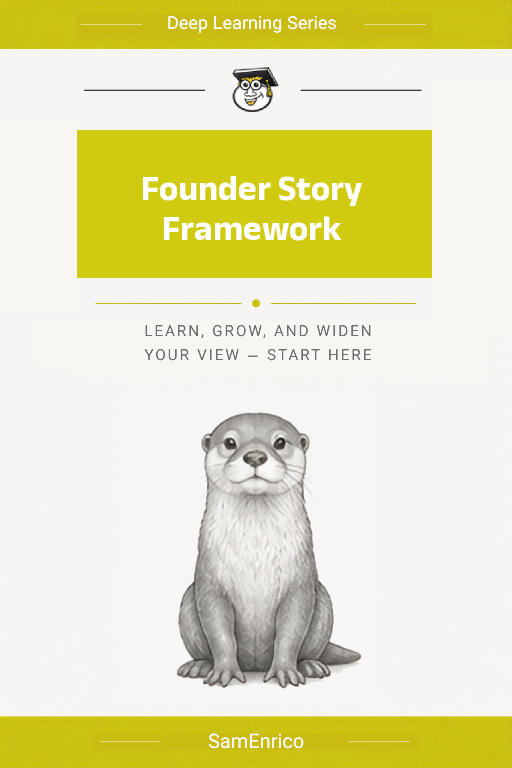
Non-FictionStartup GuideStorytellingFounder Narrative
Founder Story Framework eBook
Write your founder story in 500 words with a probl
by Wren Mason
Write your founder story in 500 words with a problem, struggle, and breakthrough.
Formats
Free sample
Chapter 1: The Logic Trap--–- In 2014, a founder named Sarah walked into a venture capital firm’s boardroom with a fifty-slide deck. Each slide was a masterpiece of data. She had market size projections, five-year revenue forecasts, customer acquisition cost models, and a sensitivity analysis that would make a Mc Kinsey consultant weep. She practiced for three weeks. She knew every number backward.
She answered every question with precision.She was rejected in eighteen minutes.The lead partner said something she never forgot: “I believe your numbers. I just don’t believe you.”That same week, a different founder—let’s call him Marcus—walked into the same boardroom. His deck was seven slides. His revenue forecast was a single line on a napkin taped to page three. But he started with a story.
He described the night his mother was charged an overdraft fee of thirty-seven dollars for a transaction that brought her account to negative twelve cents. He described watching her cry at the kitchen table. He described building a banking app in his garage while working two jobs.He received a term sheet in five days.This is not an anomaly. This is the attention economy. And most founders are losing because they are trying to win a logic competition in an emotion-driven world.The Eighteen-Minute Failure Let us linger on Sarah for a moment, because her failure was not a failure of competence.
It was a failure of framing. She believed that investors, customers, and talent are rational actors who make decisions by weighing evidence. This is what every business school teaches. This is what every pitch coach implies. This is what the entire startup industrial complex reinforces.It is also scientifically wrong.The neuroeconomic research of Antonio Damasio, whose work on the Iowa Gambling Task revolutionized our understanding of decision-making, demonstrated that patients with damage to the ventromedial prefrontal cortex—the part of the brain that processes emotion—could describe the logical pros and cons of a decision perfectly.
They could list risks. They could calculate probabilities. But they could not decide. They would spend hours debating whether to schedule an appointment at 2:00 PM or 3:00 PM. Without emotional input, logic alone cannot produce a choice.Every investor, customer, and employee you will ever face has an intact ventromedial prefrontal cortex.
They are making emotional decisions and then justifying them with logic. Your fifty-slide deck addresses the justification. It does not address the decision.Sarah’s deck was a masterpiece of post-hoc rationalization disguised as pre-decision evidence. Marcus’s story was a key that unlocked the emotional door.The Status Quo Bias: Your Silent Competitor There is a second, more insidious force working against you. It is called the status quo bias, and it is the single most underappreciated obstacle in every founder’s journey.The status quo bias is a cognitive heuristic identified by researchers William Samuelson and Richard Zeckhauser in 1988.
In study after study, they found that people overwhelmingly prefer to stick with their current situation—even when an alternative is objectively better—because the pain of change feels larger than the gain of improvement.Let me give you a concrete example. In one study, participants were offered a free coffee mug. Later, they were given the option to trade the mug for a chocolate bar of equal value. Most kept the mug. Another group was offered the chocolate bar first, then the option to trade for the mug.
Most kept the chocolate bar. The mere fact of already having something made it feel more valuable than the alternative. Loss aversion—the fear of losing what you have—is twice as powerful as the desire to gain something new.Now apply this to your founder story.Every investor you pitch already has a portfolio. Every customer you target already has a solution (even if that solution is “doing nothing” or “using a messy spreadsheet”). Every employee you want to hire already has a job.
Your product might be ten times better, cheaper, faster, and more elegant. It does not matter. The status quo bias is whispering in their ear: “What you have now is fine. Change is risky. Stay put.”How do you overcome the status quo bias?
You cannot overpower it with more data. Data does not make the status quo feel less comfortable. You must destabilize the status quo. You must make the current situation feel unbearable. You must make the cost of doing nothing feel larger than the risk of change.And that requires a story.The Three-Act Structure for Business Before we go further, let me define what I mean by “story.” I am not talking about a chronological autobiography.
I am not talking about a mission statement dressed in narrative clothing. I am talking about a specific, transferable structure that has been used for thousands of years, from Homer to Hollywood, from Steve Jobs to Oprah Winfrey.The three-act structure is not a creativity gimmick. It is a neurological mirror.Act One: The Setup In this act, you establish the ordinary world. You show how things are before the change. Crucially, you do not describe this world neutrally.
You describe it as frustrating. You linger on the friction. You make the audience feel the annoyance, the waste, the small humiliations of the status quo. This is where you name the villain—not a person, but a condition. Inefficiency.
Isolation. Missed opportunities. Financial insecurity.The Setup ends with an inciting incident: a specific moment when the status quo became unbearable. This is not “the market was ready for disruption.” This is “on a Tuesday afternoon, I watched my mother cry over a thirty-seven-dollar fee.”Act Two: The Confrontation This is the struggle. Most founders skip this act entirely, jumping from “I had an idea” to “we succeeded.” This is a catastrophic error.
The Confrontation is where trust is built. It is where you show the valley of despair—the rejected pitches, the missed payroll, the sleepless nights, the moment you almost quit.The neuroscientific reason is oxytocin. When you share vulnerability, your audience’s brain releases oxytocin, the hormone associated with trust and bonding. Paul Zak, a neuroeconomist at Claremont Graduate University, found that character-driven stories reliably produce oxytocin synthesis and lead to increased generosity and cooperation. But here is the crucial detail: the story must maintain attention and must contain tension.
A flat narrative of success produces no oxytocin. A narrative of struggle, followed by resolution, produces significant oxytocin.Act Three: The Resolution This is your breakthrough. But note carefully: the breakthrough is not “we raised money” or “we launched the product.” Those are events. The breakthrough is a lesson learned. It is the insight that changed everything.
It is the gift you are offering to the audience.The Resolution must answer the question: “What did you learn that I can use?” If your story ends with your success, you have written a brag. If your story ends with a transferable lesson, you have written a gift.Why Logic Alone Fails Let me anticipate an objection. Some founders will read this and think, “But my investors are different. They are quantitative. They run hedge funds.
They have Ph Ds in economics. They only care about data.”This objection is seductive and wrong.In 2005, researchers at Princeton…
This is the end of the free sample. Get the eBook to keep going. Buy now
About this book
Details
- Author
- Wren Mason
- Publisher
- SamEnrico
- Language
- English
- Genre
- Non-Fiction, Startup Guide, Storytelling, Founder Narrative
- Released
- 2026-05-29
- Pages (approx.)
- 120
- Available as
- eBook, Audiobook

Read better in the ZLOADR app
Your eBooks on your phone or tablet. Sign in with your SamEnrico account and start reading.
More by Wren Mason
 Hillary Everest Fame BurdenWren Mason$11.99
 The Workaholic's Relapse PreventionWren Mason$11.99
 Empathetic Listening NVC GuideWren Mason$11.99
 Twelve Step Co Sponsor GuideWren Mason$11.99
 Stress Histamine IntoleranceWren Mason$11.99
 Emotional Intelligence for Gig WorkersWren Mason$11.99
 Tsunami Wall SurvivorWren Mason$11.99
 Shimon bar Yochai Zohar SecretsWren Mason$11.99
 Ragnarok and the Serpent’s Curse: A Norse-Meets-Hindu Cosmic ClashWren Mason$11.99
 The Architect of the Achaemenid Grandeur: The Black Genius Behind PersepolisWren Mason$11.99
 Midnight in the Millennium: The Y2K Bank Run That Almost Broke the WorldWren Mason$11.99
 How to Start a Cresylic Acid Business (Beginners Guide)Wren Mason$11.99
You may also like
 Hong Kong Handover 1997Dunn Johnnie$11.99
 Zumba For Postnatal Recovery CourseNeal Christian$11.99
 Zumba for BeginnersLadner Nikia$11.99
 YouTube Comment Mining GuideHumes Pandora$12.99
 Worry Box MeditationCarlin Rudy$11.99
 Workplace Stress MeditationNguyen Lynn$11.99
 Workplace Stress and Sleep RepairHawley Ivory$11.99
 Workplace Perfectionism CureDelaney Jeffry$11.99
 Workplace Injustice Anger GuideWallen Isabelle$11.99
 Work Addiction and Burnout LinkGreenwood Ester$11.99
 Women in Yoga and WellnessBeattie Galina$11.99
 Women in Stand Up ComedyChun Evangeline$11.99