
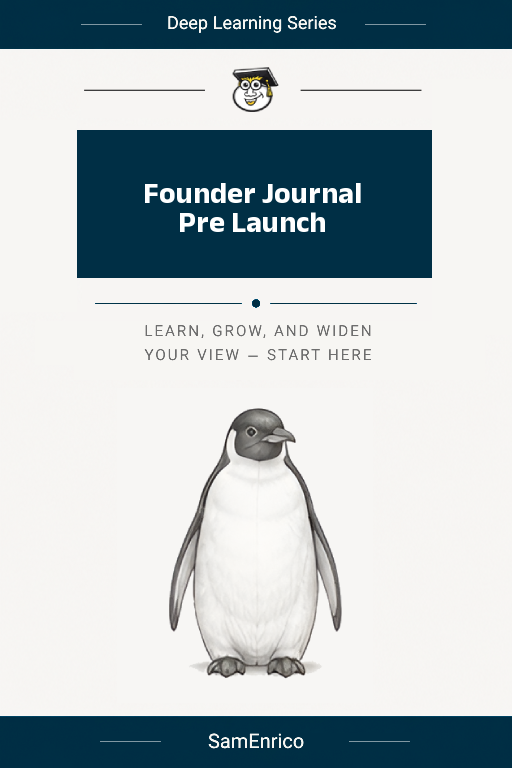
Non-FictionStartup GuideWaitlist Strategy
Founder Journal Pre Launch eBook
Keep founder journal to build pre-launch community
Keep founder journal to build pre-launch community. Share progress, lessons, and behind-scenes.
Formats
Free sample
Chapter 1: The Stealth Trap--–- The email arrived at 11:47 PM on a Tuesday. I still remember the timestamp because I was sitting in my home office, alone, staring at a product that had taken fourteen months to build. Fourteen months of late nights, of saying no to friends, of burning through savings. Fourteen months of telling myself that the smartest thing I could do was keep my mouth shut. Don't tell anyone what you are building, the startup gurus said.
Someone will steal your idea. Keep your head down. Build in stealth. Launch with a bang.The email was from my largest potential beta customer. I had sent them a cold outreach three days before launch, finally breaking my silence.
Their response was polite, professional, and absolutely devastating: "This looks interesting, but to be honest, we just signed a two-year contract with a competitor last month. If we had known about you six months ago, we would have waited. Good luck."Fourteen months of work, and I was six months too late.That night, I did what any reasonable founder would do. I opened a fresh journal—a physical notebook, the kind with thick paper and a leather cover that cost way too much—and I wrote down everything. Every mistake.
Every assumption. Every moment I had chosen secrecy over visibility. And then I wrote a sentence that would change everything about how I build companies: "What if I had started the journal before the product?"This book is the answer to that question.The 42% Problem Let me start with a number that should terrify every founder reading this page. According to CB Insights, which has analyzed thousands of startup post-mortems, 42% of startups fail because there is no market need for their product. Not because of bad code.
Not because of running out of money. Not because of a weak team. Forty-two percent fail because they build something that nobody actually wants.Let that sink in for a moment.Nearly half of all startups pour months or years of their lives into building a solution to a problem that either does not exist or is not painful enough for anyone to pay to solve. And here is the cruel irony: almost all of those failures were preventable. Not by more market research.
Not by better surveys. Not by hiring a fancy consulting firm. They were preventable by one simple, uncomfortable, radically transparent act: journaling in public before writing a single line of code.The traditional startup playbook—the one that still gets taught in business schools and preached in incubators—is broken. That playbook says: find a problem, validate it quietly, build a minimum viable product in stealth, test it with a small group of friendly insiders, then launch with a press release and a prayer. The "Big Bang Launch," as it is often called.But here is what the playbook does not tell you.
The Big Bang Launch is not a strategy. It is a gamble. It is the entrepreneurial equivalent of buying a lottery ticket and then being surprised when you do not win. You spend months in darkness, emerge briefly into the light, and then judge your entire existence on a single day's metrics. If the numbers are good, you are a genius.
If they are bad, you are a failure. But neither outcome has anything to do with skill. Both are driven by the same force: luck.I do not know about you, but I have never met a founder who wants to build a company on luck.The Myth of the Overnight Success Before we go any further, let me address the voice that is probably already forming in the back of your mind. You have seen the headlines: "Startup Launches to $10 Million in First Week." "Founder Retires at 30 After Viral Launch." "The Secret Sauce Behind the Biggest Launch of the Decade."Here is what those headlines do not show you. They do not show you the three years of community building that happened before launch.
They do not show you the 10,000 person email list that was cultivated through weekly behind-the-scenes updates. They do not show you the private Discord server where the first 500 true fans helped shape the product's features. They do not show you the journal.I want you to take a moment and think about the last product you genuinely loved. Not something you merely tolerated, but something you told your friends about. Something you defended in a comment section.
Something you felt a sense of ownership over. Now ask yourself: did you discover that product on launch day? Or did you discover it months earlier, through a blog post, a tweet, a video, or a newsletter that made you feel like you were part of something from the beginning?The answer, almost certainly, is the latter.Because here is the truth about modern consumer psychology that most founders refuse to accept: people do not buy products. They buy stories. And they do not invest in stories that start on launch day.
They invest in stories they have been following for months.The most successful launches of the past decade were not successful because of the product. They were successful because of the community that was built before the product existed. The product was simply the excuse for the community to celebrate together.A Case Study in Transparency: Million Dollar Weekend Let me show you what this looks like in practice. In 2022, a founder named Noah Kagan decided to write a book called Million Dollar Weekend. Most authors follow the traditional publishing playbook: write the book in secret, find a publisher, do a press tour, and hope for the best.
Noah did the exact opposite.Eighteen months before the book was released, he started documenting every single step of the writing process. He shared his outlines. He posted his early drafts. He asked his audience to vote on chapter titles. He showed them his rejection emails from publishers.
He revealed his advance (and how small it was). He walked them through his marketing plans, his cover design options, his pricing experiments.In other words, he treated the book launch like a startup. And he journaled the entire thing in public.By the time Million Dollar Weekend actually launched, something remarkable had happened. Noah was not launching a book to strangers. He was throwing a party for a community that had been following his journey for a year and a half.
They had seen the struggles. They had contributed ideas. They had watched him fail and get back up. They were not customers. They were co-conspirators.The book became an instant bestseller.
Not because of a big marketing budget. Not because of celebrity endorsements. But because thousands of people had been emotionally invested in the story long before the product existed.This is not an anomaly. This is the new rule.Community-Led Growth vs. Product-Led Growth Let me introduce you to a framework that will underpin everything else in this book.
It is called Community-Led Growth (CLG) , and it stands in direct opposition to the Product-Led Growth (PLG) models that have dominated startup thinking for the past decade.Here is how Product-Led Growth…
This is the end of the free sample. Get the eBook to keep going. Buy now
About this book
Details
- Author
- Pickard Allene
- Publisher
- SamEnrico
- Language
- English
- Genre
- Non-Fiction, Startup Guide, Waitlist Strategy
- Released
- 2026-05-29
- Pages (approx.)
- 118
- Available as
- eBook, Audiobook

Read better in the ZLOADR app
Your eBooks on your phone or tablet. Sign in with your SamEnrico account and start reading.
More by Pickard Allene
 Sleep Your Way To Brain HealthPickard Allene$11.99
 Assertiveness Scripts for Service WorkersPickard Allene$11.99
 Customer Service NPS SystemPickard Allene$11.99
 The Morning Pages PracticePickard Allene$11.99
 Loneliness In LeadershipPickard Allene$11.99
 The Hidden Steps of María Rivas: How a Slave Girl Revolutionized Latin DancePickard Allene$11.99
 Learn to Play the BassoonPickard Allene$11.99
 How to Become a Steam Service InspectorPickard Allene$11.99
 Provincial Nominee for GraduatesPickard Allene$12.99
 Associate Technical WriterPickard Allene$11.99
You may also like
 Hong Kong Handover 1997Dunn Johnnie$11.99
 Zumba For Postnatal Recovery CourseNeal Christian$11.99
 Zumba for BeginnersLadner Nikia$11.99
 YouTube Comment Mining GuideHumes Pandora$12.99
 Worry Box MeditationCarlin Rudy$11.99
 Workplace Stress MeditationNguyen Lynn$11.99
 Workplace Stress and Sleep RepairHawley Ivory$11.99
 Workplace Perfectionism CureDelaney Jeffry$11.99
 Workplace Injustice Anger GuideWallen Isabelle$11.99
 Work Addiction and Burnout LinkGreenwood Ester$11.99
 Women in Yoga and WellnessBeattie Galina$11.99
 Women in Stand Up ComedyChun Evangeline$11.99