
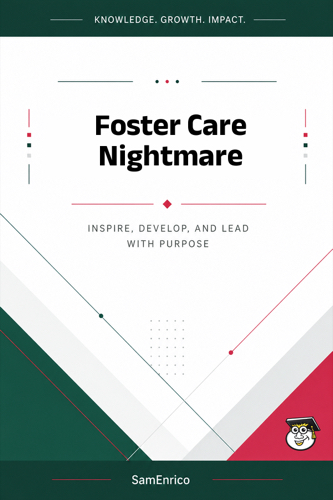
Foster Care Nightmare eBook
Chronicles a childhood spent in abusive foster hom
by Lynn Elana
Chronicles a childhood spent in abusive foster homes and ultimate adoption into safety.
Formats
Free sample
Chapter 1: The Bag with the Rip...–- The social worker smelled like coffee and sadness. I remember that before I remember her face. She knelt down next to my desk while the other kids were still spelling “cat” and “dog,” and she said my name like she was sorry. “Jamie,” she said. “You need to come with me.”I was six years old.
I didn’t know that was the last time anyone would call me by my name for a very long time.The classroom went quiet. Mrs. Patterson stopped in the middle of the spelling test. The word was “house.” I had just written H-O-U-S-E in my best handwriting, the letters trembling slightly because I was cold. I was always cold back then.
The heater in our apartment never worked right, and my mother said that fixing it cost money we didn’t have, and money was something we explained more than we spent.I looked up at the social worker. She had brown hair pulled back in a clip and circles under her eyes so dark they looked like bruises. There was a police officer behind her. He stood in the doorway of the classroom with his thumbs hooked in his belt, and he wasn’t looking at me. He was looking at the floor.
I learned later that police officers do that when they don’t want to see what they’re about to do.“Get your things, Jamie,” the social worker said.I didn’t have things. Not really. I had a backpack with a broken zipper and a half-eaten granola bar at the bottom. I had a pencil with teeth marks on it. I had a folder with my name on it—Jamesha Marie, but everyone called me Jamie—and inside that folder were worksheets with gold stars that meant nothing now.
I reached for the backpack, and the social worker put her hand on my shoulder. Her fingers were cold.“Not your school things,” she said. “You’re not coming back here.”The Walk Down the Hall The hallway of Eugene Field Elementary School was long and yellow. The fluorescent lights buzzed overhead, and somewhere a janitor was pushing a mop in slow circles. I could hear the sound of the other kids in my classroom starting to whisper.
I could hear Marcus Johnson say, “Ooh, Jamie’s in trouble,” and I could hear Mrs. Patterson shush him. I didn’t look back.The police officer walked behind me. His boots made heavy sounds on the linoleum. The social worker held my hand, but not like a mother holds a hand.
Like you might hold a leash. Like you’re not sure if the thing on the other end is going to run.“Where are we going?” I asked.The social worker didn’t answer. She pushed open the door to the principal’s office, and there was my mother.My Mother She was sitting in the plastic chair next to the principal’s desk, and she was crying. Her face was wet and red, and her hands were shaking. She had on the blue sweater with the missing button, the one she wore when she didn’t have clean clothes because the laundromat was too far and the bus cost too much.
Her hair was a mess. It was always a mess lately.“Baby,” she said, and her voice cracked. “Baby, I’m sorry.”I didn’t understand what she was sorry for. I thought maybe I had done something wrong. I thought maybe she was sorry that I had been bad, that I had left my toys on the floor or used too much hot water in the bath.
I was six. Six-year-olds think everything is their fault. That’s the secret about children that no one tells you: they are born believing they are the center of the universe, and that means they are also born believing they are the cause of every bad thing that happens in it.“Mommy,” I said, and I tried to pull my hand away from the social worker, but the social worker held on tighter.“I can’t do it anymore,” my mother said. She wasn’t talking to me. She was talking to the social worker, to the police officer, to the principal who was standing in the corner pretending to read a file.
“I can’t take care of her. I can’t even take care of myself.”The social worker nodded like she had heard this before. She probably had. “We have a placement ready,” she said. “Emergency shelter tonight.
Then we’ll assess.”Placement. Shelter. Assess. These were words I didn’t know, but I could feel them. They were heavy words.
They landed on my chest like stones.My mother stood up. She tried to hug me, but the social worker stepped between us. “We need to go,” the social worker said. “You can say goodbye from here.”So my mother said goodbye from three feet away. She said, “I love you, Jamie.
I love you so much. I just can’t.”I didn’t know what she couldn’t do. I didn’t know if she couldn’t love me or couldn’t feed me or couldn’t get out of bed in the morning or couldn’t stop drinking the stuff that made her sleep until noon. I just knew that she was saying goodbye, and that the police officer was opening the door, and that the sun was too bright outside, and that I was being led to a car with a cage between the front seat and the back.The Car Ride The back of the police car smelled like vomit and disinfectant. There was a hard plastic bench and no seatbelt that fit me right.
I watched my mother through the window. She was standing in the doorway of the school, her arms wrapped around herself, and she was getting smaller and smaller as the car pulled away. I pressed my face against the glass. I didn’t cry. I had learned not to cry when I was four, when my mother’s boyfriend at the time told me that crying was for babies and babies got left behind.“Where are we going?” I asked again.The police officer was driving.
The social worker was in the passenger seat. They looked at each other, and the social worker turned around and smiled. It was not a real smile. Real smiles reach your eyes. This one stopped at her teeth.“Somewhere safe,” she said.I didn’t believe her.
I didn’t know why I didn’t believe her. I was six. Six-year-olds are supposed to believe adults. But I had already learned that adults said things that weren’t true. Adults said “I’ll be right back” and then didn’t come back for three days.
Adults said “We’ll get ice cream” and then forgot. Adults said “You’re safe” right before something unsafe happened.I looked out the window at the houses passing by. Some of them were big. Some of them had fences. Some of them had swings in the front yard, and I…
This is the end of the free sample. Get the eBook to keep going. Buy now
About this book
Details
- Author
- Lynn Elana
- Publisher
- SamEnrico
- Language
- English
- Genre
- Non-Fiction, Biography, Survivor
- Released
- 2026-06-10
- Pages (approx.)
- 110
- Available as
- eBook, Audiobook

Read better in the ZLOADR app
Your eBooks on your phone or tablet. Sign in with your SamEnrico account and start reading.
More by Lynn Elana
 Hotel General Manager StressLynn Elana$11.99
 Light Body RelaxationLynn Elana$11.99
 Psychosis Emotion RegulationLynn Elana$11.99
 The Breath For LonelinessLynn Elana$11.99
 Psychologist Vicarious Trauma GuideLynn Elana$11.99
 Ocean Floor Mapping GuideLynn Elana$11.99
 Egyptian Cosmetics GuideLynn Elana$11.99
 Boundary Setting at Work GuideLynn Elana$11.99
 The Day the Internet Broke: Inside the 2017 Mirai Botnet AttackLynn Elana$11.99
 The Cavendish Laboratory: Where the Atom Split and the Universe UnlockedLynn Elana$11.99
 Echoes of the Ice: The Unsung Heroes of the 1952 Mount Everest DisasterLynn Elana$11.99
 The Dancer's Guide to Cajun WaltzLynn Elana$11.99
You may also like
 Hong Kong Handover 1997Dunn Johnnie$11.99
 Zumba For Postnatal Recovery CourseNeal Christian$11.99
 Zumba for BeginnersLadner Nikia$11.99
 YouTube Comment Mining GuideHumes Pandora$12.99
 Worry Box MeditationCarlin Rudy$11.99
 Workplace Stress MeditationNguyen Lynn$11.99
 Workplace Stress and Sleep RepairHawley Ivory$11.99
 Workplace Perfectionism CureDelaney Jeffry$11.99
 Workplace Injustice Anger GuideWallen Isabelle$11.99
 Work Addiction and Burnout LinkGreenwood Ester$11.99
 Women in Yoga and WellnessBeattie Galina$11.99
 Women in Stand Up ComedyChun Evangeline$11.99