
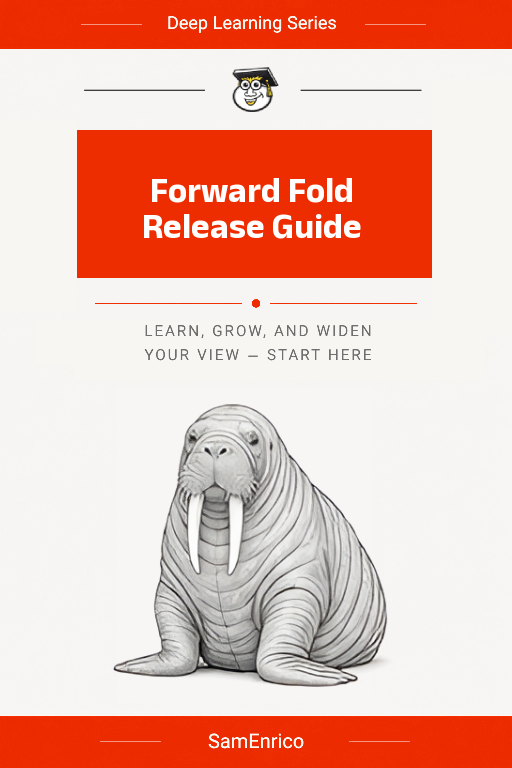
Forward Fold Release Guide eBook
Hinge forward from hips while seated to release ba
Hinge forward from hips while seated to release back and hamstring tension.
Formats
Free sample
Chapter 1: The Sitting Paradox--–- You are about to discover something that will fundamentally change how you think about your body. It is not a stretch. It is not a exercise. It is not a philosophy or a lifestyle. It is a single, overlooked fact about human anatomy that explains why your back aches, why your hamstrings feel permanently tight, and why nothing you have tried so far has given you lasting relief.Here it is: your body was never designed to sit in a chair.
But here is the paradox—the solution to the damage caused by sitting also comes from sitting. Just not the way you are doing it now.This chapter is not an introduction. It is an intervention. Before you learn a single technique, before you attempt a single forward fold, you need to understand why your body has turned against you. Not because you are lazy.
Not because you are old. Not because you are inflexible. Because you have been unknowingly training your muscles to stay short, your nerves to stay sensitive, and your brain to perceive normal movement as dangerous.By the time you finish this chapter, you will see your back pain differently. You will understand why the stretches you have tried failed. And you will be ready for the solution that the rest of this book provides.The Hidden Epidemic You Did Not Know You Had Let us start with a number that should shock you: 570,000,000.
That is how many people worldwide are living with low back pain at this very moment. Not people who have had back pain sometime in the past. People who are in pain right now, as you read these words.Back pain is the single leading cause of years lived with disability on planet Earth. It surpasses depression, diabetes, heart disease, and every form of cancer combined when measured by its impact on human suffering and lost productivity. And despite hundreds of billions of dollars spent on treatments—surgery, injections, chiropractic, physical therapy, medication, acupuncture, massage, yoga, Pilates, and countless others—the rates of chronic back pain have not declined.
They have risen.Something is not working.The standard approach to back pain treats each flare-up as an isolated event. You feel pain. You see a professional. They manipulate something—your spine, your muscles, your beliefs about pain. You feel better for a while.
Then, weeks or months later, the pain returns. Maybe in the same place. Maybe somewhere nearby. Always with the same message: you are still broken.But what if the problem is not that your back is broken? What if the problem is that your life is built around an activity that your body was never designed to perform?Consider the human spine.
It evolved over millions of years for a life of varied movement—walking long distances, squatting to rest, climbing occasional trees, running from predators, carrying children and food. Your ancestors spent almost no time sitting in chairs. When they rested, they squatted or knelt or lay on the ground. Their hips were never locked at ninety-degree angles for twelve hours a day.Now consider your average Tuesday. You wake up and sit at the kitchen table for breakfast.
You drive or ride a train to work, sitting. You arrive at your desk and sit for seven to nine hours, getting up only for coffee and lunch. You drive or ride home, sitting again. You eat dinner sitting. You watch television or scroll through your phone sitting.
You sit on the edge of your bed to take off your shoes. Then you lie down—which is essentially horizontal sitting—and repeat the entire cycle the next day.By the time you add it all up, the average desk worker spends more than twelve hours per day with their hips bent at roughly ninety degrees and their spine in a passive, flexed position. That is not living. That is a sustained postural experiment, and your body has been running that experiment for years without your consent.The results are now coming in. And they are not good.The Anatomy of a Broken Hinge To understand why sitting destroys your back and hamstrings, you need to understand one joint: the hip.
Specifically, you need to understand what happens when the hip stops moving through its full range of motion.The hip joint is a ball-and-socket joint, one of the most mobile in the human body. In a healthy, active person, the hip can flex (bringing the knee toward the chest), extend (moving the leg behind the body), abduct (moving the leg away from midline), adduct (moving the leg toward midline), and rotate internally and externally. This remarkable range of motion allows you to squat, lunge, climb, run, jump, and—relevant to this book—fold forward at the waist while keeping your spine long.But here is the problem: the hip joint, like every joint in your body, adapts to the positions you put it in most frequently. If you spend twelve hours a day with your hips flexed to ninety degrees, your body begins to believe that ninety degrees of flexion is the normal, resting position. The muscles that cross the hip joint—particularly the hamstrings and the hip flexors—shorten to match this new normal.
The connective tissue around the joint stiffens. The nerves that travel through the area adjust their sensitivity.This process is called adaptive shortening, and it happens whether you want it to or not. You do not have to try to become tight. You just have to sit.Now here is where the back comes in. When your hips lose their ability to flex fully, your body still needs to bend forward.
Bending forward is not optional—it is how you pick things up off the floor, tie your shoes, lift your child, and garden. So your body finds a workaround. It steals movement from somewhere else.The somewhere else is your lumbar spine.Your lower back is designed to flex and extend, but it is not designed to be the primary hinge for forward bending. In a healthy forward fold, the hips provide roughly seventy percent of the movement and the spine provides thirty percent. But when the hips are locked from prolonged sitting, the spine takes over.
It provides eighty percent. Then ninety percent. Then, in some people, one hundred percent.This is called lumbar dominance, and it is the hidden engine of most chronic back pain. Your lower back is doing the job that your hips refused to do. It is working overtime, every day, every time you bend.
And eventually, it breaks down. Discs bulge. Facet joints inflame. Muscles go into spasm. The nerves that run through the area become irritated.You feel this as pain.
But the pain is not the problem. The pain is a symptom of the real problem: a hip joint that has forgotten how to hinge.Why Stretching Makes Things Worse If you have ever tried to fix your back or hamstring tension by stretching, you have probably noticed something frustrating. You stretch. You feel better for a few minutes. Then the tightness returns.
You stretch again. The cycle repeats. It feels like you are Sisyphus, forever pushing a boulder up a hill only…
This is the end of the free sample. Get the eBook to keep going. Buy now
About this book
Details
- Author
- Kunkel Renate
- Publisher
- SamEnrico
- Language
- English
- Genre
- Non-Fiction, Mental Wealth
- Released
- 2026-06-01
- Pages (approx.)
- 147
- Available as
- eBook, Audiobook

Read better in the ZLOADR app
Your eBooks on your phone or tablet. Sign in with your SamEnrico account and start reading.
More by Kunkel Renate
 LinkedIn Personal Branding MasteryKunkel Renate$11.99
 CEO Executive Stress ManagementKunkel Renate$11.99
 Startup Equity Explained GuideKunkel Renate$11.99
 Listening Skills for Project ManagersKunkel Renate$11.99
 The Maintenance Plan AgeKunkel Renate$11.99
 Teacher Parent Small TalkKunkel Renate$11.99
 Morning Routine ChecklistKunkel Renate$11.99
 Low Carb Hormone BalanceKunkel Renate$11.99
 The Lost Kingdom of Elmet: Celtic Britain's Forgotten ResistanceKunkel Renate$11.99
 The Last Legion of Rome: The Secret Exodus to BritainKunkel Renate$11.99
 How to Start a Coke or Semi-coke of Coal (commission Agent) Business (Beginners Guide)Kunkel Renate$11.99
 WARN Act Compliance PrimerKunkel Renate$12.99
You may also like
 Hong Kong Handover 1997Dunn Johnnie$11.99
 Zumba For Postnatal Recovery CourseNeal Christian$11.99
 Zumba for BeginnersLadner Nikia$11.99
 YouTube Comment Mining GuideHumes Pandora$12.99
 Worry Box MeditationCarlin Rudy$11.99
 Workplace Stress MeditationNguyen Lynn$11.99
 Workplace Stress and Sleep RepairHawley Ivory$11.99
 Workplace Perfectionism CureDelaney Jeffry$11.99
 Workplace Injustice Anger GuideWallen Isabelle$11.99
 Work Addiction and Burnout LinkGreenwood Ester$11.99
 Women in Yoga and WellnessBeattie Galina$11.99
 Women in Stand Up ComedyChun Evangeline$11.99