
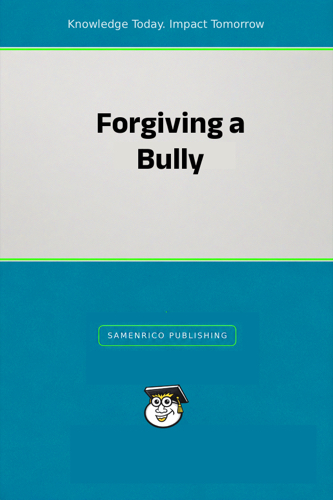
Forgiving a Bully eBook
Heal from school or workplace bullying.
by Jacob Leann
Heal from school or workplace bullying.
Formats
Free sample
Chapter 1: The Bullying Iceberg...--–- You have probably told yourself a version of this story. It goes like this: I was bullied once. It happened in middle school, or maybe during that horrible year at my first job. But it’s over now. I’m an adult.
I should be over it. Why am I not over it? If you have asked yourself that question in the dark, at three in the morning, after a team meeting where your stomach clenched for no reason you could name, or after a social event where you spent the whole time watching the door—you are not weak. You are not broken. And you are not alone.
You are, in fact, exactly where the research says you would be.The problem is not that you failed to heal. The problem is that you have been trying to heal from the wrong understanding of what happened to you. Most people believe bullying is a series of discrete, memorable events: the time the popular kid called you a name in front of everyone, the time your manager publicly mocked your presentation, the time you were left out of the group lunch invitation. Those events are real. They hurt.
But they are only the visible tip of something much larger, much more insidious, and much harder to name. They are the ten percent of the iceberg that rises above the waterline. The other ninety percent—the mass of subtle, repeated, often invisible behaviors—is what actually keeps you stuck.This chapter is not a history lesson. It is not a catalog of every terrible thing that has ever happened to you. It is a diagnostic tool, a pair of glasses you put on to see clearly for the first time.
By the end of this chapter, you will have a new language for what you experienced. You will understand the difference between ordinary conflict and systematic bullying. You will take a simple self-assessment that will confirm, once and for all, that you are not imagining things. And you will begin to see the full shape of the iceberg that has been floating beneath your life for years, maybe decades.Welcome to the first chapter of the rest of your healing. Let us begin with a story.The Woman Who Thought She Was Crazy A woman we will call Sarah came to see a therapist after leaving her job of eight years.
On paper, she had been successful: promotions, good reviews, a team that seemed to like her. But she had spent the last three years of her employment crying in her car before driving home. She had developed insomnia, then acid reflux, then a low-grade depression that she hid from everyone. When she finally quit, her boss said, "I'm surprised. You always seemed so happy here."Sarah told the therapist about specific incidents.
There was the time her manager, "Diane," had rewritten Sarah's report without telling her, then presented it as her own work in a leadership meeting. There was the time Diane had "accidentally" left Sarah off a crucial email chain, causing Sarah to miss a deadline and look incompetent. There was the time Diane had told Sarah, in a one-on-one meeting, "I'm not sure you have the emotional stamina for this role," with no explanation or evidence.The therapist asked Sarah, "Did Diane do these things to everyone?"Sarah thought about it. "No. Just me.""Did you ever confront her?""Once.
She said I was being too sensitive. She said she was just trying to help me grow. She said she was 'direct' and if I couldn't handle direct feedback, maybe I wasn't a good fit for the team."The therapist nodded. "And after that conversation, what happened?"Sarah started to cry. "Nothing changed.
Except I stopped talking about it. I told myself she was right. I told myself I was too sensitive. I told myself that if I just worked harder, she would see my value. But she never did.
And by the end, I couldn't tell anymore whether she was the problem or I was."Sarah is not crazy. She is not too sensitive. And Diane was not "direct." Diane was a bully of a specific type—the gaslighting, socially intelligent, career-savvy bully who knows exactly how to cause maximum damage while maintaining plausible deniability. Sarah's mistake was not her sensitivity. Her mistake was believing that bullying looks like a cartoon villain twirling a mustache.
It almost never does. Real bullying is subtle, strategic, and designed to make the target question their own reality.This chapter exists to make sure you never question your reality again.The Definition Problem: Why Most People Misunderstand Bullying Before we can heal from bullying, we have to be able to recognize it. And most people cannot, because most people are working with an outdated, cartoonish definition. Ask the average person to describe a bully, and they will describe a large, dim-witted child on a playground, demanding lunch money, shoving smaller kids into lockers. That image comes from movies and after-school specials from the 1980s.
It has almost nothing to do with how bullying actually operates in the real world, especially among adults.The academic definition of bullying has three components, and every single one of them matters. First, bullying involves repeated harmful behavior. One nasty comment is not bullying. One rude email is not bullying. Bullying is a pattern, a campaign, a drumbeat of small aggressions that accumulate over time.
Second, bullying involves an imbalance of power. The bully has something the target does not: social status, institutional authority, physical strength, control over resources, or simply a network of allies. Third, bullying involves intentional harm. The bully knows what they are doing, even if they would never admit it.Notice what is not in this definition. There is no requirement for physical violence.
There is no requirement for name-calling. There is no requirement for the bully to look or act like a stereotypical thug. The most dangerous bullies are often charming, well-liked, and highly competent. They are the manager who gets results. They are the teacher who is "just strict." They are the colleague who is "very direct." They are the friend who is "brutally honest." Their victims are not the weak or the socially awkward—they are often the competent, the talented, the empathetic, and the kind.
Bullies do not target weakness. They target light. They target the people whose presence makes them feel, by comparison, inadequate.This is the first hard truth of this book: If you were bullied, it is likely because you have something the bully lacks. That something might be competence, empathy, integrity, creativity, or simply the ability to form genuine connections with others. The bully did not choose you because you were broken.
The bully chose you because you were whole—and your wholeness was a mirror they could not stand to look into.The Iceberg Model: Seeing the Ninety Percent Imagine an iceberg floating in the ocean. The tip, the part above the water, is visible to everyone. It is the part that gets noticed, reported, and remembered. In bullying, the tip includes the obvious events: the public insult, the…
This is the end of the free sample. Get the eBook to keep going. Buy now
About this book
Details
- Author
- Jacob Leann
- Publisher
- SamEnrico
- Language
- English
- Genre
- Non-Fiction, Self-Help, Bullying
- Released
- 2026-06-07
- Pages (approx.)
- 148
- Available as
- eBook, Audiobook

Read better in the ZLOADR app
Your eBooks on your phone or tablet. Sign in with your SamEnrico account and start reading.
More by Jacob Leann
 Functional Analysis for ProductsJacob Leann$11.99
 Anki For GRE VerbalJacob Leann$11.99
 Zumba Choreography MasterclassJacob Leann$11.99
 The High Functioning AlcoholicJacob Leann$11.99
 Australian Outback WalkaboutJacob Leann$11.99
 Mindfulness for Decision MakingJacob Leann$11.99
 Distraction Management for ProgrammersJacob Leann$11.99
 Whispers in the Sawdust: The Curse of the Black PineJacob Leann$11.99
 The Trollwife’s Lament: A Nordic Mountain BalladJacob Leann$11.99
 How to Produce Radiology Equipment and AccessoriesJacob Leann$11.99
 How to Produce an Entertainment CenterJacob Leann$11.99
 US Business Credit Portfolio Management WorkbookJacob Leann$12.99
You may also like
 Hong Kong Handover 1997Dunn Johnnie$11.99
 Zumba For Postnatal Recovery CourseNeal Christian$11.99
 Zumba for BeginnersLadner Nikia$11.99
 YouTube Comment Mining GuideHumes Pandora$12.99
 Worry Box MeditationCarlin Rudy$11.99
 Workplace Stress MeditationNguyen Lynn$11.99
 Workplace Stress and Sleep RepairHawley Ivory$11.99
 Workplace Perfectionism CureDelaney Jeffry$11.99
 Workplace Injustice Anger GuideWallen Isabelle$11.99
 Work Addiction and Burnout LinkGreenwood Ester$11.99
 Women in Yoga and WellnessBeattie Galina$11.99
 Women in Stand Up ComedyChun Evangeline$11.99