
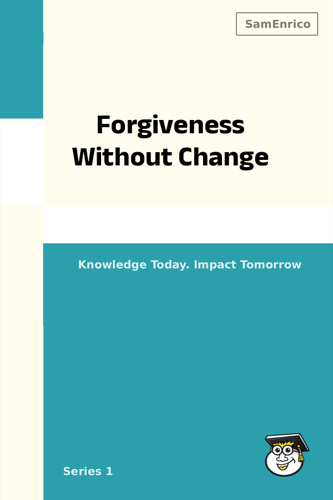
Forgiveness Without Change eBook
A child forced to forgive repeated anger without a
by Andre Matha
A child forced to forgive repeated anger without any parental change.
Formats
Free sample
Chapter 1: The Waiting Room...--–- The call came on a Tuesday. My mother’s voice had that particular edge—the one that sits exactly halfway between a plea and a threat. “I need you to forgive me,” she said. “I’m your mother. You have to.” She had screamed at me in front of my children the previous weekend.
She had called me a “selfish ingrate” on my birthday—the one day of the year I had foolishly hoped might be safe. And now, seven days later, without an acknowledgment, without a single mention of what she had done, she wanted forgiveness. Not repentance. Not change. Just the word.
Just my surrender.I sat in my car in a grocery store parking lot, watching the rain streak across the windshield, and I felt something crack open inside me. Not anger—I was used to anger. Not sadness—I had been sad for thirty years. What cracked open was a question I had never dared to ask out loud: What if she never changes? What if I forgive her today, and she does it again tomorrow?
What if I spend the rest of my life in this waiting room, holding my breath, hoping that this time my forgiveness will be the thing that finally makes her different?That question is why you are reading this book.The Longest Waiting Room in the World You have been waiting. Maybe for ten years. Maybe for forty. You have been waiting for an apology that never comes in the right shape. You have been waiting for your parent to see the damage they have caused—not just the big explosions, but the slow erosion of your sense of safety, the way you learned to read their mood before you learned to read, the way your body still tenses when you hear a car door slam or a voice raised in another room.You have been told, by well-meaning friends and therapists and religious leaders, that forgiveness is the answer.
And you have tried. God knows you have tried. You have said the words. You have knelt in pews and sat on meditation cushions and written letters you never sent. You have forgiven your parent for the Christmas Eve explosion.
And then for the birthday phone call. And then for the wedding toast that turned into an indictment of your character. And then for the way they treated your children. And then for the phone call last week.And nothing changed.Not in them. And, if you are honest, not really in you.
Because each time you forgave, you were secretly, desperately hoping that this time it would land. This time they would see your generosity and be transformed. This time your love would be the key that unlocked their locked heart.That is not forgiveness. That is bargaining. And bargaining is one of the stages of grief—not a strategy for liberation.The Dirty Secret of the Forgiveness Industry Here is what almost no one tells you: the vast majority of books, sermons, and therapeutic interventions about forgiveness are built on an unstated assumption.
The assumption is that the person who hurt you will eventually acknowledge their behavior, express remorse, and make amends. Even the most sophisticated psychological models—including the work of Michael Mc Cullough, one of the leading researchers on the psychology of forgiveness—tend to study forgiveness in contexts where the offending party eventually takes some responsibility.But what happens when they don’t? What happens when the parent is a narcissist who cannot admit fault without their entire sense of self collapsing? What happens when the parent is emotionally immature, lacking the neural architecture for genuine self-reflection? What happens when the parent is simply too old, too rigid, too defended, or too far gone to ever say, “I was wrong.
I will try to be different”?You are left holding a broken tool. You have been handed a map to a country that does not exist.I call this The Conditional Forgiveness Trap. It works like this:You are told that forgiveness is necessary for your healing.You are told (explicitly or implicitly) that forgiveness requires some gesture from the offender—an apology, a change in behavior, a demonstration of remorse.The offender offers no such thing.You cannot forgive (because the conditions have not been met).Therefore, you cannot heal.You remain stuck, waiting, hoping, and secretly believing that if you just try harder, pray more, or explain it better, this time they will finally get it.The trap is not your fault. It is built into the cultural architecture. But it is a trap, and you have been living inside it long enough.Decisional Forgiveness vs.
Emotional Forgiveness Let me give you a distinction that will serve as the backbone of everything that follows. This distinction comes from the research literature on forgiveness, but I am going to translate it into plain language.Emotional forgiveness is what happens when the negative feelings you have toward someone—the resentment, the anger, the bitterness—naturally fade over time. This usually occurs because the person who hurt you has changed their behavior, made amends, or proven themselves trustworthy. Your nervous system gets the signal that the threat has passed, and it relaxes its guard. Emotional forgiveness is beautiful.
It is also, for the person with an unrepentant parent, largely unavailable.Decisional forgiveness is different. Decisional forgiveness is a conscious choice—an act of will—to release the debt of resentment. It does not wait for feelings. It does not require an apology. It is a behavioral intention to no longer seek revenge, to no longer hold the offense over the offender’s head, and to no longer let the resentment dictate your actions.
Decisional forgiveness is something you can do today, in the parking lot of a grocery store, with rain on the windshield and your mother’s voice still ringing in your ears.Here is the crucial insight: You can practice decisional forgiveness without ever experiencing emotional forgiveness. You can choose to release the debt even while your nervous system is still bracing for the next impact. You can decide to stop waiting for an apology even while your heart still wishes for one.This is what I mean by Forgiveness Without Change. Not the absence of change in you—you will change profoundly. But the absence of change in them.
You are going to learn how to forgive unilaterally, without any cooperation from the person who hurt you, without any guarantee that they will stop hurting you, without any condition except your own willingness to put down the weight.The Two Stories We Are Told About Forgiveness To understand why this is so difficult, we have to look at the stories our culture tells about forgiveness. There are two dominant narratives, and both of them fail the adult child of a volatile parent.The Religious Story: In many religious traditions, forgiveness is framed as a divine command. You forgive because you have been forgiven. You forgive because unforgiveness is a sin. You forgive because it is the path to your own salvation.
This story has tremendous power, but it also has a dark side. When forgiveness becomes an obligation, it can be…
This is the end of the free sample. Get the eBook to keep going. Buy now
About this book
Details
- Author
- Andre Matha
- Publisher
- SamEnrico
- Language
- English
- Genre
- Non-Fiction, Religious Trauma
- Released
- 2026-06-06
- Pages (approx.)
- 130
- Available as
- eBook, Audiobook

Read better in the ZLOADR app
Your eBooks on your phone or tablet. Sign in with your SamEnrico account and start reading.
More by Andre Matha
 The MBSR for Migraine ReliefAndre Matha$11.99
 Speech Impediment Self EsteemAndre Matha$11.99
 Sales Active Listening GuideAndre Matha$11.99
 Douglas Dynasty - Michael DouglasAndre Matha$11.99
 Environment Creativity BoostAndre Matha$11.99
 Plyometric Injury PreventionAndre Matha$11.99
 Wholesaling PPC Ads GuideAndre Matha$11.99
 Left Lane Aggression GuideAndre Matha$11.99
 The Edge of the Sky: Wiley Post's Perilous Quest for the StratosphereAndre Matha$11.99
 Rhythm in the Shadows: The Untold Story of Pina Bausch's Wuppertal RevolutionAndre Matha$11.99
 Phaëthon’s Fall: The Sun Chariot DisasterAndre Matha$11.99
 The Mineral Guide to SabinaiteAndre Matha$11.99
You may also like
 Hong Kong Handover 1997Dunn Johnnie$11.99
 Zumba For Postnatal Recovery CourseNeal Christian$11.99
 Zumba for BeginnersLadner Nikia$11.99
 YouTube Comment Mining GuideHumes Pandora$12.99
 Worry Box MeditationCarlin Rudy$11.99
 Workplace Stress MeditationNguyen Lynn$11.99
 Workplace Stress and Sleep RepairHawley Ivory$11.99
 Workplace Perfectionism CureDelaney Jeffry$11.99
 Workplace Injustice Anger GuideWallen Isabelle$11.99
 Work Addiction and Burnout LinkGreenwood Ester$11.99
 Women in Yoga and WellnessBeattie Galina$11.99
 Women in Stand Up ComedyChun Evangeline$11.99