
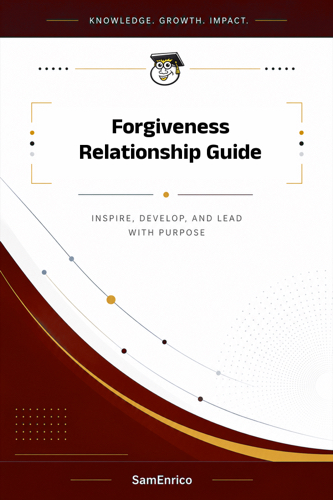
Non-FictionSelf-HelpForgiveness
Forgiveness Relationship Guide eBook
Lets go of stress-related resentments.
by Toth Sarina
Lets go of stress-related resentments.
Formats
Free sample
Chapter 1: The Stress Injury--Imagine, for a moment, that you have been carrying a backpack everywhere you go for the past three years. Inside this backpack are bricks. Each brick represents a moment when someone wronged you—a harsh word from a parent, a betrayal by a partner, a dismissal by a friend, an injustice at work. You cannot see the backpack, but you can feel it. Your shoulders are tight.
Your lower back aches. You are tired when you wake up and exhausted by noon. You have been to doctors who find nothing “wrong,” taken medications that only mask the symptoms, and tried to “think positive” only to find yourself snapping at the people you love for no apparent reason.That backpack is your resentment. And this book is the permission slip to put it down.Most people believe resentment is an emotion—something you feel, like sadness or joy. This is the first and most costly misunderstanding.
Resentment is not an emotion. It is a stress injury. It is what happens when your body’s natural alarm system, designed to protect you from immediate danger, gets stuck in the “on” position long after the danger has passed. Your nervous system does not know the difference between a tiger charging at you and a memory of your spouse’s thoughtless comment from 2019. To your amygdala—the almond-shaped cluster of neurons in your temporal lobe that serves as your brain’s smoke detector—both are threats.
Both trigger the same cascade of stress hormones. Both keep you in a state of low-grade, chronic, body-damaging alertness.This chapter will change how you see every unresolved conflict in your life. By the time you finish reading, you will understand why holding a grudge makes you physically sick, why your brain would rather be right than peaceful, and why the phrase “just let it go” is not only unhelpful but scientifically backwards. You cannot “let go” of something you have never fully understood. But once you understand that resentment is a physiological injury—not a moral failure, not a lack of faith, not evidence that you are “too sensitive”—you can begin to treat it like any other injury: with precision, with tools, and without shame.The Most Important Distinction You Will Ever Make Before we go any further, you need to learn a distinction that will serve as the foundation for every tool in this book.
It is simple, but it is not easy. And most people never learn it because no one ever taught them.Acute anger lasts minutes to hours. It is protective, energetic, and resolves when the threat passes or when you set a boundary. You feel acute anger when someone cuts you off in traffic. You yell (maybe inside your own car), your heart pounds, your face flushes.
Ten minutes later, you have forgotten about it. The physiological response has run its course and your nervous system has returned to baseline.Chronic resentment lasts weeks, months, or decades. It occurs when your brain’s alarm system never receives the “all clear” signal. The original offense may be long over—the person may have apologized, moved away, or even died—but your body is still bracing for impact. You replay the scene.
You rehearse what you should have said. You imagine future confrontations that never happen. And each time you replay, you flood your system with the same stress chemicals as if the offense were happening right now.Here is the key difference, and I want you to write it down somewhere you will see it every day:Anger says, “Something is wrong now.”Resentment says, “Something was wrong then, and I am still living in that moment.”If you are holding onto something that happened more than 48 hours ago and you are still feeling it in your body, you have crossed the line from acute anger to chronic resentment. This is not a moral judgment. It is a physiological fact.
And it is the first step toward real change: naming the injury for what it is.The Cortisol Cascade: Why Holding a Grudge Makes You Sick Let me tell you about cortisol. You have probably heard of it as the “stress hormone,” but you may not understand how profoundly it affects every system in your body. Cortisol is not evil. In fact, you would die without it. Cortisol is what wakes you up in the morning, gives you energy to face challenges, and helps your body regulate inflammation.
The problem is not cortisol itself. The problem is chronically elevated cortisol—the kind that comes from replaying the same offenses over and over, day after day, year after year.Here is what happens in your body when you hold a grudge.Your sleep is destroyed. Cortisol follows a natural daily rhythm: high in the morning to wake you up, low at night to let you sleep. Chronic resentment flattens this curve. Your cortisol stays elevated into the evening, which means you lie awake replaying conversations, or you fall asleep but wake up at 3:00 AM with your mind racing.
Over time, sleep deprivation compounds every other health problem.Your immune system weakens. Cortisol suppresses the immune system. This is useful for short-term stress (you do not want your body wasting energy on immune function when you are running from a tiger), but devastating for chronic stress. People who hold long-term grudges get more colds, take longer to heal from injuries, and have poorer outcomes from surgeries. One study of couples in conflict found that wounds healed 40 percent slower in the days following a hostile argument compared to a supportive conversation.You gain weight, especially around your midsection.
Cortisol triggers the release of glucose into your bloodstream for quick energy. When that glucose is not used (because you are sitting on your couch replaying an offense rather than running from a tiger), it gets stored as visceral fat—the dangerous kind that wraps around your organs and increases your risk of heart disease, diabetes, and stroke.Your memory deteriorates. The hippocampus, the part of your brain responsible for learning and memory, is densely packed with cortisol receptors. Chronically elevated cortisol literally shrinks the hippocampus over time. This is why people with chronic stress and unresolved resentment complain of “brain fog,” forgetfulness, and difficulty concentrating.
You are not losing your mind. You are flooding it with a hormone that damages the very structures you need to think clearly.Your risk of depression and anxiety skyrockets. The relationship between cortisol and mood disorders is bidirectional: chronic stress raises cortisol, and high cortisol makes you more vulnerable to depression and anxiety. The 63 percent statistic you may have heard elsewhere is real: patients with chronic resentment who choose to hold onto their grievances have relapse rates into depression and anxiety that are nearly two-thirds higher than those who learn to release the stress response, even when the offense itself remains unchanged.I am telling you all of this not to scare you but to free you. For years, you may have believed that your fatigue, your insomnia, your unexplained aches and pains, your irritability, and your difficulty concentrating were signs that something was fundamentally wrong with you.…
This is the end of the free sample. Get the eBook to keep going. Buy now
About this book
Details
- Author
- Toth Sarina
- Publisher
- SamEnrico
- Language
- English
- Genre
- Non-Fiction, Self-Help, Forgiveness
- Released
- 2026-06-07
- Pages (approx.)
- 146
- Available as
- eBook, Audiobook

Read better in the ZLOADR app
Your eBooks on your phone or tablet. Sign in with your SamEnrico account and start reading.
More by Toth Sarina
 Delegation Without GuiltToth Sarina$11.99
 Child Stars Of 1950s HollywoodToth Sarina$11.99
 Career Transition for Military SpousesToth Sarina$11.99
 Uber Driver Tax Deduction GuideToth Sarina$11.99
 Modesto Community ReactionToth Sarina$11.99
 Indian GST Registration for Agents and Brokers HandbookToth Sarina$11.99
 Citation Rules for Bluebook Legal GuideToth Sarina$11.99
 Carnegie HomesteadToth Sarina$11.99
 The Last Moorish Stronghold: Granada's Fall and the End of Al-AndalusToth Sarina$11.99
 The Silent Coup: How a Whisper Toppled a GovernmentToth Sarina$11.99
 Zero-Day Protocol: The Untold Story of Stuxnet’s Digital WarToth Sarina$11.99
 How to Become a Cap-jewel Plate AssemblerToth Sarina$11.99
You may also like
 Hong Kong Handover 1997Dunn Johnnie$11.99
 Zumba For Postnatal Recovery CourseNeal Christian$11.99
 Zumba for BeginnersLadner Nikia$11.99
 YouTube Comment Mining GuideHumes Pandora$12.99
 Worry Box MeditationCarlin Rudy$11.99
 Workplace Stress MeditationNguyen Lynn$11.99
 Workplace Stress and Sleep RepairHawley Ivory$11.99
 Workplace Perfectionism CureDelaney Jeffry$11.99
 Workplace Injustice Anger GuideWallen Isabelle$11.99
 Work Addiction and Burnout LinkGreenwood Ester$11.99
 Women in Yoga and WellnessBeattie Galina$11.99
 Women in Stand Up ComedyChun Evangeline$11.99