
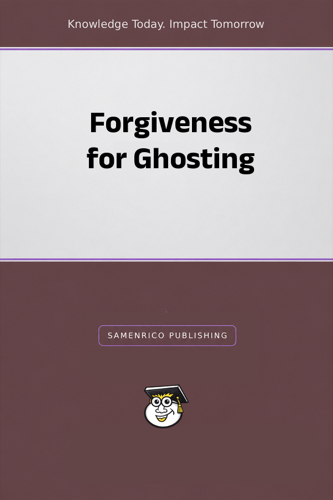
Forgiveness for Ghosting eBook
Heal from sudden unexplained disappearances withou
Heal from sudden unexplained disappearances without closure.
Formats
Free sample
Chapter 1: The Silence That Screams...--The first time it happens, you don't even realize you've been ghosted. You check your phone. Nothing. You check again an hour later. Still nothing.
You tell yourself they're busy. Work got crazy. Their phone died. They fell asleep early. You've been busy too.
It's fine.Day two arrives. You send a casual follow-up. "Hey, hope you're okay." The message sends. It doesn't deliver. Or it delivers, and there's no response.
Or worse—it delivers, shows "read," and still nothing. Now the silence has a shape. It's not neutral anymore. It's deliberate.By day three, you've started a mental investigation. You scroll back through the conversation history, looking for the exact moment you said something wrong.
You check their social media. They posted a photo. They're alive. They're fine. They're just not talking to you.
Your stomach drops. Your chest tightens. Your brain, which has been running quietly in the background, now screams to the front of your consciousness: Something is wrong.Welcome to the silence that screams. This chapter is not about why ghosting happens. That comes later.
This chapter is about what happens to you—neurologically, emotionally, physically—when someone you care about disappears without a word. Because you cannot heal a wound you do not understand. And the wound of ghosting is not just a broken heart. It is a broken loop.The Open Loop: Why Your Brain Won't Let Go Let me tell you something that will change how you see every sleepless night you've spent obsessing over that last text. Your rumination is not weakness.
It is not desperation. It is not a character flaw. It is a predictable, measurable, universal neurological response to incomplete information.Psychologists call this the Zeigarnik Effect, named after Soviet psychologist Bluma Zeigarnik, who noticed something fascinating in the 1920s. Waiters in Vienna restaurants could remember complex, unpaid orders with astonishing accuracy. But the moment a table paid their bill, the waiter's memory of that order vanished.
Zeigarnik tested this phenomenon systematically and found that the human brain holds onto unfinished tasks—open loops—with fierce tenacity, while completed tasks are quickly relegated to the mental trash bin.Your brain is not trying to torture you. It is trying to protect you. From an evolutionary perspective, incomplete information is dangerous. If you heard a rustle in the bushes and didn't wait to see if it was a predator or the wind, you might be eaten. So your brain evolved to keep incomplete loops open, replaying them, scanning for resolution, refusing to let go until the story ends.Ghosting is the ultimate open loop.A breakup—even a terrible one—provides an ending.
"I don't want to see you anymore." "I met someone else." "This isn't working." Those words, however painful, close the loop. Your brain processes the information, grieves, and eventually moves on. But ghosting offers no ending. The conversation stops mid-sentence. The relationship freezes mid-frame.
The other person is neither present nor formally absent. They exist in a quantum state of maybe, and your brain cannot tolerate maybe.This is why you cannot stop thinking about them. This is why you check your phone at red lights, in the middle of meetings, at 3 AM. This is why you replay every conversation searching for clues. Your brain is not broken.
It is doing exactly what it evolved to do. It is holding a door open for an answer that will never walk through it.And that is the first truth you must accept: The answer is never coming. Not because you don't deserve it. Not because you weren't worth an explanation. But because the person who left cannot give it.
They do not have the capacity, the courage, or the care to close the loop they opened. That is their failure, not yours. But it is now your problem to solve.The Difference Between Ghosting and Other Disappearances Before we go any further, we need to be precise about what we're actually dealing with. Not every disappearance is ghosting. And mislabeling a different kind of departure as ghosting can either prolong your suffering or make you feel victimized when you were actually protected.Let me walk you through three very different scenarios.The Slow Fade This is when communication gradually decreases over time.
Texts take longer to get replies. Plans become vaguer. The energy shifts from enthusiastic to lukewarm to barely there. Eventually, you both stop reaching out. There's no official ending, but there's also no sudden disappearance.
The slow fade is ambiguous, yes, but it contains its own kind of closure: the gradual recognition that mutual interest has died.The slow fade hurts, but it is not ghosting. In a slow fade, both parties participate in the drift. The pain comes from the slow recognition of rejection, not from the shock of sudden absence. If you experienced a slow fade, you may still benefit from this book, but some of the acute trauma responses described here may not apply to you.The Necessary Boundary This is when someone blocks you, stops responding, or disappears because you have harmed them—or because they need to protect themselves from you. A domestic violence survivor who blocks their abuser is not ghosting.
Someone who ends contact after repeated boundary violations is not ghosting. A person who realizes a friendship is toxic and walks away without a formal goodbye is exercising self-preservation.If you were on the receiving end of a necessary boundary, this book is not for you. Not because you are a bad person, but because the dynamic is fundamentally different. That person didn't disappear to avoid discomfort; they disappeared to survive. Their silence is not cruelty—it is self-defense.
You will need a different kind of help than this book provides, and I encourage you to seek it honestly.The Cruelty of Ghosting This is what we are here for. Ghosting, as defined in this book, has four specific characteristics:First, there was an established emotional investment. This isn't someone you matched with on an app and exchanged three messages with. Ghosting requires that both parties had some understanding—implicit or explicit—of ongoing interest.Second, the disappearance is sudden and unexplained. Not a gradual fade.
Not a conversation that naturally ends. One day there is connection; the next day there is silence, with no warning, no reason, and no goodbye.Third, the ghosted person makes reasonable attempts to reconnect. You send a follow-up text. You call. You ask what happened.
These attempts are ignored or met with further silence.Fourth, the ghoster remains accessible to others. They post on social media. They show up at work. They are alive and functioning—just not in relationship to you. This is the detail that adds the unique sting: They haven't disappeared from the world.
They've disappeared from you.If that is what brought you to this book, keep reading. Everything that follows is for you.The Physiological Shock of Being Left on Read Most people think ghosting is an emotional wound. And it is. But before it becomes emotional, it is physiological. Your body reacts to social rejection the same way it reacts to physical pain.
This is not a metaphor. It is neuroscience.Researchers at the University of Michigan conducted a landmark study using functional MRI…
This is the end of the free sample. Get the eBook to keep going. Buy now
About this book
Details
- Author
- Mojica Chandra
- Publisher
- SamEnrico
- Language
- English
- Genre
- Non-Fiction, Self-Help, Dating
- Released
- 2026-06-09
- Pages (approx.)
- 127
- Available as
- eBook, Audiobook

Read better in the ZLOADR app
Your eBooks on your phone or tablet. Sign in with your SamEnrico account and start reading.
More by Mojica Chandra
 Anger and Low Frustration ToleranceMojica Chandra$11.99
 Walking Meditation For Lawyers WorkbookMojica Chandra$11.99
 The Delegation Course For CarersMojica Chandra$11.99
 The Mutiny Memorial History GuideMojica Chandra$11.99
 The Day the Sky Turned Red: The Great Molasses Flood of 1919Mojica Chandra$11.99
 Voice ActorMojica Chandra$11.99
 Understanding Oculo Skeletal Renal SyndromeMojica Chandra$17.99
 Studying in China Without ChineseMojica Chandra$12.99
 Production Leveling in Food ManufacturingMojica Chandra$12.99
 How to Start a Perforated Metal Business (Beginners Guide)Mojica Chandra$11.99
You may also like
 Hong Kong Handover 1997Dunn Johnnie$11.99
 Zumba For Postnatal Recovery CourseNeal Christian$11.99
 Zumba for BeginnersLadner Nikia$11.99
 YouTube Comment Mining GuideHumes Pandora$12.99
 Worry Box MeditationCarlin Rudy$11.99
 Workplace Stress MeditationNguyen Lynn$11.99
 Workplace Stress and Sleep RepairHawley Ivory$11.99
 Workplace Perfectionism CureDelaney Jeffry$11.99
 Workplace Injustice Anger GuideWallen Isabelle$11.99
 Work Addiction and Burnout LinkGreenwood Ester$11.99
 Women in Yoga and WellnessBeattie Galina$11.99
 Women in Stand Up ComedyChun Evangeline$11.99