
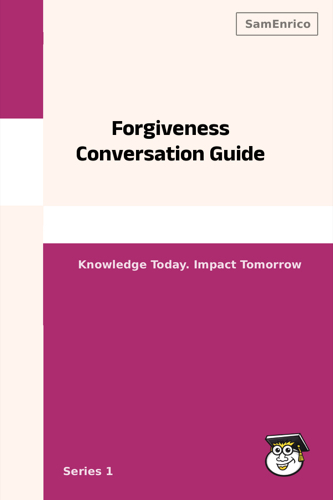
Forgiveness Conversation Guide eBook
Navigate talks about forgiveness with grace and bo
Navigate talks about forgiveness with grace and boundaries.
Formats
Free sample
Chapter 1: The Forgiveness Trap--–- Maria had not spoken to her older sister in eleven years. The offense, by most standards, was not catastrophic. No violence, no betrayal of epic proportion. At their mother’s funeral, her sister had delivered a eulogy that rewrote their shared childhood, casting herself as the dutiful caretaker and Maria as the troubled, difficult one. Maria sat in the third row, silent, while fifty relatives turned to look at her with expressions that ranged from pity to quiet accusation.
She did not correct the record. She did not stand up and object. She simply decided, somewhere between the final prayer and the awkward reception line, that she was done. “I forgive her,” Maria told herself. “I’m letting it go.
I’m the bigger person.” And for eleven years, she believed that was true.But forgiveness, as Maria understood it, had become a cage. Every family holiday she skipped, every birthday card she did not send, every time her nephew’s graduation announcement landed in the trash—each act was accompanied by a quiet internal monologue: I’ve already forgiven her. Why am I still so angry? What’s wrong with me? She had done the work, she told herself.
She had said the words. She had even prayed about it. Yet the resentment had not faded. It had fossilized. It had become a low-grade fever she barely noticed until something triggered a spike.Maria’s story is not unusual.
In fact, it is the most common forgiveness failure pattern that therapists, clergy, and relationship coaches encounter. People try to forgive. They sincerely want to forgive. They believe they have forgiven. But the resentment remains, and they conclude that they are either unforgiving monsters or that forgiveness itself is a hollow, impossible ideal.
Neither conclusion is correct. The problem is not Maria’s heart. The problem is her map. She has been trying to navigate forgiveness using a set of popular, well-intentioned but deeply misleading instructions—what this chapter will call The Forgiveness Trap.This chapter dismantles three toxic myths that keep people trapped in cycles of resentment, false peace, and self-blame. It then introduces a radically different model: forgiveness as a communicative process of release, entirely independent of the offender’s response, and sharply distinct from reconciliation.
By the end of this chapter, you will understand why your previous attempts to forgive may have failed—and you will have the foundational clarity needed to navigate the rest of this book with confidence.The Three Myths That Keep You Stuck Every culture has its folk wisdom about forgiveness. Religious traditions offer beautiful, challenging teachings about mercy. Self-help books offer simplified formulas. And social media offers bite-sized quotes that sound profound but collapse under the weight of real pain. Beneath all of these sources, three myths have taken root as the unofficial orthodoxy of popular forgiveness.
They are wrong. And they are causing real harm.Myth One: “Forgive and Forget”The phrase “forgive and forget” appears nowhere in any major religious scripture in exactly those words. It is a folk condensation, a linguistic shortcut that has hardened into a command. The problem is that forgetting is not a voluntary act. The human brain does not have a delete function for emotionally charged memories.
In fact, neuroimaging studies show that memories associated with strong emotions—especially betrayal, humiliation, and loss—are encoded more deeply, not less. Telling someone to forget a significant wound is like telling them to stop breathing. It is not a moral failure to remember. It is a biological fact.Yet the myth persists. When Maria told herself she had “forgiven and forgotten,” she was setting herself up for failure.
Every time a memory surfaced—her sister’s voice at the podium, the turned heads in the pews—Maria experienced that memory as evidence that she had not truly forgiven. She would then double down on suppression, pushing the memory down harder, which only made it more likely to erupt later. This cycle is not forgiveness. It is emotional quicksand.What works instead is remembering without revenge. True forgiveness does not require amnesia.
It requires a changed relationship to the memory. You can remember exactly what happened, in vivid detail, without the memory carrying the same emotional charge of outrage, victimhood, or desire for payback. The goal is not to erase the past but to integrate it into a larger story—one where you are no longer defined by the wound. Later chapters will provide specific practices for this, but the foundational shift is this: stop trying to forget. You have permission to remember.
Forgiveness is about what you do with the memory, not whether you can delete it.Myth Two: “Forgiveness Means Reconciliation”This is perhaps the most dangerous and destructive myth in popular forgiveness literature. It sounds so reasonable: Of course, forgiveness leads to restored relationship. That’s the whole point, isn’t it? No. It is not the point.
And conflating the two has trapped countless people in abusive or chronically unhealthy relationships.Forgiveness is an internal act. It is something you do inside your own mind and heart, independent of anyone else. You can forgive someone who is dead. You can forgive someone who has not apologized. You can forgive someone you will never speak to again.
Reconciliation (or relational repair) is an interpersonal process. It requires two willing parties, changed behavior, rebuilt trust, and often, genuine apology and amends. Reconciliation is a relationship outcome. Forgiveness is a personal one.When these two concepts are fused, people who set a boundary—such as choosing not to resume contact with an unrepentant offender—are told they have not “truly forgiven.” This is emotional blackmail disguised as spiritual wisdom. In fact, you can forgive someone completely and simultaneously decide that the relationship is unsafe, unwise, or simply not worth rebuilding.
Grace and boundaries are not opposites, as Chapter 3 will explore in depth. They are partners.Consider a woman whose spouse has repeatedly lied about finances. She can forgive him—release her resentment and her right to revenge—without automatically returning joint control of their bank accounts. Forgiveness addresses the heart. Boundaries address safety and behavior.
The myth that forgiveness requires reconciliation confuses these two domains and has kept people in cycles of trust, betrayal, forgiveness, and re-betrayal.What works instead is a clean separation: forgiveness is a gift you give yourself. Reconciliation is a gift you may offer to another person if they have earned it. You are not obligated to reconcile. You are not a failure if you choose not to. This distinction will appear throughout this book, and it is non-negotiable.Myth Three: “If You Haven’t Felt Warm Feelings, You Haven’t Forgiven”This myth is the most emotionally punishing.
It holds that forgiveness is not complete until you feel affection, compassion, or at least neutrality toward the person who hurt you. Until you “feel it in your heart,” the argument goes, you are just going through the motions.This myth confuses emotional forgiveness with emotional healing. It sets an impossible standard because feelings are not directly voluntary. You cannot decide to feel warm toward someone who harmed you. You…
This is the end of the free sample. Get the eBook to keep going. Buy now
About this book
Details
- Author
- Satterfield Tarra
- Publisher
- SamEnrico
- Language
- English
- Genre
- Non-Fiction, Self-Help, Forgiveness
- Released
- 2026-06-12
- Pages (approx.)
- 107
- Available as
- eBook, Audiobook

Read better in the ZLOADR app
Your eBooks on your phone or tablet. Sign in with your SamEnrico account and start reading.
More by Satterfield Tarra
 Cognitive Training HandbookSatterfield Tarra$11.99
 Meal Prep for Batch CookingSatterfield Tarra$11.99
 Jobs Simplicity CultSatterfield Tarra$11.99
 Instagram Personal Brand GuideSatterfield Tarra$11.99
 The Remote Worker Daily RoutineSatterfield Tarra$11.99
 Engineer Bridge Builder EuropeSatterfield Tarra$11.99
 Property Insurance DecodedSatterfield Tarra$11.99
 Quetzalcoatl’s Lost City: The Feathered Serpent’s SecretSatterfield Tarra$11.99
 The Silent Storm: How Tim Scott Became the Senate’s Unlikely VoiceSatterfield Tarra$11.99
 How to Produce Finger CotsSatterfield Tarra$11.99
 How to Trade Lean HogsSatterfield Tarra$11.99
 A Collector's Handbook to the Armstrong Siddeley Whitley 18 HPSatterfield Tarra$11.99
You may also like
 Past Self Forgiveness TalkWeldon Jeni$11.99
 Anger at Mistakes OthersFerrell Penney$11.99
 Walking Meditation for ForgivenessLaflamme Renita$11.99
 The Meditation for Forgiveness CourseMurray Jerome$11.99
 The Loving Kindness for EnemiesRagland Kindra$11.99
 The Anger Forgiveness WorkHenry Michelle$11.99
 Metta for Forgiveness PracticeBanks Ronald$11.99
 Metta For Enemies PracticeStoll Kortney$11.99
 Metta for Enemies ListYount Renea$11.99
 Imposter Syndrome Forgiveness GuideTyner Evette$11.99
 Gambling Addiction and ForgivenessGuinn Tonda$11.99
 Forgiveness for Senior SelfCotton Keisha$11.99