
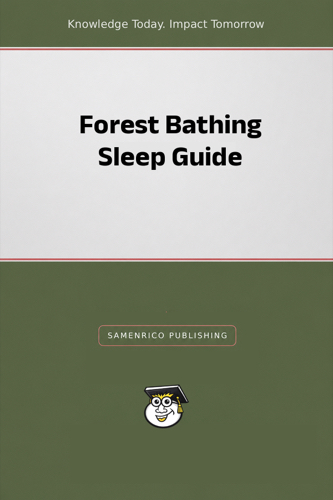
Forest Bathing Sleep Guide eBook
Combine nature visualization with meditation to ac
by York Marylou
Combine nature visualization with meditation to access deep restorative sleep.
Formats
Free sample
Chapter 1: The Vagal Brake--–- The first thing you must understand about sleep is that it is not something you do. It is something you stop fighting.This single sentence inverts almost everything you have been told about insomnia. You have likely spent years accumulating sleep hygiene rules: no screens after 9 p.m., no caffeine past noon, no eating within three hours of bed, keep the room cool, keep the room dark, keep the room quiet, take magnesium, take melatonin, take CBD, try a weighted blanket, try a different pillow, try a different mattress, try a different spouse. The list is endless. The exhaustion is deeper.And yet here you are, reading a book about forest bathing at an hour when you should already be asleep.The problem is not that you lack discipline or the right supplements or the perfect bedtime routine.
The problem is that your nervous system has forgotten how to take its foot off the accelerator. You are driving through life with the parking brake engaged and the gas pedal pressed to the floor, wondering why the engine is overheating.This chapter will introduce you to the single most important physiological concept in this entire book: the vagal brake. You do not need to become a neuroscientist to use it, but you do need to understand what it is, why it fails, and how the practice of forest bathing—specifically, the visualization of fractal nature patterns—can re-engage it from the comfort of your bed.By the end of this chapter, you will understand why a walk in the woods (or even the imagination of a walk in the woods) is not merely pleasant or relaxing. It is a biological lever that directly controls the switch between exhaustion and restoration.The Tired but Wired Epidemic Let us name the enemy. It is not insomnia in the classical sense—the inability to fall asleep for hours on end, though that is certainly part of it for many readers.
The more insidious enemy is the state of being tired but wired. You are exhausted. Your eyelids are heavy by 9 p.m. Your body aches for horizontal surrender. But the moment your head touches the pillow, something shifts.
The engine revs. The mind produces a highlight reel of every mistake you made today, every email you forgot to send, every slightly off-color comment you made at the meeting, every possible catastrophe that could befall your children or your parents or your finances or your health in the next six months.Your body, meanwhile, feels like it is humming. Not anxious exactly. Not panicked. Just...
alert. As if somewhere deep in your nervous system, a dimmer switch is stuck at 20 percent when it should be at zero.This is the "tired but wired" state, and it is the signature complaint of the modern sleepless person. You are not suffering from a sleep disorder in the classical medical sense. You are suffering from a nervous system that has been trained—by decades of evolutionarily inappropriate stimuli—to remain on guard long after the actual threats have disappeared.To understand why, we have to go back about two hundred thousand years.The Ancient Wiring Problem Your nervous system evolved on the savannas and in the forests of prehistoric Africa, not in a world of email notifications, 24-hour news cycles, and fluorescent lighting. For the vast majority of human history, the only threats that mattered were physical, immediate, and short-lived: a predator behind that bush, a rival tribe over that ridge, a poisonous snake coiled on that path.Your body's stress response—the famous fight-or-flight system—was designed to activate for about three to five minutes, resolve the threat (by running, fighting, or hiding), and then deactivate completely, allowing the body to return to a state of rest, digestion, repair, and sleep.Here is the problem.
That ancient system cannot tell the difference between a lion charging at you and a passive-aggressive email from your boss. It cannot distinguish between a rival warrior wielding a club and an unpaid bill sitting in your inbox. It cannot differentiate between the sound of a predator in the tall grass and the sound of a phone buzzing at 11 p.m. with a notification from a group chat you muted but still feel compelled to check.The result is that your stress response is now activating dozens or even hundreds of times per day for reasons that are almost never life-threatening. And crucially, because the "threats" are psychological and persistent rather than physical and brief, the stress response never fully deactivates.
It stays on. It stays low-grade. It stays humming in the background like a refrigerator that never cycles off.This low-grade, chronic stress activation is the engine of the "tired but wired" state. Your body is exhausted from running a marathon it never signed up for. But your nervous system is still alert, still scanning for danger, still refusing to hand over the keys to the sleep department.Enter the vagus nerve.The Vagus Nerve: Your Body's Information Superhighway The vagus nerve is the tenth cranial nerve, and it is the longest and most complex nerve in the human body.
Its name comes from the Latin word for "wandering," which is precisely what it does: it wanders from the brainstem, down through the neck, through the chest, and into the abdomen, branching out to touch the heart, the lungs, the digestive tract, and dozens of other organs.Think of the vagus nerve as the body's information superhighway, but with a crucial asymmetry. About 80 percent of its traffic travels from the body to the brain, carrying real-time data about heart rate, breathing, digestion, inflammation, and dozens of other internal states. Only 20 percent travels from the brain to the body, sending instructions back down.This means that your brain is far more influenced by the state of your body than most people realize. If your heart is racing, your brain assumes there must be a threat—even if there isn't one. If your breathing is shallow and rapid, your brain assumes you are in danger—even if you are safe in bed.
If your digestion is sluggish or your muscles are tense, your brain receives those signals as evidence that something is wrong.The vagus nerve is why a racing heart can cause a panic attack rather than the other way around. It is why shallow breathing can create anxiety even when you have no anxious thoughts. It is why, conversely, slowing your breath can slow your heart, which can calm your mind.But the vagus nerve is not merely a passive cable carrying signals back and forth. It is also the primary hardware of the parasympathetic nervous system—the branch of your autonomic nervous system responsible for rest, digestion, repair, reproduction, and, most relevant to this book, sleep.If the sympathetic nervous system is the accelerator (fight or flight), the parasympathetic nervous system is the brake. And the vagus nerve is the cable that connects that brake pedal to the wheels.The Vagal Brake: How You Calm Yourself Down Now we arrive at the central concept of this chapter: the vagal brake.Dr.
Stephen Porges, a distinguished neuroscientist and the creator of Polyvagal Theory, coined this term to describe a specific physiological mechanism.…
This is the end of the free sample. Get the eBook to keep going. Buy now
About this book
Details
- Author
- York Marylou
- Publisher
- SamEnrico
- Language
- English
- Genre
- Non-Fiction, Self-Help, Nature Therapy
- Released
- 2026-06-08
- Pages (approx.)
- 144
- Available as
- eBook, Audiobook

Read better in the ZLOADR app
Your eBooks on your phone or tablet. Sign in with your SamEnrico account and start reading.
More by York Marylou
 UK Social Housing DecarbonisationYork Marylou$11.99
 The High Functioning Alcoholic WorkbookYork Marylou$11.99
 OKRs for Public SpeakingYork Marylou$11.99
 Cocaine Social Network CleanseYork Marylou$11.99
 Golden Silence: The Lost Voices of Hollywood’s First Female Sound EngineersYork Marylou$11.99
 UK-EU Trade Deal Ecommerce PrimerYork Marylou$12.99
 Autonomous Farm Machinery GuideYork Marylou$12.99
 Understanding Idiopathic Diffuse Interstitial FibrosisYork Marylou$17.99
 Prosthetics FabricationYork Marylou$11.99
You may also like
 Body Scan Meditation Track PackCho Emmanuel$11.99
 Outdoor Mindfulness Walking GuideRector Elisabeth$11.99
 Forest Walking MindfulnessMarlow Yu$11.99
 Solo Hiking FlowBenavidez Lan$11.99
 Nature Walking Meditation GuideNegrete Wilda$11.99
 Nature Breaks for StudyingNorton Felipe$11.99
 Teen Nature Connection GuideChristenson Garland$11.99
 Nature Walking MindfulnessBetts Kory$11.99
 Forest Breathing VisualizationCoats Frieda$11.99
 Forest Bathing Walking MeditationHawley Marry$11.99
 Burnout Recovery Nature TimeCalderon Thi$11.99
 Nature Burnout RemedyRivera Darrel$11.99