
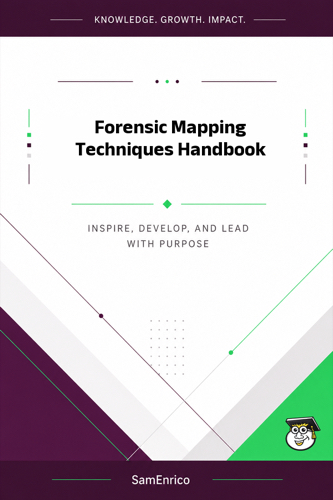
Forensic Mapping Techniques Handbook Audiobook
Use total stations, laser scanners, and photogramm
Use total stations, laser scanners, and photogrammetry to create accurate crime scene diagrams.
Formats
Free sample
Chapter 1: The Measurement of Murder...--The yellow tape fluttered in a cold October drizzle, cordoning off a patch of suburban gravel where a single brass casing lay gleaming under the forensic lights. Two dozen investigators stood waiting. The homicide detective turned to the mapping technician and asked a simple question: "Exactly where is that casing, and how do you know?"That question—deceptively simple—has haunted crime scene investigators for over a century. The answer, as this chapter will reveal, is not about a single tool or technique. It is about a fundamental truth: a crime scene is a three-dimensional puzzle, and if you cannot measure it with verifiable accuracy, you cannot reconstruct what happened.Welcome to the Forensic Mapping Techniques Handbook.
This first chapter does not teach you how to press buttons on a total station or align point clouds. Instead, it builds the intellectual and historical foundation upon which all subsequent technical chapters rest. We will travel from ancient Greek geometry to Victorian photography, through the bloodstained rooms of Whitechapel to the digital courtrooms of today. By the end, you will understand not just how forensic mapping evolved, but why the shift from 2D sketches to 3D digital twins is the most important transformation in crime scene documentation since the invention of the camera.The Ancient Roots of Measurement Before there were crime scenes, there were land disputes. The earliest systematic measurement science—what the Greeks called geometria (literally "earth measurement")—emerged not from murder investigations but from the need to answer a quarrelsome neighbor's claim: "That furrow is my boundary."Archimedes of Syracuse (c.
287–212 BCE) is the unlikely grandfather of forensic mapping. His treatise On the Sphere and Cylinder established that any point in space can be described by its relationship to fixed reference points—a concept that underpins every coordinate system used by total stations, laser scanners, and photogrammetry software today. Archimedes did not measure bloodstains, but he gave us the language of spatial relationships.The Romans systematized these principles into practical field surveying. Their gromatici (land surveyors) used an instrument called the groma—a wooden cross with four plumb lines—to establish right angles and straight lines over hundreds of meters. Roman roads, aqueducts, and city grids still bear witness to their precision.
More importantly, the Romans documented their measurements in written logs, creating the first auditable records of spatial data. A Roman surveyor could…
This is the end of the free sample. Get the Audiobook to keep going. Buy now
About this book
Details
- Author
- Shively Larue
- Publisher
- SamEnrico
- Language
- English
- Genre
- Non-Fiction, True Crime
- Released
- 2026-06-09
- Pages (approx.)
- 157
- Available as
- eBook, Audiobook

Listen in the VoxFlicks app
Audiobooks and audio dramas wherever you go. Sign in with your SamEnrico account and press play.
More by Shively Larue
 Focus For Health ProfessionalsShively Larue$11.99
 Imposter For New ParentsShively Larue$11.99
 Strategic Time BlockingShively Larue$11.99
 Education Talent ShortagesShively Larue$11.99
 The Startup Inventory AccountingShively Larue$11.99
 Job Seeker Time BlockingShively Larue$11.99
 Walking Hypnosis ListeningShively Larue$11.99
 The Great Escape of the Cape Town Convicts: A Colonial Justice ScandalShively Larue$11.99
 The Velvet Underground: Exploding the Myth of the UndergroundShively Larue$11.99
 Carrot: When to Harvest CarrotsShively Larue$11.99
 College Application Essays That Work GuideShively Larue$12.99
 New Zealand Stock Option Tax RulesShively Larue$12.99
You may also like
 Reconstruction of Baby Shaking DeathsLeahy Cathie$11.99
 Arson Scene ReconstructionKirkwood Celesta$11.99
 3D Scanning Crime Scene TechHelton Stacie$11.99
 Russian Election Interference CrimePena Jenny$11.99
 Russian Doping Cover Up CrimeBarnes Kristen$11.99
 Russian Cigarette SmugglingFlores Marcella$11.99
 Russian Art Market FraudHidalgo Ryann$11.99
 Reconstruction of Sexual Assault ScenesSchulte Chanelle$11.99
 Reconstruction of Road Rage ShootingsMount Tia$11.99
 Reconstruction of Fentanyl Overdose ScenesValenzuela Jessika$11.99
 Reconstruction of Death Scene PhotographyPeterman Norris$11.99
 Reconstruction of Botched Robbery HomicidesLucero Kareen$11.99