
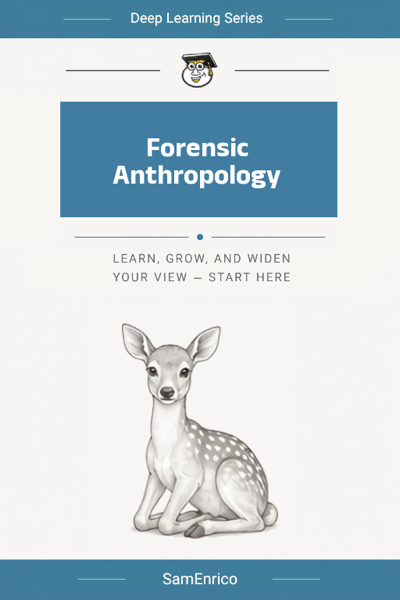
Non-FictionInformativeEducational
Forensic Anthropology
A Coursebook on Forensic Anthropology
A Coursebook on Forensic Anthropology
Formats
About this book
Free sample
Chapter 1: The Silent Witness…--– The human skeleton is a chronicle of life and a testament to death. Every fracture, every healed lesion, every ridge and groove tells a story that outlasts flesh, memory, and sometimes even time itself. In the hands of a forensic anthropologist, bones become the silent witnesses to humanity’s most intimate moments—and its most violent ends. This is the discipline that reads that silent language, translating the mute testimony of calcified tissue into evidence that can bring closure to families, identify the unknown, and convict the guilty or exonerate the innocent. Welcome to forensic anthropology: where the dead speak, and we learn to listen.Forensic anthropology is not merely the study of old bones.
It is the application of skeletal biology, human osteology, and archaeological method to the resolution of legal matters. Unlike bioarchaeology, which studies ancient populations in cultural context, or paleoanthropology, which traces human evolution, forensic anthropology operates within the crucible of the criminal justice system. Its practitioners are scientists first and expert witnesses second, bound by the rigorous standards of evidence admissibility, chain of custody, and ethical responsibility to both the living and the dead.The discipline sits at a unique intersection. It draws from anatomy, physiology, genetics, archaeology, and even criminology. A forensic anthropologist might be called to a shallow grave in a suburban backyard, a charred ruin where a house once stood, or a mass disaster site where hundreds of fragments must be sorted, identified, and returned to grieving families.
In each setting, the same fundamental question applies: who was this person, what happened to them, and how long ago did they die? The answers are etched into the very fabric of the skeleton, waiting for someone trained to read them.This chapter introduces the scope of forensic anthropology as a profession, a science, and a legal tool. It traces the discipline’s historical development from the anatomists of the nineteenth century to the DNA-integrated, computer-assisted practice of today. It defines the “Big Four” tasks that form the core of any forensic anthropological analysis: constructing the biological profile, analyzing trauma, interpreting…
This is the end of the free sample. Get the eBook to keep going. Buy now
Contents
- Chapter 1
- Chapter 2
- Chapter 3
- Chapter 4
- Chapter 5
- Chapter 6
- Chapter 7
- Chapter 8
- Chapter 9
- Chapter 10
- Chapter 11
- Chapter 12
Details
- Author
- Alonzo Lynsey
- Publisher
- SamEnrico
- Language
- English
- Genre
- Non-Fiction, Informative, Educational
- Released
- 2026-05-06
- Pages (approx.)
- 156
- Available as
- eBook, Audiobook

Read better in the ZLOADR app
Your eBooks on your phone or tablet. Sign in with your SamEnrico account and start reading.
More by Alonzo Lynsey
 The Parental Addiction and SiblingsAlonzo Lynsey$11.99
 Mindful Communication at WorkAlonzo Lynsey$11.99
 Microbiome Detox ProtocolAlonzo Lynsey$11.99
 Mindfulness For Sickle CellAlonzo Lynsey$11.99
 The Last Pharaoh's Secret: Hatshepsut's Vanished ExpeditionAlonzo Lynsey$11.99
 How to Start a Local Authority Art Galleries and Museums Business (Beginners Guide)Alonzo Lynsey$11.99
 How to Produce Business and Productivity SoftwareAlonzo Lynsey$11.99
You may also like
 Hong Kong Handover 1997Dunn Johnnie$11.99
 Zumba For Postnatal Recovery CourseNeal Christian$11.99
 Zumba for BeginnersLadner Nikia$11.99
 YouTube Comment Mining GuideHumes Pandora$12.99
 Worry Box MeditationCarlin Rudy$11.99
 Workplace Stress MeditationNguyen Lynn$11.99
 Workplace Stress and Sleep RepairHawley Ivory$11.99
 Workplace Perfectionism CureDelaney Jeffry$11.99
 Workplace Injustice Anger GuideWallen Isabelle$11.99
 Work Addiction and Burnout LinkGreenwood Ester$11.99
 Women in Yoga and WellnessBeattie Galina$11.99
 Women in Stand Up ComedyChun Evangeline$11.99