
Non-FictionInformativeEducational
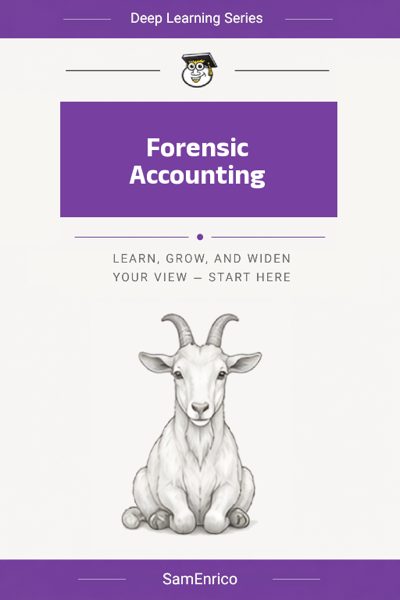
Forensic Accounting eBook
A Coursebook on Forensic Accounting
A Coursebook on Forensic Accounting
Formats
Free sample
Chapter 1: Beyond Balanced Books...–- The ledger was perfect. Every debit had a corresponding credit. The trial balance balanced to the penny. The external auditor had issued an unqualified opinion for seven consecutive years. And yet, over three hundred million dollars had evaporated into the personal bank accounts of the company's chief financial officer.
The arithmetic was honest. The people were not.This is the central paradox that every forensic accountant confronts on their first day of training. Accounting is a system of perfect logical symmetry. Double-entry bookkeeping, first codified by Luca Pacioli in 1494, ensures that the universe of debits and credits remains in eternal balance. Fraud does not disrupt that balance.
Fraud hides within it. The forensic accountant is not someone who finds mathematical errors. The forensic accountant is someone who finds the human intentions hidden beneath mathematically correct numbers.The difference between a traditional accountant and a forensic accountant is not a difference in technical knowledge. It is a difference in professional mindset. The traditional auditor asks, "Do these numbers follow the rules?" The forensic accountant asks, "What story do these numbers tell about what actually happened?" The first question leads to a checklist.
The second question leads to an investigation. This chapter introduces that investigative mindset, defines the unique domain of forensic accounting, and establishes the conceptual framework that will guide every technique and tool presented in the remaining eleven chapters.The Meaning of "Forensic": More Than a Buzzword The word "forensic" has become fashionable in business titles. There are forensic engineers, forensic psychologists, and even forensic genealogists. But in the context of accounting, "forensic" carries a precise legal meaning derived from its Latin root forensis—belonging to the forum. In ancient Rome, the forum was the public square where legal disputes were argued before magistrates and juries.
A "forensic" presentation was one suitable for that adversarial environment.Today, "forensic accounting" means accounting that is suitable for use in a court of law. This seemingly simple definition has profound implications. When an auditor prepares a financial statement, they are writing for shareholders and regulators. When a forensic accountant prepares a report, they are writing for a judge, a jury, and opposing counsel. The audience changes everything.Consider the difference in evidentiary standards.
An auditor relies on audit evidence as defined by Statement on Auditing Standards No. 142: sufficient appropriate evidence to support an opinion. A forensic accountant relies on evidence admissible under the Federal Rules of Evidence. The two categories overlap but are not identical. Audit evidence can include hearsay, unauthenticated documents, and preliminary analyses.
Admissible evidence cannot. A forensic accountant who submits a report relying on a document that was not properly authenticated has wasted everyone's time. The judge will exclude the document, the jury will never see it, and the case may collapse.This legal orientation explains why forensic accountants spend so much time on procedural matters that auditors ignore. Chain of custody, privilege, work product doctrine, spoliation, discovery, deposition preparation—these are not administrative distractions. They are the conditions under which forensic work becomes legally meaningful.
A brilliant financial analysis that cannot survive a motion to exclude is worthless. Chapter 2 explores these legal foundations in depth. For now, the key insight is that forensic accounting is accounting under adversarial rules.The Auditor's Question vs. The Investigator's Question To understand forensic accounting, one must first understand what forensic accounting is not. It is not auditing with an attitude.
It is not a certification exam specialty. It is a fundamentally different intellectual activity that happens to share some technical tools with auditing.The Auditor's Framework A financial statement audit is governed by Generally Accepted Auditing Standards (GAAS). The auditor's objective is to obtain reasonable assurance about whether the financial statements as a whole are free from material misstatement, whether caused by error or fraud. Notice the phrase "reasonable assurance." This is not absolute assurance. Auditors accept sampling risk, detection risk, and inherent risk as unavoidable features of their work.
An auditor who tested every single transaction would bankrupt the client. Auditing is therefore an exercise in risk management, not truth-seeking.Materiality is the auditor's most important tool. A misstatement is material if its omission or misstatement would influence the economic decisions of a reasonable user. Materiality is both quantitative (say, five percent of net income) and qualitative (a small misstatement that helps the company meet analyst expectations can be material even if the dollar amount is trivial). Because materiality provides a boundary, the auditor can safely ignore issues below that boundary.
That is not negligence. That is professional standards.The Forensic Accountant's Framework A forensic engagement has no materiality threshold in the audit sense. The forensic accountant is asked to investigate a specific allegation: fraud, embezzlement, hidden assets, or financial misrepresentation. The scope is narrower than an audit, but the depth is greater. Where an auditor samples fifty transactions, a forensic accountant examines every transaction in a suspect population.
Where an auditor accepts a variance as within tolerable misstatement, a forensic accountant investigates that variance until they understand why it exists.The forensic accountant's standard is not reasonable assurance. It is evidentiary support for a legal conclusion. That conclusion may be probable cause (for a criminal referral), preponderance of the evidence (for a civil case), or beyond a reasonable doubt (for a criminal conviction). Each standard requires a different quantum of evidence, but all three require more individual transaction testing than an audit would perform.The table below contrasts the two disciplines across seven dimensions:Dimension Auditing Forensic Accounting Primary question Are statements fairly presented?Did fraud occur, and who is responsible?Scope Whole financial statements Specific allegation or transaction set Sampling Almost always Almost never (entire population)Materiality Central concept Legal threshold, not audit filter Standard Reasonable assurance Evidentiary support for legal proceeding Audience Investors, creditors Judges, juries, lawyers Outcome Opinion letter Expert report and testimony Why The Distinction Matters This is not an academic distinction. Opposing counsel will exploit any confusion.
In deposition, a defense attorney will ask, "You're a CPA, correct? And you performed this engagement under your CPA license? And you followed auditing standards? And auditing standards say you only need reasonable assurance, not certainty? So you're not certain about your conclusions, are you?"A forensic accountant who does not understand the distinction between auditing and forensic work will stumble.
The correct answer is, "No, I did not follow auditing standards. I followed the standards of forensic practice, which require testing the entire population and do not rely on materiality as a pass/fail threshold. My conclusions are supported by a complete evidentiary record, not by sampling."This chapter's warning is simple: if you approach forensic work with an auditor's mindset, you will fail. You will stop too early. You will exclude relevant evidence because it fell below a materiality threshold that does not apply.
You will write reports that sound like audit opinions rather than expert conclusions. The mindset shift is the first and most difficult step.The Fraud Triangle: Understanding Why Good People Steal Forensic accounting is not a purely technical discipline. Understanding fraud requires understanding human behavior. The most influential model in fraud examination is the Fraud Triangle, developed by criminologist…
This is the end of the free sample. Get the eBook to keep going. Buy now
About this book
Details
- Author
- Mcdade Refugio
- Publisher
- SamEnrico
- Language
- English
- Genre
- Non-Fiction, Informative, Educational
- Released
- 2026-05-11
- Pages (approx.)
- 151
- Available as
- eBook, Audiobook

Read better in the ZLOADR app
Your eBooks on your phone or tablet. Sign in with your SamEnrico account and start reading.
More by Mcdade Refugio
 MBSR Beginners Eight Week CourseMcdade Refugio$11.99
 TRIZ Problem SolvingMcdade Refugio$11.99
 Survey Confidence Interval GenerationMcdade Refugio$11.99
 No Equipment HIIT WorkoutsMcdade Refugio$11.99
 OCD And Hair Pulling TrichotillomaniaMcdade Refugio$11.99
 Echoes from the Abyss: The Voyager Golden Record's Cosmic ConversationMcdade Refugio$11.99
 The Plague Hunters of Timbuktu: Africa's Forgotten Battle Against DiseaseMcdade Refugio$11.99
 Understanding Canine DistemperMcdade Refugio$17.99
 Slovak Master Degree GuideMcdade Refugio$12.99
 Coursework as Publication SubstituteMcdade Refugio$12.99
 How to Become a Mixing-machine FeederMcdade Refugio$11.99
You may also like
 Hong Kong Handover 1997Dunn Johnnie$11.99
 Zumba For Postnatal Recovery CourseNeal Christian$11.99
 Zumba for BeginnersLadner Nikia$11.99
 YouTube Comment Mining GuideHumes Pandora$12.99
 Worry Box MeditationCarlin Rudy$11.99
 Workplace Stress MeditationNguyen Lynn$11.99
 Workplace Stress and Sleep RepairHawley Ivory$11.99
 Workplace Perfectionism CureDelaney Jeffry$11.99
 Workplace Injustice Anger GuideWallen Isabelle$11.99
 Work Addiction and Burnout LinkGreenwood Ester$11.99
 Women in Yoga and WellnessBeattie Galina$11.99
 Women in Stand Up ComedyChun Evangeline$11.99