
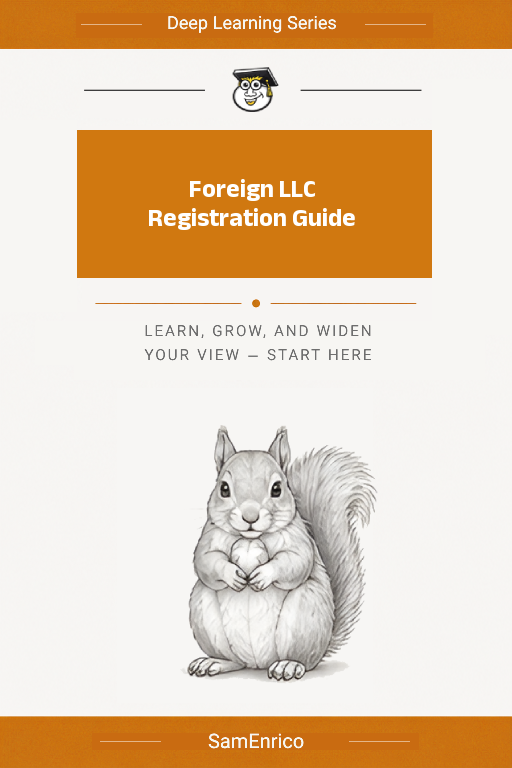
Foreign LLC Registration Guide eBook
Register your out-of-state LLC to do business in a
by Derr Romona
Register your out-of-state LLC to do business in another state properly.
Formats
Free sample
Chapter 1: The Invisible LLC--–- On a Tuesday morning in March, Sarah Chen poured her third cup of coffee and opened her email to find a subject line that would change her life: Notice of Lawsuit – Response Required within 21 Days. The email came from a District Court in Dallas, Texas. A customer named David Reynolds alleged that one of her fitness resistance bands had snapped during use, causing him to fall and fracture his wrist. He was suing for $347,000 in medical expenses, lost wages, and pain and suffering.Sarah had built a successful online fitness coaching business from her home office in Portland, Oregon. She sold resistance bands, yoga mats, and training guides through her website.
Two years earlier, an online legal service had helped her form a Limited Liability Company in Delaware—a popular choice for internet entrepreneurs because of Delaware's business-friendly laws. She had paid $90 for the filing, received her Certificate of Formation via email, and confidently told herself that her personal assets were now protected. Her house. Her savings. Her daughter's college fund.
All safely walled off from any business liability.Or so she believed.When Sarah forwarded the lawsuit notice to her Delaware-registered registered agent, the response was swift and devastating: "We cannot accept service of process on your behalf in Texas. You are not registered to do business in Texas. You will need to retain local counsel to respond to this lawsuit, but please be advised that without foreign qualification in Texas, you may not have standing to defend."Sarah read the words three times. She had never heard the term "foreign qualification." Her Delaware LLC, she assumed, was valid everywhere in the United States. Wasn't that the point of forming an LLC?The truth was far worse.
Within sixty days, a Texas judge would rule that because Sarah had never registered her Delaware LLC as a "foreign LLC" in Texas, her company was legally invisible in that state. She could not use Texas courts to defend herself. And because she had operated an unregistered business in Texas, the judge would "pierce the corporate veil"—a legal term that sounds abstract until it means the bank takes your house.Sarah's story is not an outlier. It happens thousands of times every year to business owners who believe the common myth that "an LLC protects you everywhere." The myth is dangerous because it is partially true. An LLC does protect your personal assets—but only in the state where you formed it.
Step outside that state's borders to conduct business without proper registration, and you might as well have no LLC at all.This chapter will show you exactly why that is. You will learn the foundational vocabulary of domestic versus foreign LLCs, the three catastrophic consequences of operating without foreign qualification, and the specific legal mechanisms that can strip away your liability protection. By the end of this chapter, you will understand that foreign qualification is not a bureaucratic nicety or a suggestion from nervous lawyers. It is the price of admission for multi-state business. Fail to pay it, and you are gambling everything you own.The Vocabulary That Could Save Your House Before we can understand why Sarah lost her liability protection, we need to establish two simple definitions that will appear throughout this book.
These terms are often misunderstood, but they are not complicated.Domestic LLC refers to the LLC in the state where you originally formed it. If you filed your Articles of Organization in Delaware, then your Delaware LLC is your domestic LLC. That is your home state. The state where you are "domestic" means the state whose laws govern your LLC's internal affairs—how you manage the company, how you distribute profits, how you resolve disputes among members.Foreign LLC has nothing to do with international business. In legal terms, "foreign" simply means "from another state." When you take your Delaware LLC and register it to do business in Texas, that same LLC becomes a foreign LLC in Texas.
You have not created a new company. You have simply told Texas that your existing Delaware company wants to operate within its borders. Texas then issues you a Certificate of Authority, which is essentially permission to exist as a business entity in Texas.The critical concept to understand is that an LLC is a creature of state law. It exists only because a particular state says it exists. When you formed your LLC in Delaware, Delaware law created a legal fiction: a separate person called a Limited Liability Company that can own assets, sign contracts, and be sued.
That legal fiction has no natural existence. It is a ghost that Delaware law animates.But Delaware's magic only works within Delaware's jurisdiction. When you cross into Texas, Delaware's law does not automatically follow you. Texas has its own laws, its own courts, and its own rules about which business entities are allowed to operate. If you want your Delaware-created ghost to be visible in Texas, you must ask Texas for permission.
That permission is called foreign qualification.Without foreign qualification, your LLC is not a legal person in Texas. It cannot sign a contract that Texas courts will enforce. It cannot sue a customer who fails to pay. And most terrifyingly, it cannot defend itself when someone sues it.This is the trap that caught Sarah. Her Delaware LLC was perfectly legitimate in Delaware.
But in Texas, where her warehouse was located and where her customer was injured, her LLC did not legally exist. The Texas court could not recognize her LLC because the LLC had never asked Texas for the right to be there. And without a recognized business entity to defend, the court simply looked past the LLC and held Sarah personally liable.The Three Catastrophes of Non-Compliance The consequences of failing to foreign qualify are not theoretical. They are real, they are severe, and they compound over time. Based on thousands of court cases and state enforcement actions, the risks fall into three distinct categories.
Each category alone is enough to destroy a business. Together, they are devastating.Catastrophe One: Loss of Access to Courts This is the most immediate and most surprising consequence. If you operate an unqualified foreign LLC in a state, that state's courts will generally refuse to hear any lawsuit you bring. You cannot sue a customer for non-payment. You cannot sue a supplier for breach of contract.
You cannot evict a tenant from a property you own. You are, for legal purposes, a ghost.The legal doctrine behind this is called "standing." To bring a lawsuit in a state court, you must have legal standing—the right to appear before the court and ask for relief. Only recognized legal entities have standing. An unqualified foreign LLC is not a recognized legal entity. Therefore, it has no standing.Some states are more forgiving than others.
A handful of states will allow you to cure the defect by retroactively qualifying after you file the lawsuit. But most states—including California, New York, Texas, and Florida—will simply dismiss your case. You lose. You cannot try again. The statute of limitations may have expired.
The defendant walks away.But the problem is even worse than losing your ability to sue. The same rule applies to…
This is the end of the free sample. Get the eBook to keep going. Buy now
About this book
Details
- Author
- Derr Romona
- Publisher
- SamEnrico
- Language
- English
- Genre
- Non-Fiction, First 30 Days
- Released
- 2026-06-01
- Pages (approx.)
- 158
- Available as
- eBook, Audiobook

Read better in the ZLOADR app
Your eBooks on your phone or tablet. Sign in with your SamEnrico account and start reading.
More by Derr Romona
 Bipolar WorkbookDerr Romona$11.99
 Postpartum Constipation ReliefDerr Romona$11.99
 Gluten Free Iron Sources GuideDerr Romona$11.99
 Sam Sheppard Retrial TranscriptDerr Romona$11.99
 TM During PregnancyDerr Romona$11.99
 Commute Breath MeditationDerr Romona$11.99
 Cockroach Allergen PreventionDerr Romona$11.99
 Photojournalist Trauma GuideDerr Romona$11.99
 Glucosamine For ArthritisDerr Romona$11.99
 The Smallpox Eradication: The Final Battle Against a KillerDerr Romona$11.99
 The Last Pharaoh's Secret: Cleopatra's Forgotten WarDerr Romona$11.99
 The Bone Fiddler of the Black ForestDerr Romona$11.99
You may also like
 Hong Kong Handover 1997Dunn Johnnie$11.99
 Zumba For Postnatal Recovery CourseNeal Christian$11.99
 Zumba for BeginnersLadner Nikia$11.99
 YouTube Comment Mining GuideHumes Pandora$12.99
 Worry Box MeditationCarlin Rudy$11.99
 Workplace Stress MeditationNguyen Lynn$11.99
 Workplace Stress and Sleep RepairHawley Ivory$11.99
 Workplace Perfectionism CureDelaney Jeffry$11.99
 Workplace Injustice Anger GuideWallen Isabelle$11.99
 Work Addiction and Burnout LinkGreenwood Ester$11.99
 Women in Yoga and WellnessBeattie Galina$11.99
 Women in Stand Up ComedyChun Evangeline$11.99