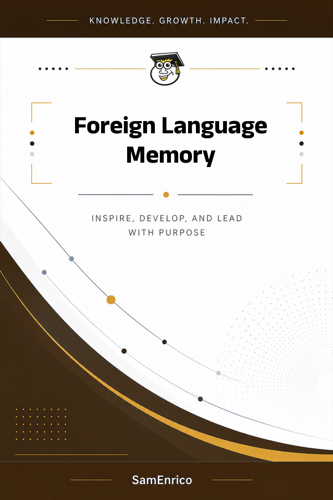
Foreign Language Memory eBook
Acquires vocabulary through keyword mnemonics.
Acquires vocabulary through keyword mnemonics.
Formats
Free sample
Chapter 1: The Forgetting Curve--–- Every language learner knows the feeling. You sit at your desk with a stack of flashcards, a vocabulary app glowing on your phone, or a neatly handwritten list taped to the wall. You repeat the word: poubelle. Trash can. Poubelle.
Trash can. Poubelle. You say it ten times, twenty times, forty times. It feels solid. It feels secure.
You close your eyes and the word is there, glowing with the confidence of hard-won repetition. You go to sleep satisfied.The next morning, you wake up. You reach for the word. It is gone.Not faded. Not fuzzy.
Not hiding in the back of your mind waiting to be retrieved. Gone. As if someone reached into your brain while you slept and pulled out that single, specific thread. You stare at the flashcard. Poubelle.
You know you studied it. You know you repeated it until your throat was dry. You know you did everything your teachers and apps told you to do. But the connection between the sound and the meaning has been severed, leaving only the vague sense of failure that every language learner knows too well.This is not your fault. This is not a sign of a "bad memory." This is not evidence that you are "not good at languages" or that you started too late in life or that your brain is simply wired differently.
This is the predictable, measurable, scientifically inevitable consequence of using the wrong learning strategy. You have been caught in the Forgetting Curve.What you are about to learn in this chapter will challenge everything you have been taught about studying. It will explain why you have forgotten thousands of words that you "knew" at some point. It will name the enemy that has wasted hundreds of hours of your language learning life. And it will introduce you to a single, powerful idea that will change how you acquire foreign language vocabulary forever.
By the time you finish this chapter, you will never waste time on rote repetition again.The Discovery That Changed Memory Science Forever In 1885, a German psychologist named Hermann Ebbinghaus did something that no one had done before. He decided to measure forgetting. Not vaguely, not anecdotally, not through philosophical speculation about the nature of memory. Precisely. Mathematically.
Experimentally.Ebbinghaus faced a fundamental problem. If he tried to measure how people forget poetry or historical facts or daily experiences, he could never be sure what they were actually forgetting. Those memories came with prior associations, emotional baggage, and existing knowledge. He needed something pure. Something neutral.
Something that had never been seen before by any human brain.So he invented the nonsense syllable.A nonsense syllable was a three-letter combination consisting of a consonant, a vowel, and another consonant, carefully constructed to have no meaning in German or any other language. "ZOF." "WUB." "QAX." "MEK." These were not words. They were not abbreviations. They were not sounds that accidentally resembled real words. They were engineered to be completely, utterly meaningless.Ebbinghaus created 2,300 of these nonsense syllables.
Then he memorized them. One by one, list by list, he repeated them until he could recite them perfectly. Then he tested himself at regular intervals—after 20 minutes, after 1 hour, after 9 hours, after 1 day, after 2 days, after 6 days, after 31 days—to see how much he had lost.What he discovered became one of the most replicated findings in the history of psychology. The Ebbinghaus Forgetting Curve is not a theory. It is not an opinion.
It is a measurement. And here is what it shows:Within 20 minutes of learning a list of new items through repetition alone, you will have forgotten approximately 42 percent of them.Within 1 hour, you will have forgotten approximately 56 percent.Within 24 hours, you will have forgotten approximately 80 percent.Let that sink in. Eighty percent. You study for an hour. You repeat each word twenty times.
You feel confident. The next day, four out of every five words are gone. Not in your "long-term memory" waiting to be retrieved. Erased. As if you had never studied them at all.This is not a failure of effort.
This is not a failure of discipline. This is a failure of method. Your brain is not designed to store isolated, arbitrary pieces of information based on repetition alone. It never was. Evolution did not shape your memory to memorize flashcard decks.
It shaped your memory to survive in a complex, dangerous, information-dense world. And survival does not reward repetition. Survival rewards connection.The Self-Experiment That Will Change Your Mind Before we go any further, I want you to experience the Forgetting Curve for yourself. Not as an abstract statistic, but as a physical sensation in your own brain. This will take five minutes.
It will be slightly uncomfortable. And it will be worth it.Take a piece of paper and draw a line down the middle. On the left side, write the numbers 1 through 10. On the right side, leave space for answers.Here are ten foreign words. Do not worry about which language they come from.
The specific sounds do not matter. What matters is that they are unfamiliar to you. They have no prior associations in your mind. They are, for you, what nonsense syllables were for Ebbinghaus.Zaloz – window Mebik – chair Daron – river Kefir – mountain Somal – bread Tiruk – fire Pelon – star Gadob – rain Lomar – mother Veset – hand Now, using pure repetition, try to memorize these ten pairs. Cover the right side of the list with your hand.
Look at Zaloz and try to remember "window." Check yourself. Say each pair out loud ten times. Spend exactly two minutes on this. No mnemonics. No tricks.
No mental images. Just repetition. The way you were taught in school. The way most apps still work.After two minutes, close your eyes or turn the paper over. Wait thirty seconds.
Then test yourself. Go through numbers 1 through 10 and write down the English word for each foreign word. Do not guess. Only write it if you are certain.How many did you get? Most people get between four and six.
A few get seven. Almost no one gets nine or ten. You have just experienced the first stage of the Forgetting Curve. Within two minutes of stopping your repetition, you have already lost nearly half of what you "learned."Now, wait twenty-four hours. Do not review the list.
Do not peek. Just go to sleep, live your normal day, and tomorrow at the same time, test yourself again on the same ten words.The results will be sobering. You will likely remember two or three. Some of you will remember one. Many of you will remember none.
That is the Forgetting Curve in its full, devastating power. You spent two minutes of focused repetition, and within a day, eighty percent of your effort has evaporated into thin air.This is what you have been doing to yourself every time you open your vocabulary app. Every time you write a list. Every time you repeat a word ten times in a row. You are not building memory.
You are pouring water into a bucket with no bottom.The Illusion of Competence Why does this feel so wrong? Why…
This is the end of the free sample. Get the eBook to keep going. Buy now
About this book
Details
- Author
- Mcclelland Trent
- Publisher
- SamEnrico
- Language
- English
- Genre
- Non-Fiction, Self-Help, Language Acquisition
- Released
- 2026-06-10
- Pages (approx.)
- 128
- Available as
- eBook, Audiobook

Read better in the ZLOADR app
Your eBooks on your phone or tablet. Sign in with your SamEnrico account and start reading.
More by Mcclelland Trent
 The One Question Drill CourseMcclelland Trent$11.99
 Family Disappearances TogetherMcclelland Trent$11.99
 Franchising Your Local Brand Across Borders Peer NetworksMcclelland Trent$11.99
 Jackal Vs Giraffe GuideMcclelland Trent$11.99
 Stimulant and AnxietyMcclelland Trent$11.99
 Property Tax Portability GuideMcclelland Trent$11.99
 Folate For Male FertilityMcclelland Trent$11.99
 The Lioness of Sheba: A Queen's Eternal LegacyMcclelland Trent$11.99
 The Great Telegraph Scandal: The First Cybercrime Conspiracy (1870s)Mcclelland Trent$11.99
 Mastering The Art of ButthanMcclelland Trent$11.99
 How to Produce All-purpose GravelMcclelland Trent$11.99
 How to Start a Engravers Business (Beginners Guide)Mcclelland Trent$11.99