
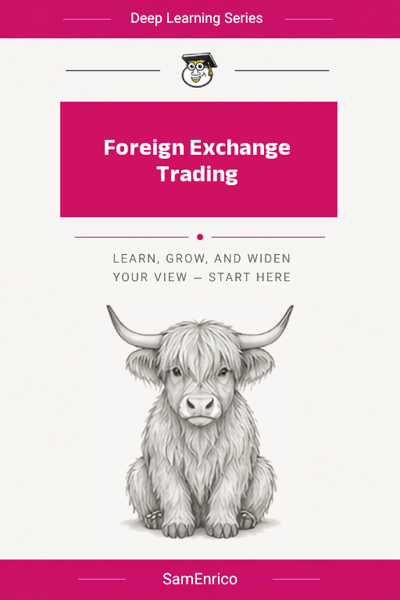
Foreign Exchange Trading eBook
A Coursebook on Foreign Exchange Trading
A Coursebook on Foreign Exchange Trading
Formats
Free sample
Chapter 1: The Graveyard of Optimism--–- Every day, thousands of new traders deposit real money into brokerage accounts with the same belief: “I am smarter than the person on the other side of this trade.” Within six months, ninety-six percent of them are gone. Their accounts are empty, their confidence is shattered, and most will never tell anyone how much they lost. This chapter is not about pips, lots, or chart patterns. Those things matter, but they are useless without a fundamental shift in how you think about money, risk, and the strange animal that is the foreign exchange market. Before you learn how to trade, you need to understand why almost everyone fails—and why your survival depends on starting differently.The foreign exchange market, or Forex for short, is the largest financial market in the world by an almost absurd margin.
Every single day, roughly seven and a half trillion dollars change hands. To put that number into perspective, the entire New York Stock Exchange trades about two hundred fifty billion dollars daily. Forex trades thirty times that volume. This is not a market where small retail traders dominate. It is a market where central banks, sovereign wealth funds, commercial banks, hedge funds, and multinational corporations move positions the size of small countries’ economies.
You, sitting at your laptop with a thousand-dollar account, are a microscopic speck on a vast ocean. That is not meant to discourage you. It is meant to wake you up.Most beginners approach Forex the way they approach a casino: they look for a simple system, a magic indicator, or a guru with a secret formula. They want certainty. They want to be told that if they just buy when the line turns green and sell when it turns red, they will make twenty percent a month.
That is the graveyard of optimism. The truth is far less glamorous and far more powerful. The truth is that successful trading is boring, repetitive, and emotionally uncomfortable. It requires accepting that you will be wrong far more often than you expect. It requires loving the process more than the profit.Before we climb into the mechanics of currency pairs, leverage, and margin calls, we need to establish one non-negotiable principle: this book will teach you to survive first.
Profit comes second. Every professional trader you have ever heard of blew up at least once. They lost everything. Then they rebuilt, not by finding a better indicator, but by fixing their relationship with risk. Chapter one will ground you in the history and structure of the Forex market, define the absolute basics you cannot trade without, and most importantly, drill into your nervous system a respect for leverage that most traders only learn after losing money.
Read this chapter twice. The second time, take notes.The Birth of Floating Money To understand why currencies move the way they do, you need to understand how the modern Forex market came into existence. It is not an ancient institution. Before 1971, the world operated under the Bretton Woods system, named after the New Hampshire resort where forty-four allied nations gathered toward the end of World War II to design the post-war financial order. Under Bretton Woods, every major currency was pegged to the United States dollar, and the dollar itself was convertible into gold at thirty-five dollars per ounce.
The system was designed to provide stability after the chaos of the Great Depression and the war. For about twenty-five years, it worked reasonably well.But by the late 1960s, the system began to crack. The United States had printed too many dollars to finance the Vietnam War and domestic social programs. Foreign central banks looked at their growing dollar reserves and started to wonder if the United States actually had enough gold to back them. In August 1971, President Richard Nixon did something that still echoes through every trading chart you will ever look at.
He closed the gold window. The dollar would no longer be convertible into gold. The Bretton Woods system collapsed, and the world moved to what economists call a floating exchange rate regime.In a floating system, currencies are not fixed to gold or to each other. Their value is determined by supply and demand in the open market. If more people want to buy Japanese goods, they need yen, so the yen rises.
If investors lose confidence in the British economy, they sell pounds, and the pound falls. This created an entirely new financial market. Banks needed to manage their currency exposure. Multinational corporations needed to hedge their overseas profits. Speculators, sensing opportunity, arrived to profit from the fluctuations.
By the 1990s, electronic trading had replaced the telephone-based interbank market, and by the 2000s, retail brokers began offering small traders access to leverage that had previously been reserved for institutions.This history matters because it explains a fundamental truth: currencies move because of human decisions and collective psychology, not because of mathematical formulas. The market is not a machine that follows predictable rules. It is a chaotic, adaptive system where billions of participants act on incomplete information, driven by fear, greed, and institutional mandates. The sooner you accept that uncertainty is permanent, the sooner you stop looking for holy grails and start building robust systems that work despite uncertainty.Spot, Forwards, Futures, and Options The vast majority of retail Forex trading happens in what is called the spot market. Spot trading means buying or selling a currency pair for immediate delivery, where “immediate” actually means settlement in two business days for most pairs.
When you open a position on Meta Trader or c Trader, you are trading spot. The price you see is the current exchange rate between two currencies, and your profit or loss is calculated as the difference between your entry price and your exit price, multiplied by your position size.But spot is not the only way to trade currencies. Forwards are private agreements between two parties to exchange a specific amount of currency at a future date at a predetermined rate. These are used almost exclusively by corporations and banks to hedge future cash flows. Futures are similar but trade on regulated exchanges like the Chicago Mercantile Exchange, with standardized contract sizes and expiration dates.
Options give the buyer the right, but not the obligation, to buy or sell a currency at a specific price before a specific date. As a retail spot trader, you will likely never trade forwards, and futures and options are different instruments with their own complexities. This book focuses exclusively on spot trading because it is the most accessible and most commonly traded by retail participants.The reason spot dominates retail trading is leverage. Brokers offer leverage because currency prices move in tiny increments. The average daily range of a major currency pair like EUR/USD is often less than one percent.
Without leverage, moving a thousand-dollar account would generate pennies of profit or loss. Leverage magnifies those tiny movements into meaningful numbers. It also magnifies losses, which is why Chapter nine exists. For now, understand that spot trading is simple in concept and brutal in execution. You are betting on the direction of one currency…
This is the end of the free sample. Get the eBook to keep going. Buy now
About this book
Details
- Author
- Mccane Georgette
- Publisher
- SamEnrico
- Language
- English
- Genre
- trading, Informative, Educational
- Released
- 2026-05-04
- Pages (approx.)
- 132
- Available as
- eBook, Audiobook

Read better in the ZLOADR app
Your eBooks on your phone or tablet. Sign in with your SamEnrico account and start reading.
More by Mccane Georgette
 Intern Frustration Anger GuideMccane Georgette$11.99
 Anger ABCDE TechniqueMccane Georgette$11.99
 Homelessness and AddictionMccane Georgette$11.99
 Stop Living Paycheck to PaycheckMccane Georgette$11.99
 The Work Guilt GuideMccane Georgette$11.99
 The Ghost in the Print: How Fingerprints Solved Prohibition's Deadliest CrimeMccane Georgette$11.99
 Pre Seed Government Grants GuideMccane Georgette$12.99
 Certification Stacking StrategyMccane Georgette$12.99
 Understanding Urbach–wiethe DiseaseMccane Georgette$17.99
 Ultimate Handbook Guide to Aleppo : (Syria) Travel GuideMccane Georgette$11.99
You may also like
 Shift Work Shift Trading GuideDuff Cathrine$11.99
 Insider Trading SentimentWurtz Shawnda$11.99
 Gambler's Fallacy TradingGaydos Shu$11.99
 Cryptocurrency Trading AddictionGeorge Kathleen$11.99
 Brokerage Account Margin TradingSegura Hermila$11.99
 Gambling Addiction and Day TradingClanton Hyacinth$11.99
 Beginner Mindfulness for Stock TradersFultz Mary$11.99
 Dividend Capture Strategy GuideWallace Antoinette$11.99
 Unauthorized Trading CasesQuintanilla Ima$11.99
 Insider Trading Heist TheoryTripp Luvenia$11.99
 Trader Distraction Control GuideSummers Gina$11.99
 Loss Aversion Trading GuideBoucher Ellamae$11.99