
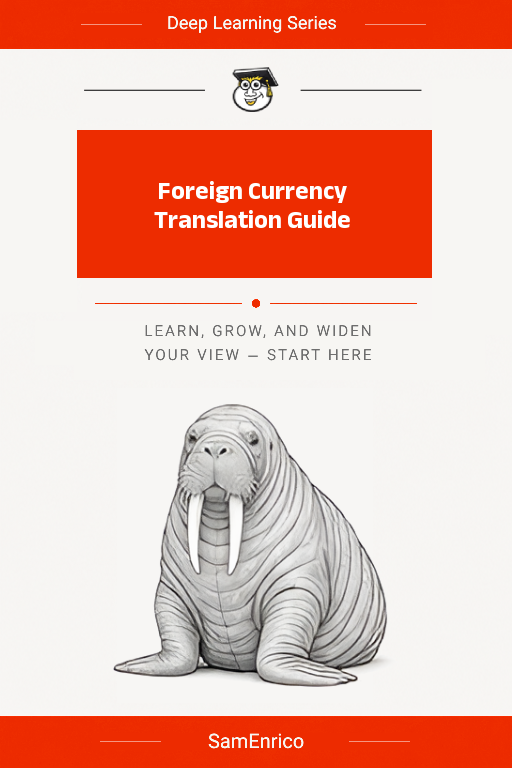
Non-FictionStudent's ShortcutInternational Accounting
Foreign Currency Translation Guide Audiobook
Calculate translation adjustment using current rat
by Kovach Seema
Calculate translation adjustment using current rate method. Apply formulas to convert financial statements of foreign subsidiaries.
Formats
Free sample
Chapter 1: The Phantom Loss--–- The conference room on the 38th floor of Procter & Gamble’s Cincinnati headquarters had hosted countless high-stakes meetings. But on the morning of August 1, 2017, the atmosphere was different. David Taylor, then-CEO, sat at the head of a polished mahogany table surrounded by his CFO, Jon Moeller, the corporate controller, and three senior members of the finance team. Spread across the table were printed copies of the preliminary fourth-quarter earnings release. One number, highlighted in yellow, stood out like a wound: a $2.1 billion reduction in international revenue attributed solely to foreign currency translation.No one in the room had lost a single customer.
No factory had closed. No supply chain had failed. The company had sold exactly the same volume of Tide detergent, Gillette razors, and Pampers diapers overseas as it had the year before. In local currencies—Euros, British Pounds, Japanese Yen, Brazilian Reais—revenue was up 3 percent. Yet when those numbers were translated into US dollars for consolidated reporting, $2.1 billion had evaporated.The stock market’s reaction was swift and brutal.
Within two hours of the announcement, P&G shares dropped 7 percent, wiping out nearly $15 billion in market capitalization. Analysts demanded explanations. One particularly pointed question from a Barclays analyst captured the confusion: “Is this a real loss or an accounting loss? And frankly, should we care?”That question—Is this a real loss or an accounting loss?—is the central puzzle of foreign currency translation. It is the question this entire book answers.
And the answer, as the P&G board learned that day, is more nuanced than anyone in that conference room initially understood.This chapter establishes the foundational framework for everything that follows. By the time you finish these pages, you will understand the three currencies that govern every global company’s financial reporting, the regulatory mandate that makes translation non-negotiable, and the critical distinction between transaction risk (which hits your income statement immediately) and translation risk (which hides in Other Comprehensive Income until a subsidiary is sold). More importantly, you will understand why a $2.1 billion “phantom loss” is both entirely real from a reporting perspective and completely disconnected from the company’s operational health.The Three Currencies You Cannot Ignore Every multinational corporation operates in a world of multiple currencies, but for financial reporting purposes, only three truly matter. Understanding these three—and the relationships among them—is the prerequisite for every calculation, every journal entry…
This is the end of the free sample. Get the Audiobook to keep going. Buy now
About this book
Details
- Author
- Kovach Seema
- Publisher
- SamEnrico
- Language
- English
- Genre
- Non-Fiction, Student's Shortcut, International Accounting
- Released
- 2026-06-01
- Pages (approx.)
- 160
- Available as
- eBook, Audiobook

Listen in the VoxFlicks app
Audiobooks and audio dramas wherever you go. Sign in with your SamEnrico account and press play.
More by Kovach Seema
 Sustainable Success Habits GuideKovach Seema$11.99
 Pomodoro Technique Study GuideKovach Seema$11.99
 Indian GST Composition Scheme Registration CourseKovach Seema$11.99Indian GST Composition Scheme Registration CourseKovach Seema$11.99
 Remote Work Career Transition GuideKovach Seema$11.99
 Uber Driver Rating GuideKovach Seema$11.99
 Laci Peterson Birth FamilyKovach Seema$11.99
 Citation Rules Memory Palace GuideKovach Seema$11.99
 Henry Ford AssemblyKovach Seema$11.99
 Sir Sandford Fleming: The Timekeeper of the Transcontinental RailwayKovach Seema$11.99
 Black Sunday: The Storm That Stole the ChildrenKovach Seema$11.99
 The Complete Guide to Packaged Food DietsKovach Seema$11.99
You may also like
 Hong Kong Handover 1997Dunn Johnnie$11.99
 Zumba For Postnatal Recovery CourseNeal Christian$11.99
 Zumba for BeginnersLadner Nikia$11.99
 YouTube Comment Mining GuideHumes Pandora$12.99
 Worry Box MeditationCarlin Rudy$11.99
 Workplace Stress MeditationNguyen Lynn$11.99
 Workplace Stress and Sleep RepairHawley Ivory$11.99
 Workplace Perfectionism CureDelaney Jeffry$11.99
 Workplace Injustice Anger GuideWallen Isabelle$11.99
 Work Addiction and Burnout LinkGreenwood Ester$11.99
 Women in Yoga and WellnessBeattie Galina$11.99
 Women in Stand Up ComedyChun Evangeline$11.99