
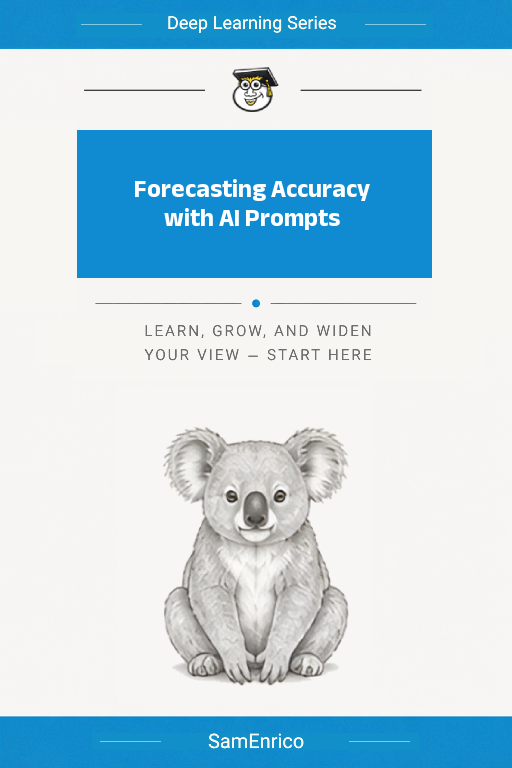
Non-FictionAI OperatorPredictive Analytics
Forecasting Accuracy with AI Prompts
Craft effective prompts that reduce forecast error
Craft effective prompts that reduce forecast error and bias. Includes real-world examples for intermittent demand, new product launches, and discontinued items.
Formats
About this book
Free sample
Chapter 1: The Confidence Trap--–- The email arrived at 4:47 PM on a Friday. "Forecast attached. Please review by Monday. Confidence is high." The attachment predicted 50,000 units for Q4. The actual number three months later?
12,000. The AI had been wrong by a factor of four. It had also been utterly, dangerously certain.This is the confidence trap. Large Language Models like GPT-4, Claude, and Gemini are trained to be helpful, fluent, and convincing. They are not trained to be accurate.
When you ask them to forecast demand, they do not perform statistical calculations in the way Excel or R does. Instead, they predict the next most plausible word—or number—based on patterns in their training data. And because their training data is filled with confident statements from textbooks, reports, and executive summaries, they learn that confidence sells. Even when the numbers are hallucinated from thin air.Consider a simple test. Ask GPT-4: "What will be the exact demand for winter coats in Chicago next January?" It will not say, "I don't know." It will generate a number.
It might say 1.2 million units. It will sound reasonable. It might even provide a breakdown by week. But that number has no statistical basis. It is a linguistic simulation of a forecast, not a mathematical one.This chapter diagnoses why AI fails at forecasting, introduces the core metrics you need to measure failure (forecast bias, MAPE, and tracking signal), and establishes the single most important principle of this book: always audit AI output before trusting it.
Every subsequent chapter will apply this principle in specific contexts. Chapter 2 shows you how to structure prompts to prevent hallucinations. Chapter 7 shows you how to audit anomalies. Chapter 9 shows you how to use multiple AI agents to cross-check each other. Chapter 12 shows you how to build a human review process.
But all of it starts here: recognizing that your AI is not a mathematician. It is a confident storyteller who happens to be good with language.The Paradox of Fluent Numbers Large Language Models are trained on massive corpora of text: books, websites, academic papers, and internal documents.…
This is the end of the free sample. Get the eBook to keep going. Buy now
Contents
- Chapter 1
- Chapter 2
- Chapter 3
- Chapter 4
- Chapter 5
- Chapter 6
- Chapter 7
- Chapter 8
- Chapter 9
- Chapter 10
- Chapter 11
- Chapter 12
Details
- Author
- Carden Danita
- Publisher
- SamEnrico
- Language
- English
- Genre
- Non-Fiction, AI Operator, Predictive Analytics
- Released
- 2026-05-28
- Pages (approx.)
- 157
- Available as
- eBook, Audiobook

Read better in the ZLOADR app
Your eBooks on your phone or tablet. Sign in with your SamEnrico account and start reading.
More by Carden Danita
 The Caregiver Legal and Financial PlanningCarden Danita$11.99
 The Sinai Desert GuideCarden Danita$11.99
 Heart Health After MenopauseCarden Danita$11.99
 Thunberg Asperger Superpower GuideCarden Danita$11.99
 Lifeguard Ocean Rescue StressCarden Danita$11.99
 The Last Samurai’s Ghost: A Knight’s Vow in the Land of the Rising SunCarden Danita$11.99
 Icebound: The SS Manhattan's Arctic Ordeal and the Birth of Polar Submarine ScienceCarden Danita$11.99
 Leadership Competency ExamplesCarden Danita$12.99
 Terahertz Radiation TechnicianCarden Danita$11.99
 Understanding FitzSimmons–walson–mellor SyndromeCarden Danita$17.99
 A Beginners Guide to Caid (Volume 1)Carden Danita$11.99
You may also like
 Hong Kong Handover 1997Dunn Johnnie$11.99
 Zumba For Postnatal Recovery CourseNeal Christian$11.99
 Zumba for BeginnersLadner Nikia$11.99
 YouTube Comment Mining GuideHumes Pandora$12.99
 Worry Box MeditationCarlin Rudy$11.99
 Workplace Stress MeditationNguyen Lynn$11.99
 Workplace Stress and Sleep RepairHawley Ivory$11.99
 Workplace Perfectionism CureDelaney Jeffry$11.99
 Workplace Injustice Anger GuideWallen Isabelle$11.99
 Work Addiction and Burnout LinkGreenwood Ester$11.99
 Women in Yoga and WellnessBeattie Galina$11.99
 Women in Stand Up ComedyChun Evangeline$11.99