
Non-FictionInformativeEducational
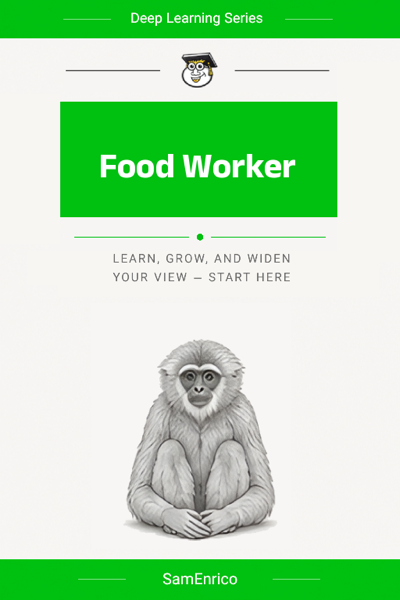
Food Worker eBook
A Coursebook on Food Worker
A Coursebook on Food Worker
Formats
Free sample
Chapter 1: The Silent Guest...--Every morning, before the first pot of coffee is brewed and before the first knife touches a cutting board, an invisible guest takes a seat in your dining room. This guest carries no reservation, orders no meal, and leaves no tip. But it has the power to shut down your restaurant, send your customers to the hospital, and end your career before it truly begins. That guest is foodborne illness, and it is always watching.The food service industry is the backbone of social life in America. We celebrate birthdays with cake, mourn losses with casseroles, fall in love over candlelit dinners, and close business deals over three-martini lunches.
Restaurants, cafeterias, food trucks, catering halls, school lunchrooms, hospital kitchens, and senior living dining rooms serve billions of meals every single year. The vast majority of those meals are nourishing, delicious, and perfectly safe. But when food safety fails, the consequences are not measured in lost revenue alone. They are measured in suffering. In hospital beds.
In funeral services.This chapter is not a collection of abstract rules designed to help you pass a certification exam, though it will certainly help you do that. This chapter is an invitation to see your work differently. It is an argument that the person who washes lettuce, the cook who flips burgers, the server who carries plates, and the manager who schedules shifts all share a profound responsibility. You are not merely feeding people. You are holding their health in your hands.
And once you understand what is at stake, you will never handle food the same way again.The Hidden Threat That Cannot Be Seen Let us begin with a simple but unsettling fact: you cannot tell if food is contaminated by looking at it, smelling it, or tasting it. Pathogens do not turn food green. They do not produce a rotten odor. They do not make the food taste bitter or sour. A salad that contains norovirus looks identical to a safe salad.
A chicken breast carrying Salmonella smells exactly like a clean one. A batch of potato salad that has been left out too long and is teeming with Staphylococcus aureus tastes no different than it did when it was first made.This invisibility is what makes foodborne illness so insidious. Every other hazard in a kitchen announces itself. A sharp knife is visible. A wet floor is visible.
A fire produces smoke and heat. But pathogens are silent, odorless, and invisible. They are the hidden threat, and they are everywhere: in the soil where vegetables grow, in the water where shellfish live, in the intestinal tracts of the animals whose meat we prepare, and even on our own skin and inside our own bodies.Consider a single statistic from the Centers for Disease Control and Prevention. Each year, approximately 48 million Americans contract a foodborne illness. That is roughly one in every six people.
Of those, 128,000 are hospitalized, and 3,000 die. Let those numbers land. Three thousand people do not go home to their families because of something they ate. They are not dying in car accidents or from chronic disease. They are dying from contaminated food, often served by well-meaning workers who never intended to harm anyone.Now consider the flip side of those statistics.
The vast majority of foodborne illnesses are preventable. Not mysterious. Not inevitable. Preventable. The pathogens that cause these illnesses have predictable sources, predictable growth patterns, and predictable vulnerabilities.
They need specific conditions to survive and multiply. Your job as a food worker is to understand those conditions and interrupt them at every opportunity.How Foodborne Illness Actually Occurs A foodborne illness is defined as a disease carried to people by food. When two or more people experience the same illness after eating the same food, and an investigation confirms the food as the source, that is called a foodborne illness outbreak. These outbreaks make headlines. They close restaurants.
They launch lawsuits. But for every outbreak that gets reported, countless individual cases go undocumented. A person gets sick, assumes it was a stomach bug, stays home for a day, and never connects their illness to the meal they ate forty-eight hours earlier.For foodborne illness to occur, three conditions must be met. First, pathogens must be present in or on the food. Second, the food must be conducive to pathogen growth.
Third, enough time must pass for the pathogens to multiply to dangerous levels. Remove any one of these conditions, and illness does not occur. That is the foundation of food safety. You are not trying to eliminate all pathogens from the universe, which is impossible. You are trying to break the chain of transmission.Pathogens enter the food supply through many routes.
A chicken can carry Salmonella in its intestinal tract without appearing sick. A worker with norovirus can contaminate a cutting board with a single touch. A cutting board used for raw chicken and then for salad vegetables can transfer Campylobacter from one food to another. A container of pasta salad left on a counter for six hours can allow Clostridium perfringens to multiply from a few cells to millions. Each of these scenarios is a failure of the food worker to break the chain.The Three Categories of Hazard To understand how contamination happens, you must understand the three categories of food hazards: biological, chemical, and physical.
Each requires different prevention strategies, and each can cause serious harm.Biological hazards are living organisms that cause disease. This category includes bacteria, viruses, parasites, and fungi. Biological hazards are the most common cause of foodborne illness and the primary focus of food safety training. They are invisible, they reproduce rapidly under the right conditions, and they can cause illness with very small doses. A single norovirus particle is enough to infect a person.
A few Salmonella cells can become millions within hours. Chapter 2 will examine biological hazards in exhaustive detail, including the specific pathogens you must know for certification. For now, the essential point is this: biological hazards come from living sources, including animals, soil, water, and people. They are everywhere. Your job is not to eliminate them from the universe.
Your job is to prevent them from reaching the customer's plate.Chemical hazards are non-living substances that can cause illness or injury. This category includes cleaning supplies, sanitizers, pesticides, and toxic metals that can leach from cookware. A worker who stores a bottle of bleach on a shelf above a bowl of lettuce is creating a chemical hazard. A cook who uses a copper pot to prepare tomato sauce is creating a chemical hazard because the acid in the tomatoes can leach copper into the food. Chemical hazards are prevented by storing chemicals separately from food, labeling all chemical containers, using only food-grade equipment, and following manufacturer instructions for all cleaning and sanitizing products.Physical hazards are foreign objects that can injure a customer.
This category includes glass shards, metal filings, bone fragments, hair, bandages, jewelry, staples, and even plastic fragments from damaged cutting boards. A physical hazard does not need to be toxic to cause harm. A piece of broken glass in a bowl of soup can cut a customer's…
This is the end of the free sample. Get the eBook to keep going. Buy now
About this book
Details
- Author
- Burkhart Olympia
- Publisher
- SamEnrico
- Language
- English
- Genre
- Non-Fiction, Informative, Educational
- Released
- 2026-06-03
- Pages (approx.)
- 160
- Available as
- eBook, Audiobook

Read better in the ZLOADR app
Your eBooks on your phone or tablet. Sign in with your SamEnrico account and start reading.
More by Burkhart Olympia
 Peg System for WorkoutsBurkhart Olympia$11.99
 Interview Body Language PlaybookBurkhart Olympia$11.99
 Remote Review for Marketing TeamsBurkhart Olympia$11.99
 Miscarriage and Loss TriggersBurkhart Olympia$11.99
 EdTech Capital Strategy GuideBurkhart Olympia$11.99
 The Last Stand of the Dodo: A 500-Year Extinction MysteryBurkhart Olympia$11.99
 Understanding ParapsoriasisBurkhart Olympia$17.99
 How to Start a Painted Steel Sheet Business (Beginners Guide)Burkhart Olympia$11.99
 Education Mentor LinkedIn GuideBurkhart Olympia$12.99
 Asia Pacific ESG Benchmark GuideBurkhart Olympia$12.99
You may also like
 Hong Kong Handover 1997Dunn Johnnie$11.99
 Zumba For Postnatal Recovery CourseNeal Christian$11.99
 Zumba for BeginnersLadner Nikia$11.99
 YouTube Comment Mining GuideHumes Pandora$12.99
 Worry Box MeditationCarlin Rudy$11.99
 Workplace Stress MeditationNguyen Lynn$11.99
 Workplace Stress and Sleep RepairHawley Ivory$11.99
 Workplace Perfectionism CureDelaney Jeffry$11.99
 Workplace Injustice Anger GuideWallen Isabelle$11.99
 Work Addiction and Burnout LinkGreenwood Ester$11.99
 Women in Yoga and WellnessBeattie Galina$11.99
 Women in Stand Up ComedyChun Evangeline$11.99