
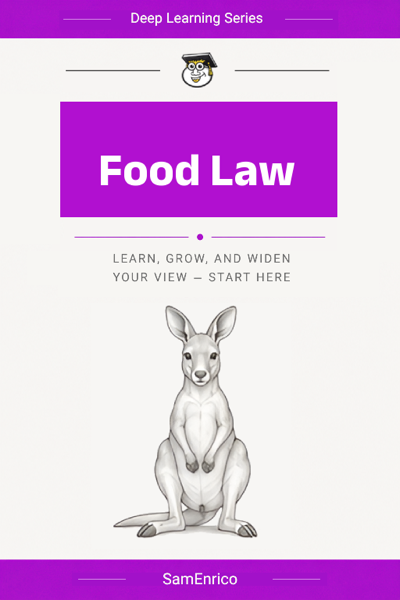
Non-FictionInformativeEducational
Food Law
A Coursebook on Food Law
A Coursebook on Food Law
Formats
About this book
Free sample
Chapter 1: The Tomato’s Secret--The organic heirloom tomato sat on a cutting board in a Santa Monica kitchen, its skin blushing red under the morning sun. It had been grown without synthetic pesticides, watered with captured rainwater, and transported twelve miles from a certified local farm. The woman slicing it believed she knew everything about this tomato—its flavor, its provenance, its virtue. She did not know that the same tomato, transformed into a seed extract and marketed as an anti-aging elixir, would have been regulated not by the Food and Drug Administration’s food division but by its drug division. She did not know that if that extract were sold as a “cosmetic serum,” it would face virtually no pre-market review at all.
And she certainly did not know that the label “local,” so reassuring on the cardboard basket, occupied a legal grey zone so contested that it had been the subject of World Trade Organization disputes.This is the first thing food law teaches: the same physical object can be food, drug, or cosmetic depending entirely on how it is presented, marketed, and consumed. The tomato does not change. The law does.Why Food Law Exists Before we can understand the rules that govern food, we must understand why food demands its own unique body of law. A toaster can burn your bread but cannot give you a chronic disease twenty years later. A shirt can be mislabeled as silk when it is polyester, but that deception will not send a child to the emergency room with anaphylaxis.
A car can have a design defect that causes crashes, but that car is not consumed in the literal sense—it does not enter the human body and interact with every physiological system.Food requires special legal treatment for three fundamental reasons that are baked into every regulation we will explore in this book.First, food is biological and perishable. Unlike manufactured goods, which can be engineered to precise specifications and tested for quality before leaving a factory, food rots. It hosts bacteria, molds, and viruses. It changes composition during storage. A batch…
This is the end of the free sample. Get the eBook to keep going. Buy now
Contents
- Chapter 1
- Chapter 2
- Chapter 3
- Chapter 4
- Chapter 5
- Chapter 6
- Chapter 7
- Chapter 8
- Chapter 9
- Chapter 10
- Chapter 11
- Chapter 12
Details
- Author
- Guenther Trina
- Publisher
- SamEnrico
- Language
- English
- Genre
- Non-Fiction, Informative, Educational
- Released
- 2026-05-11
- Pages (approx.)
- 143
- Available as
- eBook, Audiobook

Read better in the ZLOADR app
Your eBooks on your phone or tablet. Sign in with your SamEnrico account and start reading.
More by Guenther Trina
 Goal Setting to Combat Self DoubtGuenther Trina$11.99
 Async User Research Synthesis BriefGuenther Trina$11.99
 TM Military VeteranGuenther Trina$11.99
 MAT for Homeless IndividualsGuenther Trina$11.99
 The Last Stand of the Great Auk: A Feathered ExtinctionGuenther Trina$11.99
 The Good Doctor's Poisoned HandsGuenther Trina$11.99
 Right To Cure Notice PeriodGuenther Trina$12.99
 World Bank Recruitment GuideGuenther Trina$12.99
 Understanding Craniofacial DysostosisGuenther Trina$17.99
 How to Start a Prepared Rubber Accelerators (commission Agent) Business (Beginners Guide)Guenther Trina$11.99
You may also like
 Hong Kong Handover 1997Dunn Johnnie$11.99
 Zumba For Postnatal Recovery CourseNeal Christian$11.99
 Zumba for BeginnersLadner Nikia$11.99
 YouTube Comment Mining GuideHumes Pandora$12.99
 Worry Box MeditationCarlin Rudy$11.99
 Workplace Stress MeditationNguyen Lynn$11.99
 Workplace Stress and Sleep RepairHawley Ivory$11.99
 Workplace Perfectionism CureDelaney Jeffry$11.99
 Workplace Injustice Anger GuideWallen Isabelle$11.99
 Work Addiction and Burnout LinkGreenwood Ester$11.99
 Women in Yoga and WellnessBeattie Galina$11.99
 Women in Stand Up ComedyChun Evangeline$11.99