

Non-FictionInformativeEducational
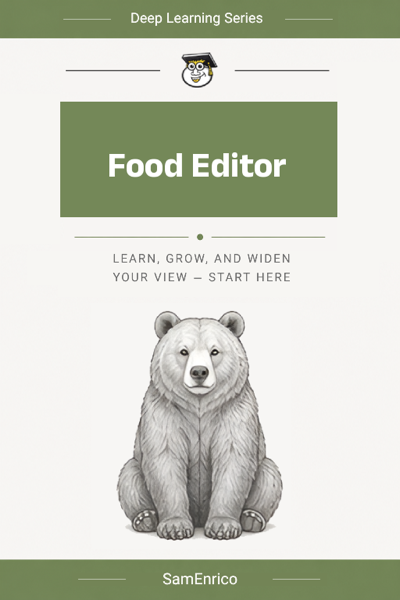
Food Editor eBook
A Coursebook on Food Editor
by Dancy Jovita
A Coursebook on Food Editor
Formats
Free sample
Chapter 1: The Spectrum of Taste...--–- The email arrived at 11:47 PM on a Tuesday. The subject line read: “URGENT – Recipe failure.” The attached photo showed a chocolate cake that had collapsed into a dense, sunken crater. The baker, a food blogger with eighty thousand Instagram followers, had written: “I followed your recipe exactly. This is the third time. What did I do wrong?”The problem was not the baker.
The problem was the recipe. And the recipe’s failure was not a matter of grammar or missing punctuation. It was a failure of something far more fundamental: the invisible architecture that separates a set of instructions from a guarantee. The editor who had approved that recipe had skipped a step, made an assumption, or trusted a voice instead of a protocol. And now, at midnight, eighty thousand people had seen a crater where a cake should have been.This book exists because that editor’s mistake happens thousands of times every day.
It happens on food blogs, in cookbooks, on Tik Tok, and in the test kitchens of major magazines. It happens because the food editing profession has changed more in the last ten years than in the previous fifty, and the training has not kept pace. The romantic image of a food editor – someone who sits at a beautiful table, tastes a chef’s creation, and murmurs “a touch more salt” – is not only outdated. It is actively harmful.The modern food editor operates in a world that would be unrecognizable to the generation before. Print deadlines have been replaced by the relentless churn of the content calendar.
The authority of a masthead has been supplanted by the algorithmic verdict of a “save” or a “share.” A single recipe might need to perform as a 3,000-word blog post, a 30-second Tik Tok, a newsletter teaser, and an SEO-optimized Pinterest pin – all before lunch. And somewhere in that chaos, the editor is expected to ensure that the cake does not collapse.This chapter is not a pep talk. It is a recalibration. Before we can talk about headnotes or testing protocols or monetization strategies, we must first understand what a food editor actually is in 2026 – and just as importantly, what a food editor is not. The answer is more complex, more demanding, and more exciting than the romantic myth suggests.The Myth of the Solitary Taster The most persistent myth about food editing is that it is primarily a sensory job.
In this fantasy, the editor possesses a palate so refined that they can detect the difference between two brands of vanilla extract blindfolded. They spend their days in a gleaming test kitchen, tasting dishes sent up by chefs, and rendering verdicts with the authority of a culinary supreme court.This myth persists because it is flattering. It suggests that food editors are born with a gift – a magical tongue – rather than having developed a rigorous, learnable set of skills. But the myth is also dangerous. It leads aspiring editors to believe that if they simply eat enough interesting food, they will eventually qualify for the job.
It leads publications to hire based on a candidate’s Instagram feed rather than their ability to catch a missing ingredient in a 12-step method. And it leads to collapsed chocolate cakes at midnight.The reality is that a food editor’s sensory ability is only useful insofar as it can be translated into reproducible instructions. A chef can cook by instinct. An editor cannot. The editor’s job is to take a chef’s instinct – “cook until it looks right” – and turn it into a set of conditions that a home cook in Wichita, with a gas stove and hard tap water, can reliably meet.
This requires not a magical palate but a systematic approach to observation, documentation, and verification. It requires the humility to admit that your own preferences are irrelevant. And it requires the discipline to test, test again, and then test one more time.The editor who approved that collapsed chocolate cake almost certainly tasted the original version. They probably thought it was delicious. But they did not test whether the recipe worked when made by a stranger in a different kitchen.
They trusted their own experience instead of the scientific method. And that trust was misplaced.The Two Maps: Print and Digital Before we go any further, we need to acknowledge a fundamental tension that runs through every page of this book. The world of food editing is no longer unified. It is split between two overlapping but distinct realities: the print mindset and the digital-first reality.This is not a generational argument. There are brilliant editors in their twenties who have never worked in print but whose instincts are deeply “print” in their emphasis on permanence, precision, and linear narrative.
There are editors in their sixties who have fully embraced the chaos of digital and produce work that is native to Tik Tok and Substack. The distinction is not about age. It is about the underlying assumptions you bring to the work.The print mindset assumes that a recipe, once published, is fixed. It will be printed in ink, bound into a magazine or book, and cannot be changed. This creates a culture of extreme caution.
Print editors obsess over every comma because there is no second chance. They value authority – the authority of the publication, the authority of the chef, the authority of the testing protocol – because that authority is the only thing standing between a reader and a ruined dinner. Print editors tend to be generalists. They work on many recipes in many categories because the publication needs to fill pages.The digital-first reality assumes the opposite. A recipe can be changed after publication.
You can update a blog post, add a note, replace a photo, or even delete the whole thing if it is not working. This creates a culture of iteration. Digital editors publish faster, learn from data, and revise constantly. They value relatability and speed over traditional authority because in the algorithm-driven world, engagement is oxygen. Digital editors tend to be specialists.
They build audiences around a specific niche – gluten-free baking, budget meal prep, Instant Pot recipes – because the algorithm rewards clarity and consistency.Neither approach is inherently better. The best food editors working today are fluent in both mindsets. They know when to apply the cautious, authority-driven rigor of print (for a cookbook, a sponsored post from a major brand, a recipe that will be printed and shared offline) and when to embrace the iterative, data-driven speed of digital (for a blog post, a social media recipe, a trend-driven piece that will have a 48-hour shelf life).Throughout this book, we will flag where these two worlds diverge. Look for the “Print vs. Digital” callout boxes.
But here is the most important takeaway: whichever world you work in, the fundamental skills are the same. You still need to taste objectively. You still need to write clear instructions. You still need to test for reproducibility. The difference is in the speed, the scale, and the consequences of failure.The Spectrum Model: Beyond False Binaries The original sin of most career advice is…
This is the end of the free sample. Get the eBook to keep going. Buy now
About this book
Details
- Author
- Dancy Jovita
- Publisher
- SamEnrico
- Language
- English
- Genre
- Non-Fiction, Informative, Educational
- Released
- 2026-06-02
- Pages (approx.)
- 144
- Available as
- eBook, Audiobook

Read better in the ZLOADR app
Your eBooks on your phone or tablet. Sign in with your SamEnrico account and start reading.
More by Dancy Jovita
 Self Hypnosis For Sleep CourseDancy Jovita$11.99
 Music Student Performance AnxietyDancy Jovita$11.99
 Grocery List Chunking GuideDancy Jovita$11.99
 The Anger Vulnerability LinkDancy Jovita$11.99
 Fitness for Obese BeginnersDancy Jovita$11.99
 Silicon Shadows: The Great Chip Heist of 2005Dancy Jovita$11.99
 The Billion-Dollar Betrayal: How a Tech Mogul Bankrupted a NationDancy Jovita$11.99
 Understanding Encephalopathy Intracerebral Calcification RetinalDancy Jovita$17.99
 How to Start a Continuation School Business (Beginners Guide)Dancy Jovita$11.99
 Pharma Logistics DirectoryDancy Jovita$12.99
 Bookkeeping Failure GuideDancy Jovita$12.99
You may also like
 Hong Kong Handover 1997Dunn Johnnie$11.99
 Zumba For Postnatal Recovery CourseNeal Christian$11.99
 Zumba for BeginnersLadner Nikia$11.99
 YouTube Comment Mining GuideHumes Pandora$12.99
 Worry Box MeditationCarlin Rudy$11.99
 Workplace Stress MeditationNguyen Lynn$11.99
 Workplace Stress and Sleep RepairHawley Ivory$11.99
 Workplace Perfectionism CureDelaney Jeffry$11.99
 Workplace Injustice Anger GuideWallen Isabelle$11.99
 Work Addiction and Burnout LinkGreenwood Ester$11.99
 Women in Yoga and WellnessBeattie Galina$11.99
 Women in Stand Up ComedyChun Evangeline$11.99