
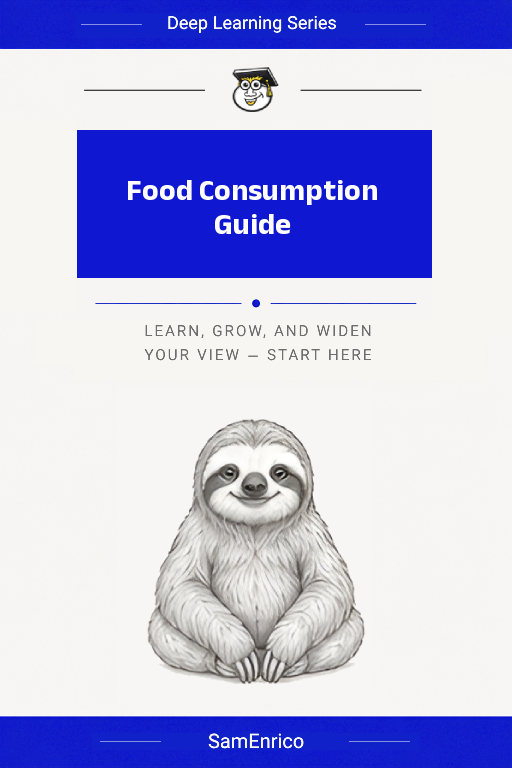
Non-FictionConsumer Mind ReportFood
Food Consumption Guide eBook
Contrast dining out vs cooking, meal delivery vs g
Contrast dining out vs cooking, meal delivery vs grocery shopping, organic vs conventional, and diet trends.
Formats
Free sample
Chapter 1: The Paradox Pantry--–- The average American adult makes 227 food-related decisions every single day. That is not a typo. Before you have brushed your teeth in the morning, you have already decided whether to check the fridge, pour a glass of water, open a delivery app, skip breakfast entirely, or eat the leftover pizza from last night. By the time you sit down for dinner, you have navigated a labyrinth of choices that would have been utterly incomprehensible to your great-grandparents. They had seasons, scarcity, and a small set of rotating meals.
You have fifty thousand items in a single supermarket, twenty-seven cuisines available for delivery, and a social media feed telling you that gluten is poison, dairy is inflammatory, meat is murder, vegan cheese is plastic, organic is a scam, and local is the only moral option. Welcome to the paradox pantry, where more choice has not led to more freedom. It has led to paralysis, guilt, and a quiet, nagging sense that whatever you are eating right now is probably wrong.This is not your fault. The human brain did not evolve for this environment.The Omnivore’s Dilemma, Revisited In 2006, Michael Pollan published a book that would fundamentally reshape how educated eaters thought about their food. The Omnivore’s Dilemma asked a deceptively simple question: what should we eat for dinner?
The answer, Pollan discovered, was extraordinarily complicated because humans occupy a unique biological niche. Unlike pandas, who eat bamboo, or koalas, who eat eucalyptus, humans can eat almost anything. That flexibility was our evolutionary superpower. It allowed our ancestors to migrate out of Africa, survive ice ages, and colonize every continent on earth. But that same flexibility comes with a hidden cost.Pollan named this cost the omnivore’s dilemma.
When you can eat anything, every meal becomes a potential experiment. Is that red berry poisonous or nutritious? Is that mushroom safe or lethal? Is that new grain going to provide energy or cause an allergic reaction? Our ancestors solved this dilemma with culture, tradition, and a healthy dose of neophobia—the fear of new foods.
Children are born neophobic. Watch a toddler confronted with a green vegetable for the first time. That rejection is not pickiness. It is an ancient survival mechanism. The child who ran toward every new berry got poisoned.
The child who hesitated survived to pass on their cautious genes.But humans also evolved neophilia, the craving for novelty and variety. A diet of only one food leads to nutritional deficiencies. The ancestor who tried a new protein source when the herd animals migrated away survived the winter. The one who stuck stubbornly to mammoth meat starved. So we are caught between two competing impulses: fear the new, crave the new.
For most of human history, this tension was managed by culture. Your grandmother’s recipes, your region’s traditions, the seasonal rhythm of planting and harvest—all of these created a manageable set of options. You ate what was available, what was familiar, and what your community had deemed safe.Then the supermarket happened.The Fifty-Thousand-Item Problem The first true supermarket, King Kullen, opened in Queens, New York, in 1930. It stocked roughly one thousand items. By 1950, the average supermarket had doubled that.
By 1980, it had doubled again. Today, a standard American supermarket stocks between forty thousand and sixty thousand unique products. That is not hyperbole. Walk down any aisle and count. The cereal aisle alone contains over one hundred varieties.
The yogurt section has two hundred. The salad dressing display is a wall of indecision stretching thirty feet.This explosion of choice was supposed to be liberating. The postwar American dream promised abundance. You could have any flavor, any brand, any convenience level. You could eat strawberries in January and avocados in Maine.
You could choose low-fat, no-fat, extra-fat, organic, conventional, non-GMO, gluten-free, keto-friendly, paleo-approved, vegan, vegetarian, flexitarian, and pegan—a portmanteau of paleo and vegan that should tell you everything about how absurd the situation has become.But psychologists have discovered that abundance does not produce happiness. It produces anxiety. In a famous series of experiments conducted in the early 2000s, researchers set up a tasting booth at a high-end grocery store. On some days, they offered shoppers a selection of six jams. On other days, they offered twenty-four jams.
The booth with twenty-four jams attracted more attention. More people stopped, more people sampled, more people engaged. But here is the kicker: shoppers who saw the twenty-four-jam display were ten times less likely to actually buy a jar than shoppers who saw the six-jam display. More choice led to less action. The shoppers were paralyzed.This is called the paradox of choice, a term popularized by psychologist Barry Schwartz.
When options are few, decision-making is easy. You compare two or three alternatives, pick the best, and move on. When options are many, your brain goes into overdrive. You worry about opportunity cost—the fear that choosing one thing means losing out on another. You worry about regret—the anticipation that you will look back and wish you had chosen differently.
You worry about social judgment—that your choice will mark you as the kind of person who buys the wrong yogurt.Now apply this to food. Every time you walk into a supermarket or open a delivery app, you are confronting not six jams but fifty thousand jams. The result is decision fatigue, a well-documented psychological state in which the quality of your decisions deteriorates after a long session of decision-making. This is why grocery stores put candy at the checkout. By the time you have navigated fifty thousand options, your prefrontal cortex is exhausted.
You are running on impulse. And that candy bar looks very, very good.The Consumption Calculus: A Way Out This book offers a tool to cut through the noise. I call it the Consumption Calculus. It is a simple framework for evaluating any food choice across four fundamental dimensions. You do not need to optimize all four every time.
That would be impossible. But you do need to know which dimension matters most to you in this moment, and you need to be honest about the trade-offs.The four dimensions are Time, Money, Health, and Planet. Let me define each carefully.Time is the most undervalued currency in modern life. When you choose a meal, you are not just spending dollars. You are spending minutes and hours.
That includes preparation time (chopping, cooking, assembling), shopping time (driving, walking aisles, waiting in line), cleanup time (washing dishes, storing leftovers), and waiting time (delivery windows, restaurant seating, microwave beeps). The average American spends thirty-seven minutes per day on food preparation and cleanup. That is over two hundred hours per year. The Consumption Calculus asks you to be conscious of that time. Is thirty minutes of cooking worth the savings and health benefits compared to ten minutes of reheating a frozen dinner?
For some people, on some days, the answer is yes. For other people, on other days, the answer is no. The goal is not to eliminate convenience. The goal is to stop pretending convenience has no cost.Money is the most obvious dimension, but it is…
This is the end of the free sample. Get the eBook to keep going. Buy now
About this book
Details
- Author
- Odell Gertrud
- Publisher
- SamEnrico
- Language
- English
- Genre
- Non-Fiction, Consumer Mind Report, Food
- Released
- 2026-05-29
- Pages (approx.)
- 129
- Available as
- eBook, Audiobook

Read better in the ZLOADR app
Your eBooks on your phone or tablet. Sign in with your SamEnrico account and start reading.
More by Odell Gertrud
 Plant Slant Longevity DietOdell Gertrud$11.99
 Improv for DepressionOdell Gertrud$11.99
 Filibuster Exceptions GuideOdell Gertrud$11.99
 Floating On Cloud VisualizationOdell Gertrud$11.99
 The Cloud Skills Gap ForecastOdell Gertrud$11.99
 Anansi's Web: The Spider Who Wove the WorldOdell Gertrud$11.99
 Understanding Rapunzel SyndromeOdell Gertrud$17.99
 Highway Maintenance WorkerOdell Gertrud$11.99
 Non Resident LLC Annual ReportOdell Gertrud$12.99
 How to Start a Drawn Products Made of Copper Business (Beginners Guide)Odell Gertrud$11.99
You may also like
 Hong Kong Handover 1997Dunn Johnnie$11.99
 Zumba For Postnatal Recovery CourseNeal Christian$11.99
 Zumba for BeginnersLadner Nikia$11.99
 YouTube Comment Mining GuideHumes Pandora$12.99
 Worry Box MeditationCarlin Rudy$11.99
 Workplace Stress MeditationNguyen Lynn$11.99
 Workplace Stress and Sleep RepairHawley Ivory$11.99
 Workplace Perfectionism CureDelaney Jeffry$11.99
 Workplace Injustice Anger GuideWallen Isabelle$11.99
 Work Addiction and Burnout LinkGreenwood Ester$11.99
 Women in Yoga and WellnessBeattie Galina$11.99
 Women in Stand Up ComedyChun Evangeline$11.99