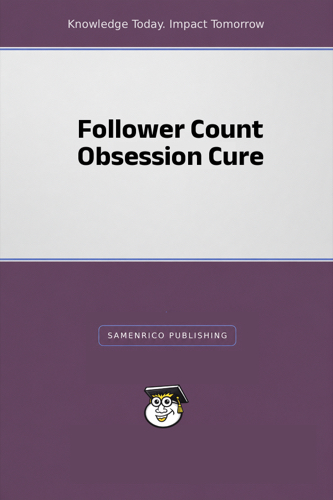
Follower Count Obsession Cure eBook
Stop equating your worth with audience size using
Stop equating your worth with audience size using metrics reframing techniques.
Formats
Free sample
Chapter 1: The Little Red Needle--The notification appeared at 7:43 AM. A red heart beside a username I barely recognized. Within one second, my pupils dilated. My heart rate increased. A small amount of dopamine released into my bloodstream.
And just like that, I was hooked for the next four hours.This is not a confession of weakness. It is a description of biology.I want you to imagine something. Imagine a slot machine that you carry in your pocket. A slot machine that costs nothing to play. A slot machine that pays out not in coins but in tiny bursts of social approval.
A slot machine that you check first thing in the morning, last thing at night, and approximately forty-seven times in between. Now imagine that this slot machine has been designed by thousands of engineers working in Silicon Valley office buildings with nap pods and free kombucha. Their only goal is to make sure you never stop pulling the lever.You already own this slot machine. It is your phone. And the lever is the pull-to-refresh gesture that checks for new likes, comments, and follows.Here is what most people get wrong about social media obsession.
They think it is a matter of willpower. They think that if they just tried harder, cared less, or touched more grass, they could break free. They blame themselves for being weak, vain, or shallow. They scroll in shame, promising to stop, then scroll again five minutes later, hating themselves for the betrayal.You are not weak. You are not shallow.
You are a human being whose ancient brain has been hijacked by a supernormal stimulus designed to exploit your deepest evolutionary needs.The purpose of this chapter is to name the enemy. Not yourself. Not your followers. Not even the platforms entirely, although they bear responsibility. The enemy is a neurological mechanism that has been weaponized.
Once you understand how it works, you cannot unsee it. And once you cannot unsee it, you can begin to disarm it.Let me tell you a story about pigeons.The Pigeons Who Gambled In the 1940s, a psychologist named B.F. Skinner placed hungry pigeons in a box. The box contained a lever. When the pigeon pecked the lever, a small amount of food dropped into a tray.
Skinner wanted to understand how animals learn. What he discovered would eventually explain why you cannot stop checking your phone.The first experiment was simple. Every time the pigeon pecked the lever, food appeared. The pigeon learned quickly. Peck, food.
Peck, food. The behavior was efficient and, frankly, boring. The pigeon pecked exactly as much as necessary to get fed and then stopped.Then Skinner changed the game.Instead of delivering food every single time, he set the machine to deliver food randomly. Sometimes one peck worked. Sometimes ten pecks worked.
Sometimes fifty pecks worked. Sometimes the pigeon pecked for minutes with no reward at all. And then, suddenly, food.Something remarkable happened. The pigeons went insane. They pecked compulsively, obsessively, long after any rational animal would have stopped.
They developed superstitious rituals. One pigeon learned to turn in circles before pecking. Another learned to brush its wing against the side of the box. They pecked faster, longer, and with more emotional investment than they ever had when the reward was guaranteed.Skinner had discovered what scientists now call variable rewards. A variable reward is a payoff that is unpredictable in both timing and magnitude.
Sometimes you get nothing. Sometimes you get a little. Sometimes you get a lot. And that unpredictability is precisely what makes the behavior addictive.The pigeons were not stupid. They were responding to a psychological mechanism that exists in every vertebrate brain.
Including yours.Now let me ask you a question. When you post a photo, do you know exactly how many likes it will receive? Do you know exactly when they will arrive? Do you know which post will go viral and which will die in silence?Of course not. Sometimes a post explodes.
Sometimes it limps to twelve likes from your most loyal aunt. Sometimes you pour your heart into a caption and hear nothing but crickets. And sometimes the random photo you barely thought about gets picked up by the algorithm and carried to thousands of strangers.This unpredictability is not a bug. It is the feature. It is the variable reward.
And it has turned you into Skinner's pigeon.The Dopamine Loop To understand why variable rewards are so powerful, you need to meet a molecule. Dopamine.Most people think dopamine is the pleasure chemical. This is incorrect. Dopamine is not about pleasure. It is about anticipation.
It is about wanting, not liking. It is the molecule that says "maybe something good will happen if you keep doing what you are doing."Here is how it works in your brain. You perform an action that has, in the past, led to a reward. Your brain releases a small burst of dopamine. This dopamine does not make you feel good.
It makes you feel motivated. It says "do that again." It creates a feeling of craving. You are not enjoying yourself. You are pursuing the hope of enjoyment.This system evolved for survival. Your ancient ancestors needed to eat, find water, and reproduce.
The dopamine system kept them moving. It said "keep searching, there might be food over that hill." It said "keep socializing, there might be a mate in the next tribe." It was not designed for happiness. It was designed for persistence.Now consider what happens when you post content on social media. You have learned that sometimes, unpredictably, you receive a reward. A like.
A comment. A follow. A DM that says "this really helped me." Each of these is a social reward, and social rewards are among the most powerful stimuli in the human brain because they tap directly into our evolutionary need for belonging and status.Your brain releases dopamine the moment you decide to check your notifications. Not when you receive the likes. Before.
The anticipation is the engine. You pull your phone out of your pocket. You open Instagram. You navigate to your profile. You tap on the activity tab.
Throughout this sequence, your dopamine system is humming with expectation. "Maybe something good happened. Maybe someone noticed you. Maybe you matter."This is the loop. Trigger (post or check) leads to craving (dopamine release) leads to behavior (scrolling, refreshing) leads to variable reward (or not) which reinforces the trigger.
Each cycle tightens the neural pathway. Each cycle makes the compulsion stronger.And here is the cruelest twist. When you actually receive likes, the dopamine stops. The reward system quiets. You feel a brief moment of satisfaction, maybe, but it fades quickly.
Because dopamine is not about the reward. It is about the search for the reward. The moment you find what you are looking for, the engine shuts off. And then you need to post again. Or check again.
Or refresh again. Because the craving never truly ends. It only pauses.The Supernormal Stimulus There is a reason social media feels different from real-world social approval. Real-world approval works on a predictable, manageable…
This is the end of the free sample. Get the eBook to keep going. Buy now
About this book
Details
- Author
- Satterfield Norah
- Publisher
- SamEnrico
- Language
- English
- Genre
- Non-Fiction, Self-Help, Social Metrics
- Released
- 2026-06-06
- Pages (approx.)
- 127
- Available as
- eBook, Audiobook

Read better in the ZLOADR app
Your eBooks on your phone or tablet. Sign in with your SamEnrico account and start reading.
More by Satterfield Norah
 Executive Kidnap First Responder GuideSatterfield Norah$11.99
 Dysthymia And Appetite ChangesSatterfield Norah$11.99
 Async Meeting Replacement ManualSatterfield Norah$11.99
 Hormone Therapy Prostate Cancer GuideSatterfield Norah$11.99
 The Vanishing: The Case of the Disappearing Flight MH370Satterfield Norah$11.99
 The Great Arctic Relay: How Millions of Birds Race Against TimeSatterfield Norah$11.99
 Understanding Congenital MSatterfield Norah$17.99
 Resource CoordinatorSatterfield Norah$11.99
 Cross Border Compliance UpdatesSatterfield Norah$12.99
 University of Wollongong DubaiSatterfield Norah$12.99
 How to Become a Cell-feed-department SupervisorSatterfield Norah$11.99