
Non-FictionSelf-HelpDefensiveness
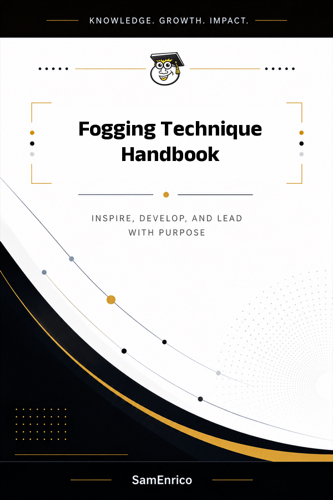
Fogging Technique Handbook eBook
Agree with valid criticism without losing your pos
Agree with valid criticism without losing your position or becoming defensive.
Formats
Free sample
Chapter 1: The Stone Trap--–- You are about to learn a single sentence that will end more arguments than any other phrase in the English language. It is not clever. It is not aggressive. It does not require wit, speed, or superior logic. In fact, it requires almost nothing except the willingness to stop doing what your nervous system is screaming at you to do.
That sentence is this: "You're right about that part."Most people will read those four words and feel a visceral rejection. Agree? With someone who is attacking me? That is surrender. That is weakness.
That is admitting they win. This reaction is not intellectual; it is biological. Your brain has been wired over millions of years to treat social criticism as a threat to survival. When someone says "You made a mistake" or "That was careless" or "You never listen," your amygdala—the ancient alarm system buried deep in your temporal lobe—interprets that comment the same way it would interpret a predator lunging from the bushes. Your heart rate spikes.
Cortisol floods your system. Blood rushes to your limbs to prepare for fight or flight. And in that state, agreeing feels like dying.But here is the paradox that will reshape how you navigate every conflict for the rest of your life: agreement is the most powerful form of verbal self-defense ever discovered. It is not surrender. It is not weakness.
It is the verbal equivalent of a martial artist using an attacker's own momentum to throw them to the ground. When you agree with the small piece of truth inside any criticism, you remove the fuel that keeps the conflict burning. The critic came prepared for a fight. They came armed with counter-arguments, evidence, emotional ammunition. They did not come prepared for you to say, "You know what?
You're right about that."This chapter introduces the foundational metaphor of this book: the difference between responding to criticism like a stone wall versus responding like fog. You will learn why your instinct to defend, explain, and justify is actually the engine that powers most arguments. You will discover the hidden structure of criticism—how even the most vicious attack contains a small grain of truth that you can agree with honestly. And you will begin to understand why the technique called Fogging, first developed in 1975 but largely misunderstood ever since, remains the most effective tool for disarming hostility without losing your dignity, your boundaries, or your self-respect.By the end of this chapter, you will have practiced your first Fogging response. It will feel strange.
It will feel wrong. That is exactly how you know it is working.Why Your First Instinct Is Wrong Imagine a man named David. David is a project manager at a mid-sized marketing firm. He has just finished a presentation to his team about a new client campaign. The presentation took him twelve hours to prepare.
He stayed up until 2 AM refining the slides. He practiced his delivery three times in front of a mirror. He is proud of the work.His colleague Maria raises her hand and says, "David, I think your timeline is unrealistic. You haven't accounted for the feedback loops from legal, and honestly, the budget section is a mess."What happens inside David's body in the next three seconds is a masterclass in human biology working against human connection. His amygdala fires.
His sympathetic nervous system activates. His prefrontal cortex—the part of the brain responsible for rational thought, impulse control, and long-term planning—begins to shut down. Blood flows away from his higher cognitive functions and toward his muscles. He is, for all practical purposes, a animal preparing to fight for its life.David has three options. He can fight: "That's ridiculous.
I spent twelve hours on this. You have no idea what you're talking about." He can flee: "Fine, you do it then. I'm done." Or he can explain: "Well, actually, if you look at slide fourteen, you'll see that I included a contingency buffer, and the budget section is only preliminary because finance hasn't released the Q3 numbers yet."Most people believe the third option—explaining—is the mature response. It is not. Explaining is fight in disguise.
You are not offering information; you are defending your ego. And here is the brutal truth that every argument you have ever been in proves: explaining almost never works. It does not work because the critic did not ask for an explanation. They made a statement. They expressed a judgment.
And by responding with an explanation, you have implicitly accepted their frame: that you are on trial, that they are the judge, and that your job is to prove your innocence.This is the stone wall. The stone wall is rigid, defensive, and heavy. When someone throws a verbal stone at a wall—"Your timeline is unrealistic"—the wall does not absorb the impact. It reflects it. The stone bounces back, often with greater force.
The critic feels the rebound and throws another stone, harder this time. The argument escalates. Both people leave feeling misunderstood, disrespected, and exhausted.The stone wall response follows a predictable pattern that you have experienced hundreds of times: Criticism lands. You feel the sting. You defend, explain, or counter-attack.
The critic doubles down. You double down. The original issue—the actual work product, the missed deadline, the forgotten task—disappears entirely, replaced by a meta-argument about tone, respect, and who is being unreasonable. Nothing gets resolved. Everyone loses.There is another way.The Fog Revealed Fogging is a technique that transforms you from a stone wall into fog.
Fog has no hard edges. When someone throws a stone at fog, the stone does not bounce back. It passes through, slowed and absorbed, until it falls harmlessly to the ground. The fog remains unchanged. It does not need to defend itself because it has nothing to defend.In verbal terms, Fogging means offering calm, selective agreement with the factual portion of any criticism.
You do not agree with the tone. You do not agree with the insult. You do not agree with the demand that may follow. You agree only with the small, verifiable piece of truth hidden inside the critic's statement. And then you stop talking.Consider David again.
Maria says, "Your timeline is unrealistic, and the budget section is a mess." Instead of fighting, fleeing, or explaining, David takes a breath and says: "You're right, the budget section is incomplete." That is Fogging. He did not agree that the timeline is unrealistic. He did not apologize for the budget being a mess—he simply acknowledged its incomplete state, which is objectively true. He offered no defense, no justification, no counter-attack. He agreed with the one small fact he could honestly endorse, and then he stopped.What happens next is the magic of Fogging.
Maria came prepared for a fight. She had counter-arguments ready. She had examples of why the timeline was flawed. She had emotions loaded. But David did not fight.
He agreed. Her momentum has nowhere to go. The stone she threw—"the budget section is a mess"—landed in fog. She cannot throw another stone because the first…
This is the end of the free sample. Get the eBook to keep going. Buy now
About this book
Details
- Author
- Stinson Clorinda
- Publisher
- SamEnrico
- Language
- English
- Genre
- Non-Fiction, Self-Help, Defensiveness
- Released
- 2026-06-10
- Pages (approx.)
- 141
- Available as
- eBook, Audiobook

Read better in the ZLOADR app
Your eBooks on your phone or tablet. Sign in with your SamEnrico account and start reading.
More by Stinson Clorinda
 Persuasive Budget Request GuideStinson Clorinda$11.99
 The Angry Parent AffirmationsStinson Clorinda$11.99
 Taurine Heart Rhythm GuideStinson Clorinda$11.99
 Equatorial Guinea 1968Stinson Clorinda$11.99
 Executive Boardroom CuesStinson Clorinda$11.99
 Elderly Parent Technology HelpStinson Clorinda$11.99
 Joy Identification GuideStinson Clorinda$11.99
 LGBTQIA+ Body AcceptanceStinson Clorinda$11.99
 Shadows Over the Silk Road: The CIA’s Secret War in AfghanistanStinson Clorinda$11.99
 Blood and Silk: The Forgotten Surgeons of Ancient ChinaStinson Clorinda$11.99
 The War of Jenkins' Ear: Smugglers, Sugar, and the Spark of EmpireStinson Clorinda$11.99
 HES vs LSE Online Cost ComparisonStinson Clorinda$12.99
You may also like
 Hong Kong Handover 1997Dunn Johnnie$11.99
 Zumba For Postnatal Recovery CourseNeal Christian$11.99
 Zumba for BeginnersLadner Nikia$11.99
 YouTube Comment Mining GuideHumes Pandora$12.99
 Worry Box MeditationCarlin Rudy$11.99
 Workplace Stress MeditationNguyen Lynn$11.99
 Workplace Stress and Sleep RepairHawley Ivory$11.99
 Workplace Perfectionism CureDelaney Jeffry$11.99
 Workplace Injustice Anger GuideWallen Isabelle$11.99
 Work Addiction and Burnout LinkGreenwood Ester$11.99
 Women in Yoga and WellnessBeattie Galina$11.99
 Women in Stand Up ComedyChun Evangeline$11.99